
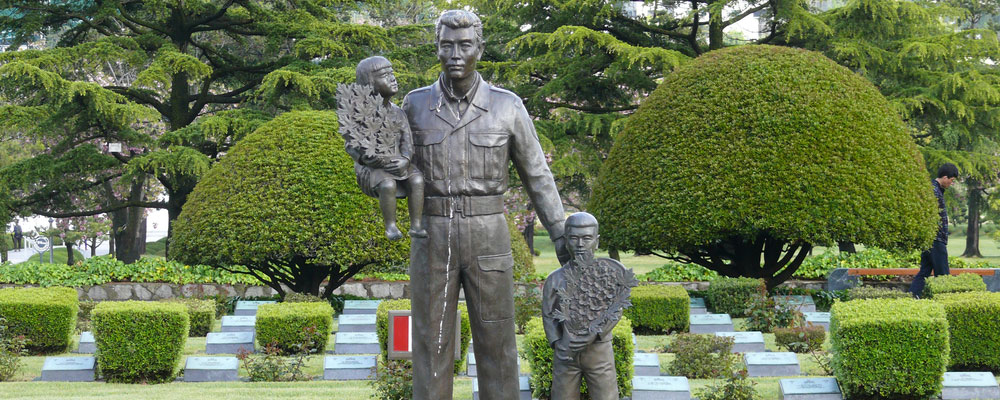
Sacrifice remembered
The Monument to Canadian Fallen in the United Nations Memorial Cemetery in Busan, South Korea, commemorates more than 30,000 Canadians who served in the Korean War from 1950 to 1953 and as peacekeepers in Korea until 1957.
There is a slightly larger replica of the monument in Ottawa.
Designed by a Canadian Veteran
The monument was designed by Princess Patricia's Canadian Light Infantry Korean War Veteran Vincent Courtenay, who managed the fund-raising effort from Korea. It was made by Korean artist Yoo Young Mun.
The oval bronze base has two rings - the top is inscribed with the names of fallen soldiers, and the bottom ring has a patriotic inscription. The bottom base is made of Korean granite.
Never to be forgotten
The monument is inscribed with the names of 516 Canadian soldiers who died during the Korean War. One soldier was too young for service in Korea and enlisted under his older brother’s name. Both names are recorded on the monument. Another soldier often used a pseudonym and was known by that name among friends, so he is identified by two names as well.
There was no machine to produce the words for the monument, so every letter - more than 6,000 - were hand cut from rubber sheeting. The hand-cut names were glued to the plane of the base, a plaster splash was made, and the raised letters were formed on the casting. The process distorted many of them and they had to be hand tooled to perfection. This was done for both the Canadian and Busan monuments!
Both Monuments to Canadian Fallen were cast in a hillside foundry in Korea, which was actually a tent rigged over a melting pot on one of the hills where Canadian soldiers once fought. The formed components were laid out on sand in their plaster splashes to cool, formed in the open air by artisans who had done the work all of their lives and lived there in the hills in huts.
Vincent worked with Yoo Young Mun in his small studio in Pocheon, near the Demilitarized Zone. Vincent designed every element and sculptor Yoo Young Mun translated them into a three-dimensional form in composite. He then cut it in sections, made his plaster splashes, poured the bronze, welded the components together, treated the bronze with acid, painstakingly hand carved the granite plinth, then directed the workers who set the assembled bronze in place on the plinth in the Canadian Graves Section in the United Nations Memorial Cemetery.
It was designed with the entire United Nations Memorial Cemetery embracing it, so that the monument would become part of the overall architecture and capture its solemnity. The monument is the central view from any angle in the cemetery, with the Canadian statue looking at the graves of his buried comrades, keeping them company. There is a black stone walkway incorporated into the setting, specifically so that people can walk completely around it. This gives them the ability to locate the names of the Canadian fallen and to view the three figures from every vantage point.
Permission to place the monument within the cemetery grounds was challenging. The custodian had to win approval from the United Nations Cemetery commission, made up of Ambassadors from the 11 nations whose countrymen are buried there. No monument with statues of people had ever been permitted within the cemetery before.
The monument took almost three years to complete. It was set in place in September 2001, dedicated on November 11, 2001, with Denis Comeau, Ambassador of Canada officiating, and rededicated and consecrated in April 2002.
