

Joined
1977

Postings
- CFS Kamloops: 1985-1987
- Kington, ON: 1987-1990
- CFB Trenton: 1990-1991
- CFS Barrington: 1991-1993
- Richmond, BC: 1993-1997
- CFB Esquimalt: 1997-2001
- NORAD HQ, Colorado Springs, CO, USA: 2001-2005
- 4 Wing Cold Lake: 2006-2008
- 1 Cdn Air Division HQ: 2008-2010 / 2011-2025

Deployments
- Operation Kobold, Kosovo: 2010-2011
A life in uniform
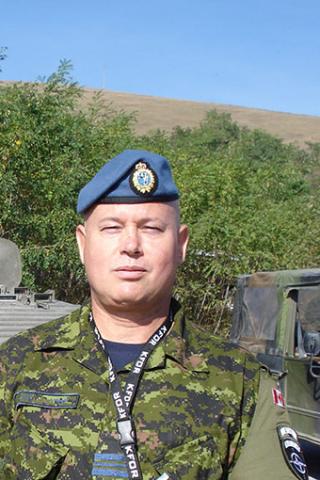
Ronald “Ron” Lee has spent his life in uniform. The self-described “Air Force brat” donned his first distinctive garb as a young Cub Scout, later moving to Boy Scouts and Army Cadets. At the age of 16, he learned that he could continue down this path and earn a living. That’s when he joined the communications reserves, and when his career took root.
Following in his father’s footsteps
Born in 1960 in Winnipeg, Lee grew up in a military family. His father, Major (Retired) Henry (Harry) George Lee, had served as a non-commissioned member of the Royal Canadian Air Force (RCAF) as a radar technician and later commissioned as a Communications Electronic Engineering (CELE) officer.
“He was my role model,” says Lee. “I just thought everything he did was exciting.” Lee followed the blueprint of his father’s career, starting as an airframe technician, transferring to the Regular Force and later commissioned as a CELE officer.
“It’s been an adventure ever since I did two years in the Reserves,” he says.
From the start, he was drawn to the diverse opportunities a career in service offered and made it his objective to seek unique experiences.
Watching the skies from coast to coast
In the mid-1980s, Lee served at Canadian Forces Station (CFS) Kamloops. It was part of the NORAD Pine Tree Line—the Cold War-era radar network lining the 50th parallel. High atop Mount Lolo, he led a team of technicians maintaining long-range radar systems designed to watch for Soviet Bear bombers entering North American airspace. Lee, then a young lieutenant, was the last Technical Maintenance Officer on this station as the Pine Tree Line began to close down.
In 1991, he found himself across the country at CFS Barrington, another long-range radar site. “I had the honour to be the last Commanding Officer of that site,” says Lee. With the Cold War winding down, the Soviet Union collapsing, and the radar chain closing, Lee witnessed the strangeness of Soviet warships visiting Halifax on a friendly visit, even while his station still scanned the skies for adversaries.
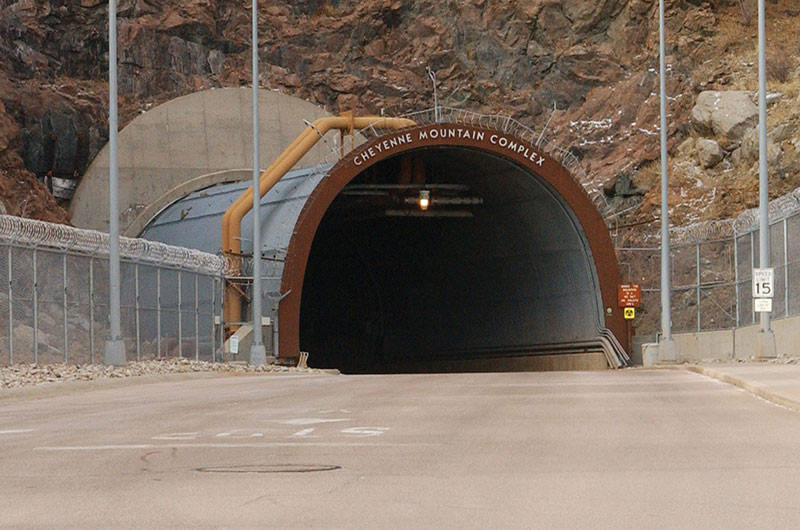
Entrance to Cheyenne Mountain Complex.
A first day like no other
In June 2001, Lee was posted to NORAD Headquarters in Colorado Springs. Before heading up to the Missile Warning Centre in Cheyenne Mountain, he enrolled in the U.S. Air Force’s Missile and Space Operators course at the nearby Shreiver Air Force Base. Over the summer months through early September, he worked on enhancing his skills to better prepare for a job that would prove to be like no other.
After completing the course, Lee enjoyed an extended weekend before reporting for work on his first shift as Deputy Crew Commander. It was 5:30 a.m. Central Time, Tuesday, 11 September 2001.
Inside NORAD’s Missile Warning Center, Lee received intel about a possible airplane hijacking—the scale of which was yet unknown. Seated at a panel of screens monitoring satellite imagery, Lee observed heat signatures that would soon be correlated with the attacks on New York, Washington and Pennsylvania.
Fresh off his training, and unsure if this was some kind of test or a drill, he immediately jumped into action.
They were witnessing unprecedented terrorist attacks in real time. First one plane on the World Trade Center, then another, then a third striking the Pentagon. And the fourth heat signature of Flight 93’s crash in Pennsylvania.
While news agencies were on the scene at the Twin Towers and the Pentagon, no one was around when that fourth flight went down.
“I saw it on my screen,” says Lee. “When I look back at that now, it's sort of eerie to me that I was the only one that saw that.”
It was Lee’s responsibility to activate secure communications linking NORAD with the Pentagon and other commands. On his very first day, he was thrust into history, helping to coordinate data collection and reporting.
NORAD was in lockdown. Lee carried out his duties inside while carrying the weight of the events unfolding outside. “You're trained and you're doing your thing (…) but at the back of your head you’re going, what's happening? Are we being targeted? It was a weird time,” recalls Lee.
When he emerged from Cheyenne Mountain later that evening, traffic was lining the roads to the U.S. Army base down in the valley. “Seeing all this traffic going one way to Fort Carson, that sort of amplified the magnitude of the situation,” he says. “It wasn't just in my little confined ops centre in the mountain—the whole world was reacting.”
Lee stayed in Colorado for four years. This pivotal time saw an increase in missile launches that demanded changes to how he performed his tasks.
Service beyond borders
Lee later deployed with NATO’s Kosovo Force in 2010. He mentored the newly established Kosovo Security Force in building communications and information systems. They built everything from internet connections to government networks and tactical field radios. His days were spent with local forces, helping them lay the foundations of a functioning state there.
Leading into the future
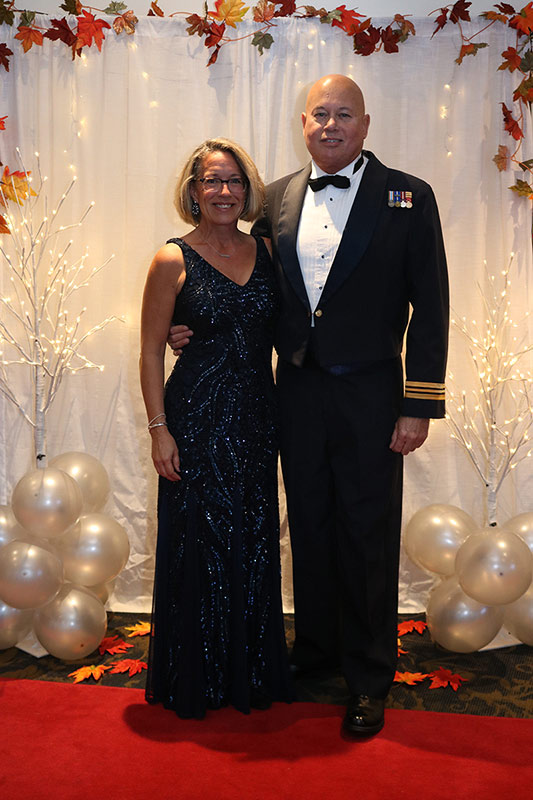
Ron Lee and his partner Christine at the annual 1st Canadian Air Division (1 CAD) Commander's Gala in 2022.
He finished his career overseeing the technical management of radar and communications systems across the RCAF, contributing to Canada’s aviation safety. But perhaps more importantly, he devoted those years to mentoring the next generation of officers and technicians.
“I can't say enough about the new generation, I've got the utmost confidence that they will do well.”
After 48 years in uniform, Lee retired in September 2025. Looking back, he emphasizes teamwork, mentorship, and following one’s passion. His advice to younger members of the Forces is simple: “Do what you want to do and not what you think the system needs you to do.”
Lee looks forward to a well-earned retirement with his partner Christine by traveling to warm destinations and playing volleyball. Each Remembrance Day, he will continue to stand in honour of those who served before him, just as he has since childhood. It’s a day that he says brings a heightened sense of patriotism.
With courage, integrity and loyalty, Ron Lee has left his mark. He is one of our Canadian Veterans. Discover more stories
If you are a Veteran, family member or caregiver in need of mental health support, the VAC Assistance Service is available to you 24/7, 365 days a year at no cost. Call 1-800-268-7708 to speak to a mental health professional right now.