

Year joined
1993

Postings
- Halifax
- Shilo
- Wainwright
- Edmonton
- Ottawa
- Kingston

Medals
- Canadian Forces' Decoration
Meet Tania Pendergast
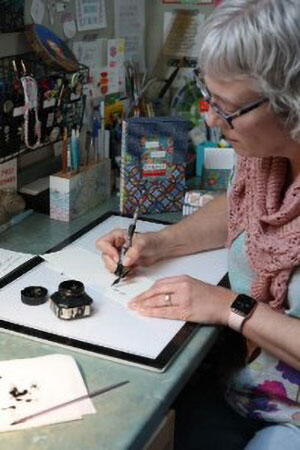
Tania Pendergast sits at a sunny desk in her artist's loft, dips the nib of her pen in an inkwell, and begins to write a quote in beautiful calligraphy.
She is surrounded by paint, pens, colourful paper and inspirational words pinned to the walls. Half-complete knitting projects sit patiently in nearby baskets.
"Find a place inside where there's joy, and the joy will burn out the pain," a quote from comparative mythology professor Joseph Campbell reads.
In the sunny stillness, it's hard to imagine her former life. For two decades, she oversaw complex organizations, managed military communications systems, budgets, personnel and more than 250 officer cadets at the Royal Military College of Canada.
Toughness as a measure of success
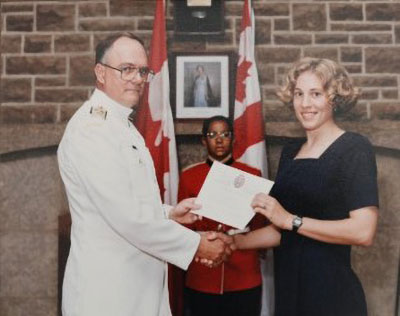
For much of Pendergast's life, she measured success by how much she could endure and accomplish. Today, she is embracing inner peace and creativity as a new definition of success.
Her transition from military officer to artist was more than a career change. It was a slow and often painful journey. Along the way, she discovered that healing deserves as much respect as achievement.
Before she even understood what post-traumatic stress disorder (PTSD) looked like, she had become very skilled at carrying on.
That began when she enrolled at the Royal Military College while her father (who was also a Veteran) was dying of lung cancer.
"I think I made very different life decisions as a result of that. I initially had aspirations of a medical or more creative field, maybe architecture or whatnot. But I knew that my father had really enjoyed his career, the challenges, the roles that he was in, the places he went," she remembered.
"That was inspiring to me."
Her father passed away when she was in the first year of her electrical engineering program at RMC, on her path towards becoming an Army Signals Officer. She set aside her grief, meeting the demanding expectations and earning her engineering degree.
Growing responsibilities
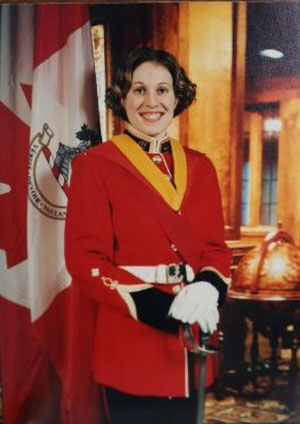
Her first posting was to Land Force Atlantic Area Headquarters in Halifax. As a Lieutenant, she was in charge of procuring all IT equipment for the Atlantic provinces.
Later, she went to Shilo, Manitoba where she could be closer to her husband. There she worked as Base Information Systems Officer and Deputy Commanding Officer for two years.
After Shilo, she and her husband were both posted to Wainwright, Alberta where she was in charge of 742 Signal Squadron Detachment.
"In that role, I had a lot more autonomy and a lot more responsibility. I had civilian staff, all the complement of Signals staff, and was responsible for the Base telephone system and computer network, the Base and training area cable plants, the service desk, and managing the Detachment's budget," she said.
After Wainwright, she was posted to 73/74 Communication Group Headquarters in Edmonton, Alberta to work with the Signals Reserve. They had units from Thunder Bay to Alberta. During that posting, she was promoted to Major and became the Chief of Staff.
A master's degree in modeling and simulation
She then completed a two-year master's degree at Carleton University in Ottawa in modeling and simulation. Her sponsoring unit was the Canadian Forces Warfare Centre, where she worked after graduation. She was pregnant with her second child when she left the Warfare Centre.
Her final posting was to the Royal Military College in Kingston, Ontario as a Division Commander where she helped mentor the next generation of officers.
"I came full circle," she said.
"I really appreciated seeing how it ran on the inside. When you're there as a student, you don't see what's under the hood."
At this posting, there was a death by suicide. This was traumatic for the whole community. In the painful period that followed, she provided support to the family and the four Squadrons in her division.
The situation impacted her severely, but she did not have time to fall apart.
"It had a huge impact on the staff and students. It was a prolonged traumatic event and I was worried about the well-being of the cadets in my division and in the Cadet Wing, I was worried about my staff," she said.
After the tragic death, there were briefings on operational stress injuries and suicide prevention. The padres were engaged to provide ongoing support.
"We all struggled. I could have gone on to do some very interesting jobs afterwards, but I was pretty, I think, broken by it."
The psychological weight of that loss followed her long after she left the parade square.
A history of leadership
When she first retired in 2013, she found employment in a role she found intellectually challenging that put her leadership experience and master's degree to good use.
But just nine months into the new job she was overwhelmed with pain and depression. She was finding it hard to concentrate and complete simple tasks so she decided to take a sick leave.
After getting support from a psychiatrist, occupational therapist, group and art therapy, she challenged herself to be creative every day for a year.
In spring 2015, she and her husband moved to PEI to be closer to his family.
"I had to rebuild my health care team from scratch. I was really struggling with low mood, pain and exhaustion. It was very difficult to feel like I had a sense of purpose."
"It was my work with an art therapist and my year of being creative that led me to consider opening a small business based around my art. I have always been a curator of beautiful words, writing quotes that inspired me in notebooks as far back as high school," she said.
I began hand-lettering quotes that uplifted and moved me. I shared them online on Instagram and connected with a beautiful community of creatives. Then I discovered modern calligraphy and dove into that as an even better medium to bring my quotes to life."
Eventually, she combined her love of quotes, calligraphy and watercolour illustration into her own designs. With encouragement from friends and family, she opened an Etsy shop in 2016 -- offering original artwork, prints, greeting cards and more. She started selling her art at local Etsy markets and shops.
"I didn`t leave the military with aspirations to become an entrepreneur," Pendergast said.
"My goal was to explore where I could go with my master's degree and military skills. When my health led me to abruptly leave my first post-retirement civilian job, I really struggled to find purpose, understand what was happening with my health and find the motivation to get out of bed every day."
Her creative endeavors allowed her to work at her own pace and look after her physical and mental health.
"I had a sense of purpose and goals I was working toward. It was a period that was not without its significant struggles, but it was also a very rewarding time. I was grateful to get to connect with a community of creatives, energized by the opportunities to create custom artwork for weddings, family and friends and new customers near and far."
She was contracted to create custom artwork for CBC East Coast.
Years passed before she finally received a diagnosis of post-traumatic stress disorder connected to her military service. By then, she had become better at knowing what she needed to stay healthy.
"Pushing through pain, not asking for help, none of those are good habits to develop. The perception that pain is weakness…we need to do away with that kind of thinking. And certainly because I deal with PTSD, I deal with chronic pain, (from fibromyalgia and arthritis) I deal with depression…" she said.
"I think they're a function of that traumatic event, but also service and being in situations where maybe, you're pushed beyond the limits of what your body can do. But you suck it up. You don't want to be perceived as weak. You don't want to be considered 'less than'. You want to be viewed as a member of the team."
"Talking to your peers, not hiding your struggles, is so important. I think baked into the military system is not wanting to show weakness and fear that it will impact your career," she said.
"(There can be this) fear that it will impact your prospects, your opportunities. I think maybe it's a healthier environment now. There is no benefit to pushing through and harming yourself. It shortens your career, shortens your longevity and leaves you with chronic health conditions in the end."
Throughout her career, Pendergast was the one who was always able to solve complex problems. It was difficult for her to accept that she no longer had the mental or emotional capacity to navigate the complicated systems designed to support Veterans like her. She struggled to find services, complete paperwork, and advocate for herself.
"I didn't know what was happening."
Her PTSD diagnosis helped her access programs and services through Veterans Affairs Canada.
A creative talent
Healing did not come through another promotion or ambitious project. It came after her occupational therapist encouraged her to explore her creativity.
"She encouraged me to delve into that, which was really helpful. She connected me with an art therapist which was a really interesting process and a comfort that kept me from ruminating or focusing on being in pain."
First, she started hand lettering quotes in calligraphy, then illustrating borders in watercolour, then bookbinding, then knitting; creative work that required patience instead of urgency.
She opened an online shop to sell original artwork, prints, cards, stickers, mugs, and tank tops. She attended makers' markets and offered her art in local shops.
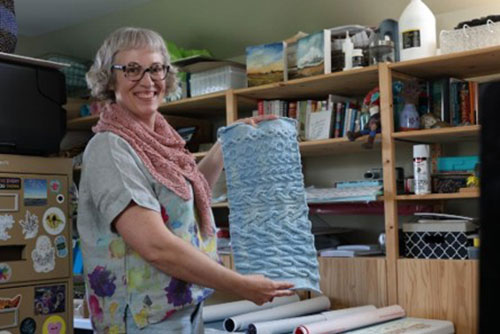
Making something beautiful with her hands became a way of reconnecting with herself.
"In the military, your markers of success are very external, like your rank, your career courses, your postings. So defining for myself what success was, was quite a process, because it felt like a failure that my civilian job ended so abruptly. I started my creative career with a real headstrong attitude that I've got to make something of this," she said.
She no longer feels compelled to transform every interest into another accomplishment or another measure of success.
"I consider my creative pursuits as my own form of meditation. When I get into a creative flow, it can help dull my pain and stop me from ruminating. While my path after retirement did not match what I had envisioned and my health was not what I expected it to be, I did find joy and fulfillment in building an art-based small business at my own pace."
Today, she is extending to herself the same compassion she spent a lifetime offering to others.
"How do I define success now? It's more about who I am as a person. And also success is showing myself grace, not expecting myself to be extraordinary all the time and high-functioning all the time," she said.
"I'm doing things to help my mental and physical health. I'm not striving. It's more like just being a human being who is patient with myself, who tries to connect with other people who have like-minded interests. That, to me is success."
Tania Pendergast is leaving her mark. She is a Canadian Armed Forces Veteran. Discover more stories.
The well-being of Canadian Veterans is at the heart of everything we do. As part of this, we recognize, honour and commemorate the service of all Canadian Veterans. Learn more about the services and benefits that we offer.
If you are a Veteran, family member or caregiver, the support of a mental health professional is available anytime at no cost to you. Call 1-800-268-7708.