
In 2007 an indoor replica of the Brooding soldier monument was built
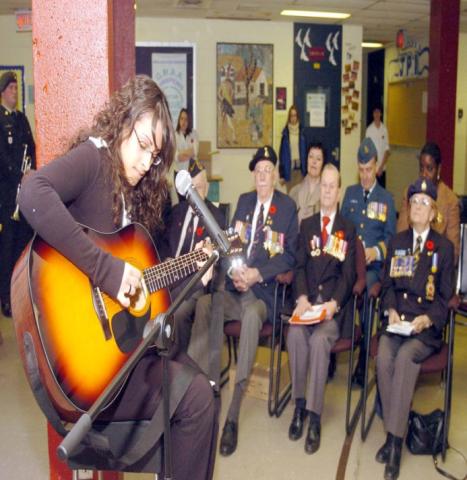
in order to mark the 90th anniversary of the Battle of Vimy Ridge
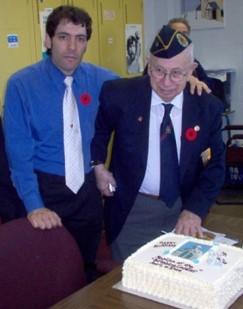
It was planned, paid for and built by Mr. Speranza
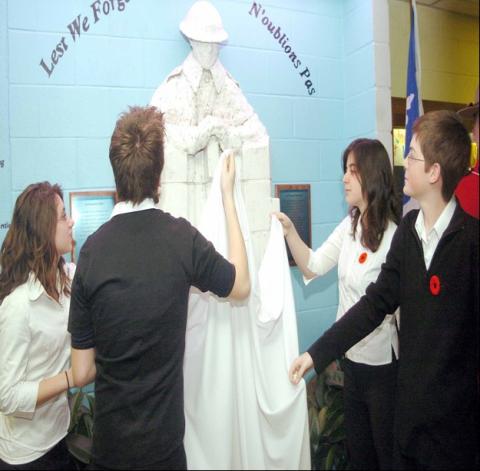
Students and teachers aided in the process.
.
Sign in to My VAC Account
Sign in to My VAC AccountTHIS COLUMN MARKS THE BATTLEFIELD WHERE 18,000 CANADIANS ON THE BRITISH LEFT WITHSTOOD THE FIRST GERMAN GAS ATTACKS THE 22ND-24TH OF APRIL 1915. 2,000 FELL AND HERE LIE BURIED
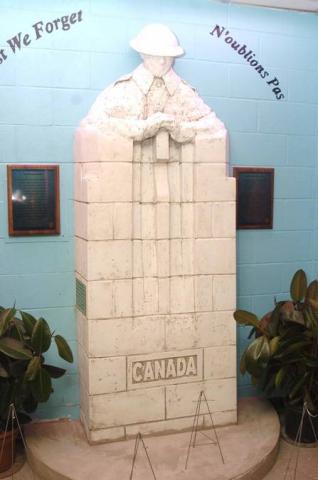
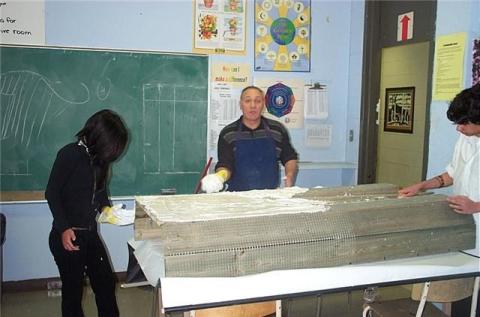
In 2007 an indoor replica of the Brooding soldier monument was built
in order to mark the 90th anniversary of the Battle of Vimy Ridge
It was planned, paid for and built by Mr. Speranza
Students and teachers aided in the process.
.
[front/devant]
THEY WERE LOVELY
AND PLEASANT
IN THEIR LIVES
AND IN THEIR DEATH
WERE NOT DIVIDED
SWIFTER THAN EAGLES
STRONGER THAN LIONS
TO DO THE WILL
OF THEIR MASTER
AND THE DESIRE
OF THEIR ROCK
[main monument, right side]
ROLL OF HONOUR
[main monument, left side]
ROLL OF HONOUR
[left wall]
[right wall]
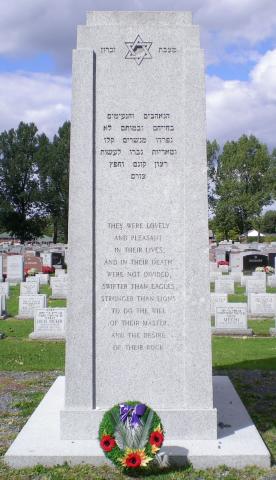
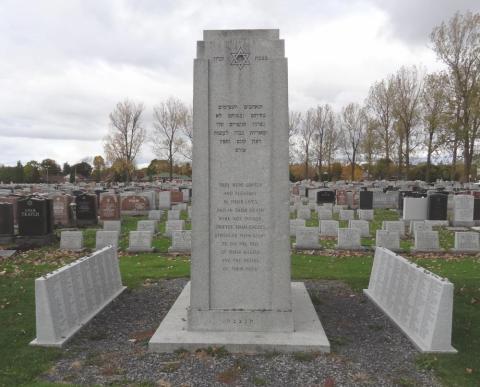
The main monument was erected by the Association of Jewish Members of the Canadian Armed Forces in 1947. Two additional monuments were dedicated on November 11, 2013. It is Canada’s largest monument to the military service of Canada’s Jewish community.
The names of 579 Jewish Canadians, who died while serving their country in uniform, are inscribed in black on the monument’s light grey stone. These fallen heroes include those who lost their lives in the First and Second World Wars and the Korean War. A Star of David is near the top of the monument.
The initiative to erect an expanded Jewish war monument in the Baron de Hirsch Cemetery was spearheaded by Larry G. Rosenthal, whose older brother, Gunner William Guy Rosenthal (Willy), was killed in action during the Second World War.
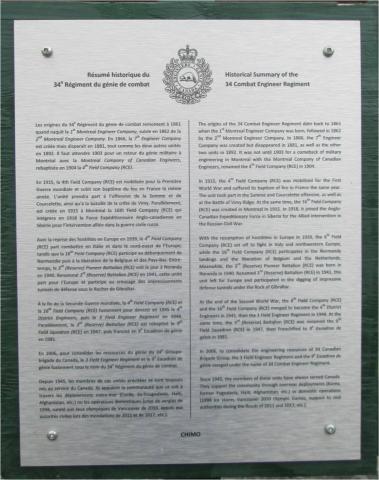
Les origines du 34e Régiment du génie de combat remontent à 1861 quand naquit la 1st Montreal Engineer Company, suivie en 1862 de la 2nd Montreal Engineer Company. En 1866, la 7th Engineer Company est créé mais disparait en 1881, tout comme les deux autres unités en 1892. Il faut attendre 1903 pour un retour du génie militaire à Montréal avec la Montreal Company of Canadian Engineers, rebaptisée en 1904 la 4th Field Company (RCE).
En 1915, la 4th Field Company (RCE) est mobilisée pour la Première Guerre mondiale et subit son baptême de feu en France la même année. L’unité prendra part à l’offensive de la Somme et de Courcelette, ainsi qu’à la bataille de la crête de Vimy. Parallèlement, est crée en 1915 à Montréal la 16th Field Company (RCE) qui intégrera en 1918 la Force Expéditionnaire Anglo-Canadienne en Sibérie pour l’intervention allié dans la guerre civile russe.
Avec la reprise des hostilités en Europe en 1939, la 4th Field Company (RCE) part combattre en Italie et dans le nord-ouest de l’Europe tandis que la 16th Field Company (RCE) participera au débarquement de Normandie puis à la libération de la Belgique et des Pays-Bas. Entre temps, le 3rd (Reserve) Pioneer Battalion (RCE) voit le jour à Noranda en 1940. Renommé 3rd (Reserve) Battalion (RCE) en 1941, cette unité part pour l’Europe et participe a creusage des impressionnants tunnels de défense sous le Rocher de Gilbraltar.
À la fin de la Seconde Guerre mondiale, la 4th Field Company (RCE) et la 16th Field Company (RCE) fusionnent pour devenir en 1945 le 4th District Engineers, puis le 3 Field Engineer Regiment en 1948. Parallèlement, le 3rd (Reserve) Battalion (RCE) est rebaptisé le 9th Field Squadron (RCE) en 1947, puis francisé en 9e Escadron de génie en 1981.
En 2006, pour consolider les ressources du génie du 34e Groupe-Brigade du Canada, le 3 Field Engineer Regiment et le 9e Escadron de génie fusionnent sous le nom du 34e Régiment du génie de combat.
Depuis 1945, les membres de ces unités précitées se sont toujours mis au service du Canada. Ils appuient la communauté que ce soit à travers les déploiements outre-mer (Corée, Ex-Yougoslavie, Haïti, Afghanistan, etc) ou les opérations domestiques (crise de verglas de 1998, sureté aux Jeux Olympiques de Vancouver de 2010, appuis aux autorités civiles lors des inondations de 2011 et de 2017, etc)
CHIMO
The origins of the 34 Combat Engineer Regiment date back to 1861 when the 1st Montreal Engineer Company was born, followed in 1862 by the 2nd Montreal Engineer Company. In 1866, the 7th Engineer Company was created but disappeared in 1881, as well as the two other units in 1892. It was not until 1903 for a comeback of military engineering in Montreal with the Montreal Company of Canadian Engineers, renamed the 4th Field Company (RCE) in 1904.
In 1915, the 4th Field Company (RCE) was mobilized for the First World War and suffered its baptism of fire in France the same year. The unit took part in the Somme and Courcelette offensive, as well as the Battle of Vimy Ridge. At the same time, the 16th Field Company (RCE) was created in Montreal in 1915. In 1918, it joined the Anglo-Canadian Expeditionary Force in Siberia for the Allied intervention in the Russian Civil War.
With the resumption of hostilities in Europe in 1939, the 4th Field Company (RCE) set off to fight in Italy and northwestern Rurope, while the 16th Field Company (RCE) participates in the Normandy landings and the liberation of Belgium and the Netherlands. Meanwhile, the 3rd (Reserve) Pioneer Battalion (RCE) was born in Noranda in 1940. Renamed the 3rd (Reserve) Battalion (RCE) in 1941, this unit left for Europe and participated in the digging of the impressive defence tunnels under the Rock of Gibraltar.
At the end of the Second World War, the 4th Field Company (RCE) and the 16th Field Company (RCE) merged to become the 4th District Engineers in 1945, then 3 Field Engineer Regiment in 1948. At the same time, the 3rd (Reserve) Battalion (RCE) was renamed the 9th Field Squadron (RCE) in 1947, then Frenchified to 9e Escadron de génie in 1981.
In 2006, to consolidate the engineering ressources of 34 Canadian Brigade Group, the 3 Field Engineer Regiment and the 9e Escadron de génie merged under the name 34 Combat Engineer Regiment.
Since 1945, the members of these units have always served Canada. They supprt the community through overseas deployments (Korea, former Yugoslavia, Haiti, Afghanistan, etc) or domestic operations (1998 ice storm, Vancouver 2010 Olympic Games, support to civil authorities during the floods of 2011 and 2017, etc)
CHIMO
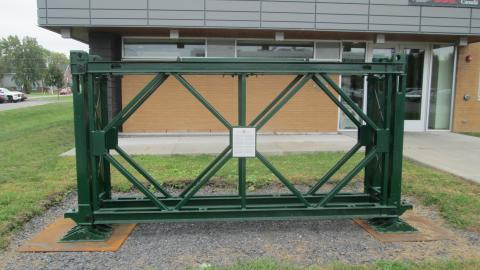
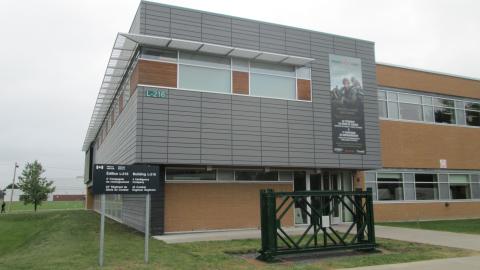
This monument, based on a Bailey Bridge panel, is a tribute to 34 Combat Engineer Regiment and its predecessor units.
[plaque/plaque]
Honneur aux Patriotes morts à Saint-Denis
Eusèbe Faneuf
François Dufaux
Pierre Minet
dit Montigny
Charles Gazailles
dit Saint-Germain
Antoine Amiel
dit Lusignan
Jean-Baptiste
Patenaude
André Mandeville
Joseph Dudevoir
[The wording is not clear in the photo./Le texte n’est pas clair sur la photo.]
Patriotes morts à Saint-Denis mais inhumés en d'autres lieux:
Honoré Bouteillet
Benjamin Durocher
François Lamoureux
Levy Bourgeois
Charles-Ovide Perrault
[crosses/croix]
Eusèbe Faneuf
François Dufaux
Pierre Minet
dit Montigny
Charles Gazailles
dit Saint-Germain
Antoine Amiel
dit Lusignan
Jean-Baptiste
Patenaude
André Mandeville
Joseph Dudevoir
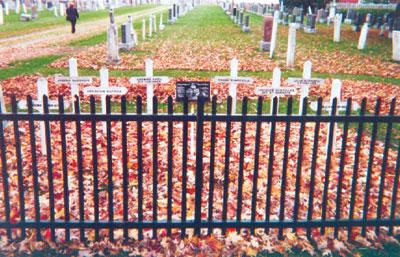
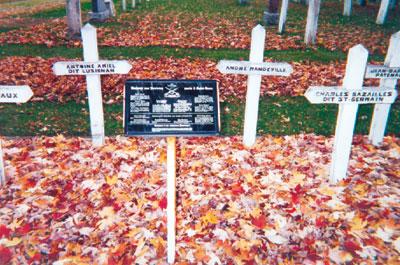
Eight crosses were erected in memory of the Saint-Denis Patriots killed at the battle of Saint-Denis. They were erected in the parish cemetery by the Comité de la Fête des Patriotes de Saint-Charles et Saint-Denis, with the contribution of the Patriotes du Pays, and unveiled on June 24, 1988.
[left plaque on obelisk/plaque de gauche sur l’obélisque]
Allaire, Joseph
Bourgeois, Lévy
Cartier, George-Étienne
Cormier, Gédéon
Gauthier, Théodule
Lenoir-Rolland, Nicolas
Marchessault, Augustin
[centre plaque on obelisk/plaque du centre sur l’obélisque]
HOMMAGE AU PATRIOTES DE 1837 - 1838 et à leurs compagnons d'armes
St-Antoine-sur-Richelieu 24 mai 1987
[right plaque on obelisk/plaque de droite sur l’obélisque]
Allaire, Pierre
Bouteillet, Honoré
Cartier, Henri
Durocher, L.-Benjamin
Gravel, Nicolas
Mandeville, F.-André
Perodeau, Joseph
Roberge, François
[individual plaque/plaque individuelle]
Les patriotes
de Saint-Antoine
[The balance of the wording is not clear in the photo]
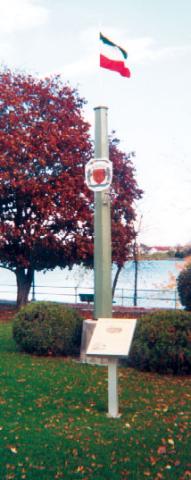
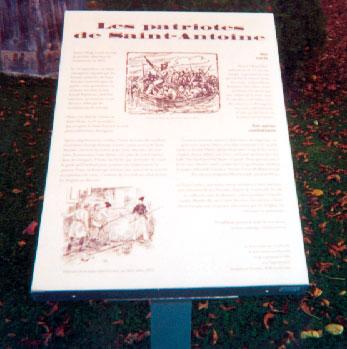
In November 1837, some 250 Patriots gathered in Saint-Antoine and crossed the river to fight at Saint-Denis, answering a call from George-Étienne Cartier, one of Papineau’s lieutenants. The obelisk is made of wood and measures approximately 20 feet high, with a cement base on which have been installed three plaques bearing the names of the 15 known Patriots from Saint-Antoine. It also bears the Saint-Antoine coat of arms. The memorial was erected on May 24, 1987 by the 150th anniversary municipal commission.
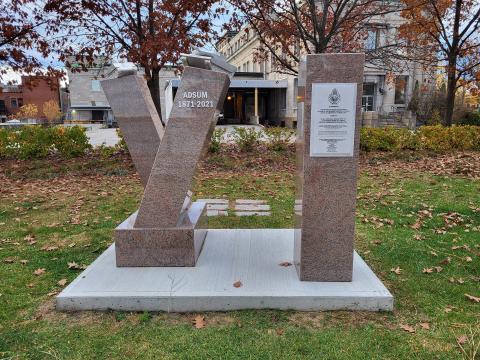
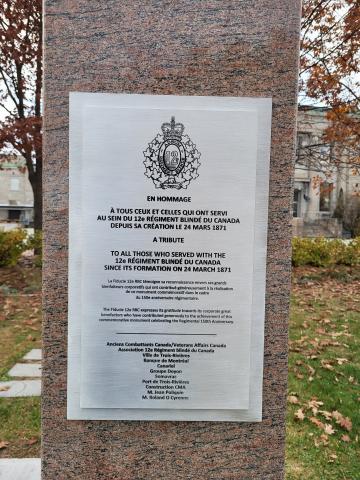
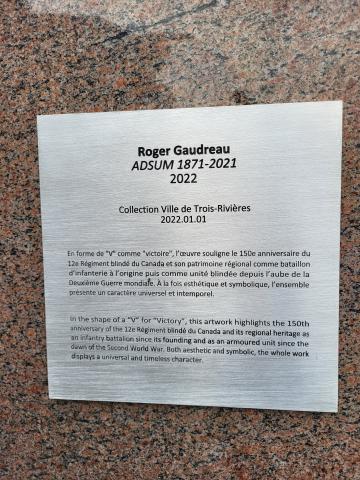
A tribute to all those who served with the 12e Régiment Blindé.
[wall/mur]
IN MEMORIAM
[plaque on slab/plaque sur dalle]
A LA GLOIRE DE DIEU
ET A LA MEMOIRE DES FILS DE
SAINT - LAURENT
QUI ONT DONNE LEUR VIE POUR
LA PATRIE, LA PAIX ET LA LIBERTE
TO THE GLORY OF GOD
AND IN MEMORY OF THE SONS OF
SAINT - LAURENT
WHO MADE THE SUPREME SACRIFICE
FOR COUNTRY, PEACE AND LIBERTY
1966
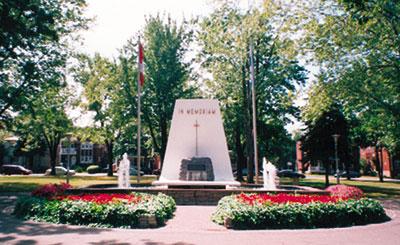
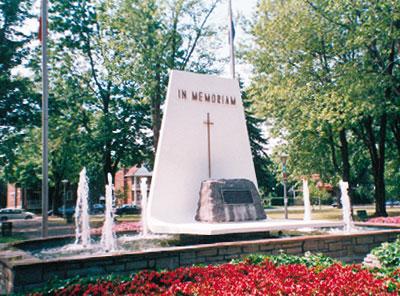
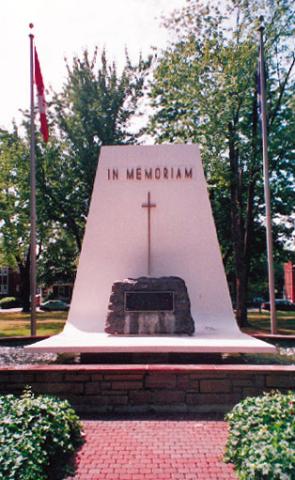
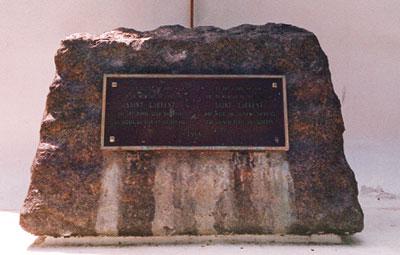
This memorial is dedicated to the men of Saint-Laurent who gave their lives fighting for their country. It was erected in 1966.
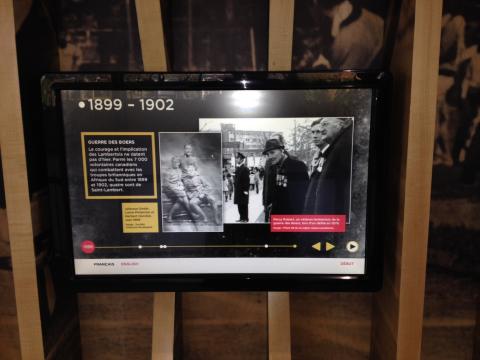
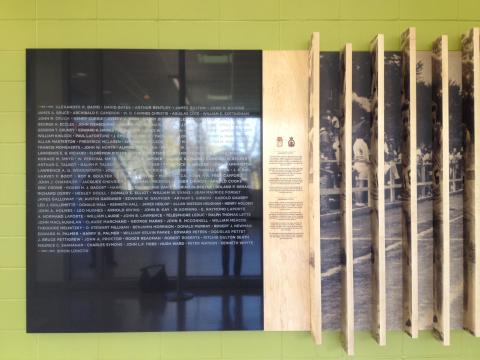
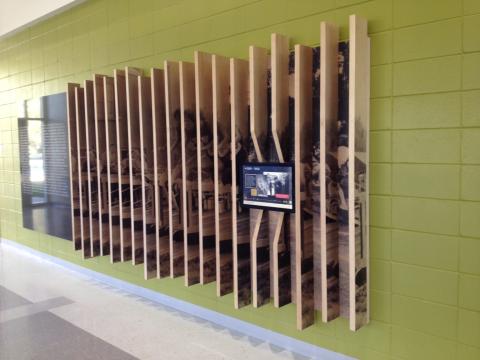
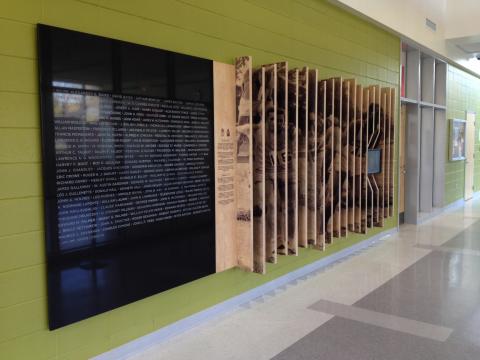
This memorial, consisting of an engraved granite stone, panels, and interactive TV station, is dedicated to Saint-Lambert veterans of the First and Second World Wars, and the Afghanistan conflict. The stone is engraved with the names of 133 heroes of the Saint-Lambert municipality. It was unveiled on October 4, 2013 by AQUARIUM MEDIA.
[plaque]
BATTLEFIELD OF ODELLTOWN
IN ABIDING MEMORY OF CAPTAIN DONALD MCALLISTER, JAMES ALLEN, THOMAS DURHAM, MARTIN FLOWERS, ROBERT AND WILLIAM MCINTYRE, KILLED
LEWIS BARTLETT, WILLIAM DURHAM, WILLIAM KIDD AND HIRAM ODELL, WOUNDED IN ACTION, AND OF THEIR BRAVE COMRADES OF THE ROYAL MILITIA OF CANADA WHO FOUGHT HERE ON NOVEMBER 9TH, 1838.
CHAMP DE BATAILLE D'ODELLTOWN
A LA PERPÉTUELLE MÉMOIRE DU CAPITAINE DONALD MCALLISTER, DE JAMES ALLEN, THOMAS DURHAM, MARTIN FLOWERS, ROBERT ET WILLIAM MCINTYRE, MORTS AU CHAMPS D'HONNEUR ET DE LEWIS BARTLETT, WILLIAM DURHAM, WILLIAM KIDD ET HIRAM ODELL, BLESSÉS ET DE LEURS BRAVES COMPAGNONS DE LA LOYALE MILICE DU CANADA, QUI ONT PRIS PART AUX COMBATS DES 7 ET 9 NOVEMBRE 1838.
[cannon/canon]
THIS GUN CAPTURED AT THE BATTLE OF ODELLTOWN AND PRESENTED BY THE GOVERNOR GENERAL TO COLONEL EDWARD MARCH WAS DONATED BY HIS GRANDCHILDREN IN 1924 TO THE DOMINION OF CANADA.
La Bataille d'Odelltown
Battle of Odelltown
Après l'échec de l'insurrection de 1837, des membres du parti des patriotes, rassemblés aux États-Unis sous la conduite de Robert Nelson, proclamèrent la République du Bas-Canada et tentèrent de revnerser le gouvernement. L'invastion de 1838, médiocrement organisée et mal ravitaillée, fut un échec. Le 8 novembre, l'armée se replia sur Odelltown. Les 9 et 10 novembre, elle attaqua la milice d'Odelltown mais celle-ci, soutenue par des renforts, la repoussa. Nelson s'échappa mais la dispersion de ses forces mit fin à l'avenuture.
Following the failure of the 1837 rebellion, a fraction of the partriote party gathered in the United States under the leadership of Robert Nelson to proclaim the Republic of Lower Canada and plot the overthrow of the government. Their invasion in 1838, however, was a fiasco, largely due to poor planning and inadequate supplies, and on November 8 the rebel force retreated toward Odelltown. On November 9 and 10 they attacked the defending militia, but were finally replulsed by reinforcements. Although Nelson escaped, the subsequent dispersal of his men virtually ended the insurrection.
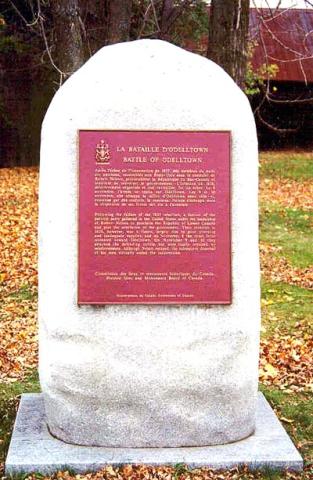
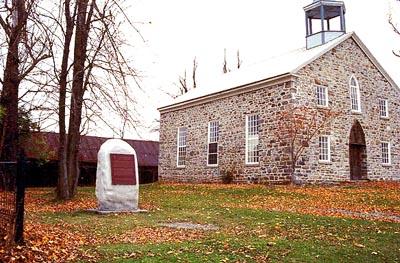
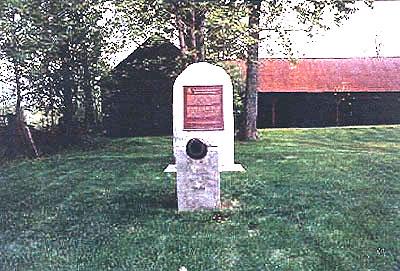
The Battlefield of Odelltown. A cannon appears in front of the slab in Photo 24063-022c.jpg. However, the cannon seems to have been removed in photo 24063-022a.jpg.
Monument- front
Leurs vies ont été le prix de notre liberté
Monument- right side
Les fils d’Amqui tombés au champ de bataille
(1939 - 1945)
Joseph Ludger Jean
Eugène Saint-Amand
Jean-Marie Saint-Onge
(1914 – 1918)
Monument- rear
Their lives were the price of our liberty
Monument- left side
Sons of Amqui fallen on the field of battle
(1939 - 1945)
Joseph Ludger Jean
Eugène Saint-Amand
Jean-Marie Saint-Onge
(1914 – 1918)
Dedication plaque
Inauguré le 10 mai 2015, le monument aux soldats disparus nous rappelle ces courageux jeunes hommes d’Amqui décédés à la guerre et du grand vide que leur perte a cause dans la communauté.
Mi-autel, mi-tombeau, son esthétique tend vers un idéal de paix; la colombe placée sur le casque militaire soulignant le temps révolu des combats.
Après tout, cette paix qui est le nôtre aujourd’hui nous a d’abord été léguée par tous ceux-là qui ont donné leur vie pour elle.
Monument au soldats disparus
Sculpteur: Roger Vaillancourt
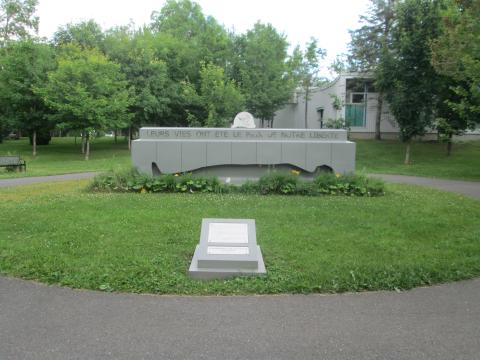
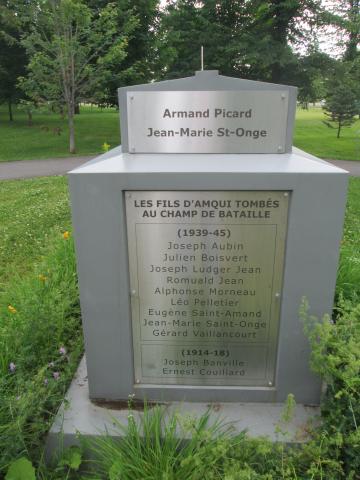
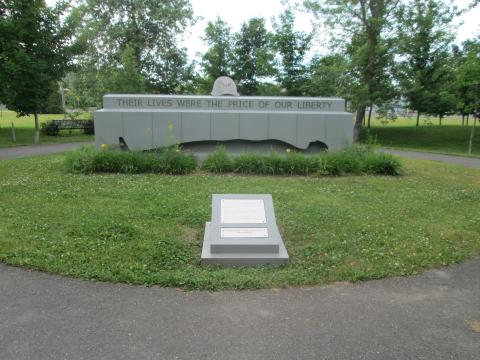
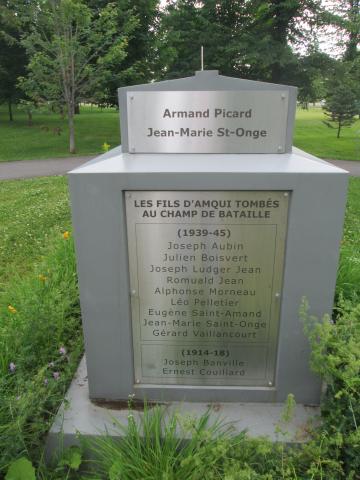
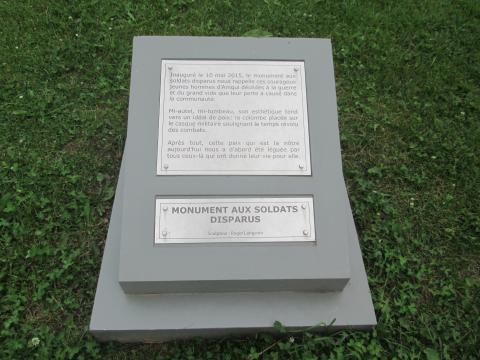
This monument is dedicated to the citizens of Amqui who lost their lives during the First and Second World Wars