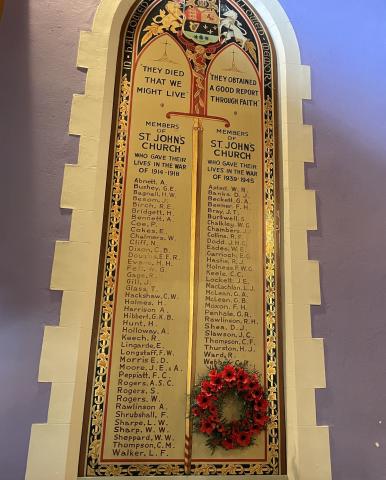
The World Wars Tablet was erected in 1963 to honour St. John's Anglican Church parishioners who gave their lives in the First and Second World Wars. A long sword is in the center of the tablet.
World Wars Tablet
Sign in to My VAC Account
The World Wars Tablet was erected in 1963 to honour St. John's Anglican Church parishioners who gave their lives in the First and Second World Wars. A long sword is in the center of the tablet.
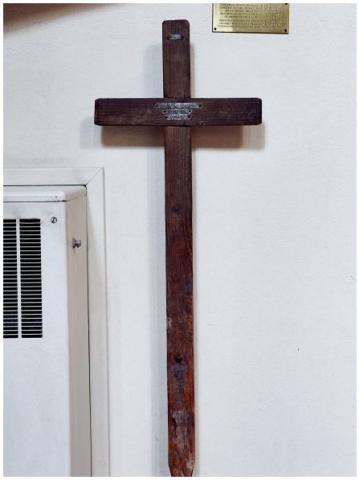
Under the large Great War memorial hangs a raw wooden cross that originally marked the grave of Maj. Sidney Burnham in France; his family donated it to the church after a stone marker was laid on top of his final resting place in Caix British Cemetery, Somme, France. He was the son of Dr. George Herbert Burnham and Frances Sarah Burnham, of Toronto, Ontario.
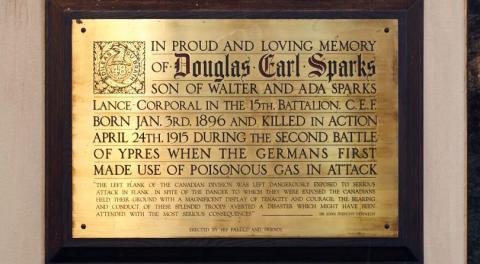
IN PROUD AND LOVING MEMORY
OF Douglas Earl Sparks
SON OF WALTER AND ADA SPARKS
LANCE-CORPORAL IN THE 15TH, BATTALION, C.E.F.
BORN JAN. 3RD, 1896 AND KILLED IN ACTION
APRIL 24TH, 1915 DURING THE SECOND BATTLE
OF YPRES WHEN THE GERMANS FIRST
MADE USE OF POISONOUS GAS IN ATTACK.
"THE LEFT FLANK OF THE CANADIAN DIVISION WAS LEFT DANGEROUSLY EXPOSED TO SERIOUS
ATTACK IN FLANK. IN SPITE OF THE DANGER TO WHICH THEY WERE EXPOSED THE CANADIANS
HELD THEIR GROUND WITH A MAGNIFICENT DISPLAY OF TENACITY AND COURAGE, THE BEARING
AND CONDUCT OF THESE SPLENDID TROOPS AVERTED A DISASTER WHICH MIGHT HAVE BEEN
ATTENDED WITH THE MOST SERIOUS CONSEQUENCES" SIR JOHN FRENCH'S DESPATCH
ERECTED BY FAMILY AND FRIENDS
A brass tablet in memory of Lance Corporal Douglas Earl Sparks, donated by his family and friends, was unveiled on April 27, 1924 on the west side of the church.
To the greater glory of God and in everlasting remembrance of the men of St. Paul's parish who gave their lives in defense of Justice, Liberty and Truth. A. D. 1914-1919.
St. Paul's Anglican Church has more than 30 memorials from the First World War, including windows, chancel screens, tablets, panels and artifacts. Almost every person who was able to enlist served in the military by the time the war ended. Of the more than 500 men and dozens of female Nursing Sisters who served from St. Paul’s Church during the First World War, 76 died.
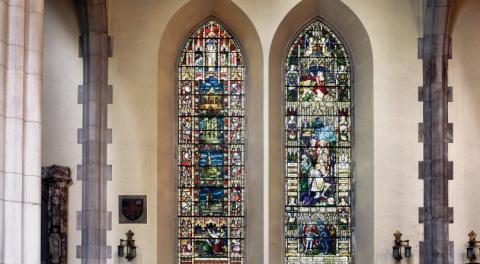
There is a memorial window for the 76 who served in the First World War and fell and for the 507 who served in the First World War and lived. The stained glass memorial windows are known as Window for the Fallen and Window for the Living. The windows were unveiled by Governor General Sir Julian Byng of Vimy on February 27, 1927 on the east wall of the nave. They were manufactured by John Hardman & Co. in Birmingham, England. The names and dates of death were printed in the order of service for the unveiling of the grand windows above the altar.
A year after unveiling the windows, Governor General Sir Julian Byng returned to St. Paul's to dedicate yet another window to the fallen. The window includes around 700 pieces of glass from 70 destroyed/damaged churches/buildings in the war zones of France, Belgium and Italy. The pieces were found among the ruins by Brig.-Gen. Charles Mitchell, who as a senior intelligence officer, was able to move around behind the lines.
In 1910, St. Paul’s became the regimental church for The Queen's Own Rifles of Canada. Outside of St. Paul’s stands the Cross of Sacrifice, built after the First World War to commemorate members of Queen's Own Rifles who died in combat.
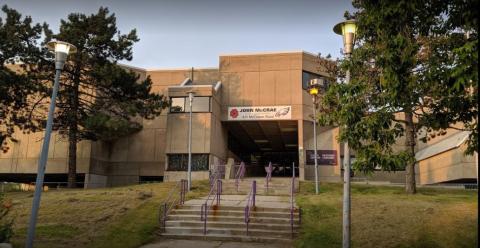
John McCrae Public School was named in honour of John McCrae B.A. M.D. Tor; M.R.C.P. & Lt Col: C.A.M.C. Pathologist, poet, physician and soldier. a man among men. In 1899 he came to McGill University as Governor's Fellow in Pathology and was lecturer in Pathology and later a Lecturer in Medicine. He served with the Artillery in the South African War and in the Great War as M. O. with the 1st B.de C.F.A. as Chief Physician to No 3 C.G.H. McGill & as Consultant in Medicine to First Army. Born at Guelph Ont. 1872. Died in service at Boulogne France 1918. He wrote In Flanders Fields in May, 1915, just after the horrendous second battle of Ypres, in which he lost a close friend.
IN MEMORIAM
THOMAS MOOR JR.
KILLED IN ACTION AT BATOCHE N.W.T. MAY 9TH 1885.
ISAAC HUGHES
DIED AT BATTLEFORD N.W.T. SEPTEMBER 1ST
FROM INJURIES RECEIVED IN ACTION AT BATOCHE MAY 12TH 1885.
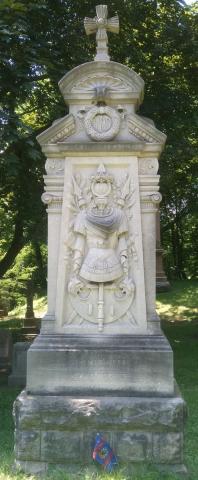
The memorial is dedicated to two privates of Toronto's Tenth Royal Grenadiers, who died during the Northwest Rebellion. It was designed by Frank Darling and unveiled on May 16, 1887.
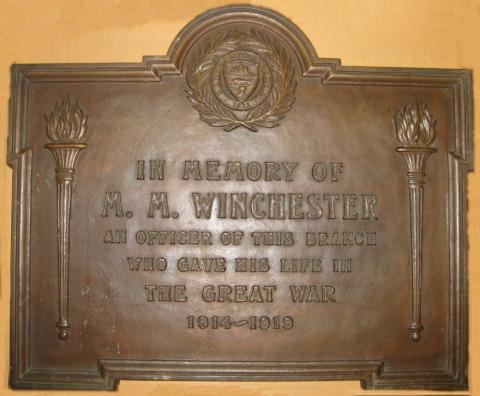
IN MEMORY OF
M.M. WINCHESTER
AN OFFICER OF THIS BRANCH
WHO GAVE HIS LIFE IN
THE GREAT WAR
1914∼1919
As a memorial to staff who gave their lives in the Great War, the Bank of Nova Scotia commissioned about 60 bronze tablets, between July 1920 and February 1921, to be placed on the wall of the branch where each known staff member was employed when they joined the military forces. These plaques listed the names of staff killed on the field, as well as those who died from their wounds after they returned home from the war.
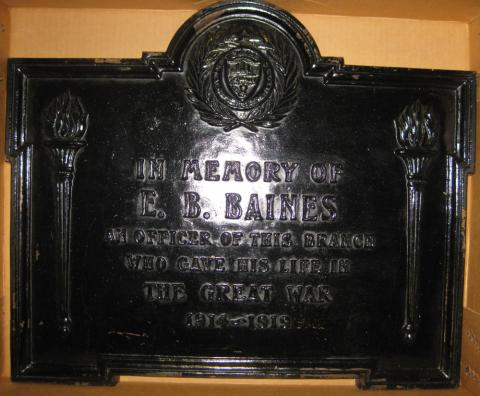
This plaque honours Egerton Bancks Baines a former officer of the Bank of Nova Scotia & Spadina Branch in Toronto, Ontario, who was killed in service during the Great War.
IN MEMORY OF
E.B. BAINES
AN OFFICER OF THIS BRANCH
WHO GAVE HIS LIFE IN
THE GREAT WAR
1914∼1919
As a memorial to staff who gave their lives in the Great War, the Bank of Nova Scotia commissioned about 60 bronze tablets, between July 1920 and February 1921, to be placed on the wall of the branch where each known staff member was employed when they joined the military forces. These plaques listed the names of staff killed on the field, as well as those who died from their wounds after they returned home from the war.
This plaque honours Egerton Bancks Baines a former officer of the Bank of Nova Scotia General Office in Toronto, Ontario, who was killed in service during the Great War.
PEACE BE ON YOU - ON YOU BE THE PEACE
[plaque]
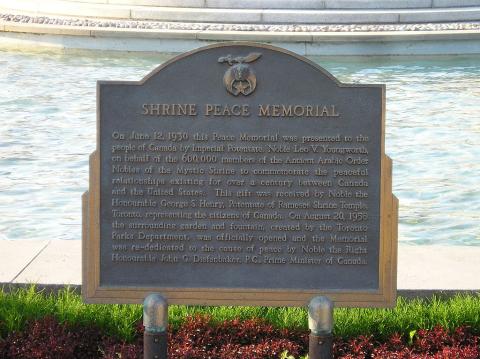
SHRINE PEACE MEMORIAL
On June 12, 2930 this Peace Memorial was presented to the
people of Canada by Imperial Potentate, Nobel Leo V. Youngworth,
on behalf of the 600,000 members of the Acient Arabic Order
Nobles of the Mystic Shrine to commemorate the peaceful
relationships existing for ever a century between Canada
and the United States. This gift was received by Nobel the
Honourable George S. Hentry, Potentate of Ramese Shrine Temple,
Toronto, representing the citizens of Canada. On Auguts 20, 1958
the surrounding garden and fountain, created by the Toronto
Parks Department, was officially opened and the Memorial
was re-dedicated to the cause of peace by Noble the Right
Honourable John G. Diefenbaker, P.C., Prime Minister of Canada.
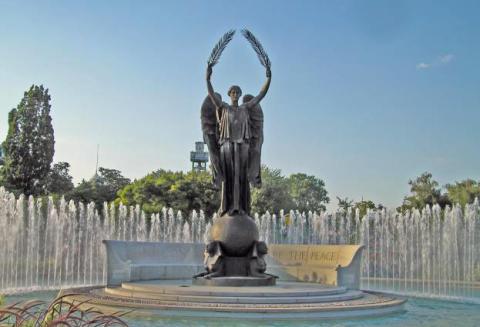
The Shrine Peace Memorial was designed by American sculptor Charles Keck. It features a bronze figure and a white granite semi-circular bench set on a stone base. The bronze figure depicts a winged angel, the Goddess of Peace, with her arms upraised and holding two olive branches (the symbol of peace). The angel stands on a globe supported by three female sphinxes. It was unveiled on June 12, 1930, during a convention of the Ancient Arabic Order of the Nobles of the Mystic Shrine (Shriners).
The sculpture commemorates over a century of peace between Canada and the United States and the location is thought to be where American troops landed during the War of 1812 for the Battle of York.
In 1931, floodlights were added to the memorial to represent the great sacrifices made by Canadians in the interest of peace.
The garden and fountain were officially opened on August 20, 1958, and the memorial was re-dedicated to the cause of peace by Canadian Prime Minister John Diefenbaker. It was again re-dedicated on July 4, 1989, during a Shriners convention.
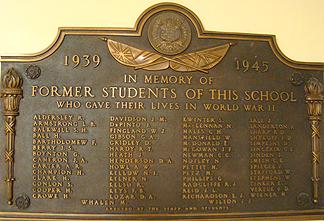
There is a WWII memorial plaque at Central Commerce Collegiate, Toronto. In 1892, two commercial classes taught in the basement of Harbord Collegiate Institute by R.H. Eldon. In 1902/1904 Commercial classes at Harbord, Jarvis and Parkdale Collegiates transferred to “Technical School” housed in the Toronto Athletic Club (Stewart Building). In 1911 March 16: High School of Commerce used the upper portion of King Edward School. In 1911 May 18: New school named High School of Commerce and Finance; to open Sept 1911: Principal R.H. Eldon. In 1914: School moved to Clinton Street Public School Annex. In 1916 Sept 5: (New) High School of Commerce formally opened. In 1925: Renamed Central High School of Commerce. In 1991 Sept: Name changed to Central Commerce Collegiate.