Ontario

Province Code
ON
City/Municipality
Borden
Memorial Number
35078-062
Type
Address
538 Cambrai Road
Location
Canadian Forces Military Police Academy, Canadian Forces Base Borden
in Canada
Yes
GPS Coordinates
44.2623874, -79.9012688
Inscription

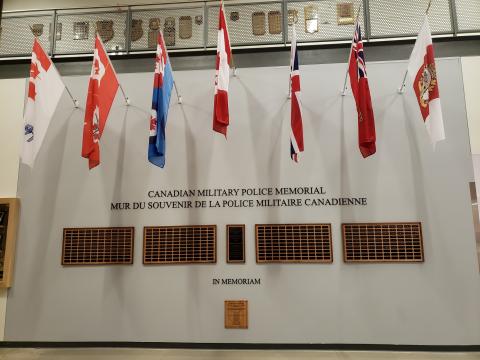
CANADIAN MILITARY POLICE MEMORIAL
MUR DU SOUVENIR DE LA POLICE MILITAIRE CANADIENNE

Image
Photo Credit
Sergeant Ian Beswick
Caption
Canadian Military Police Memorial
Province
!4v1669060061885!6m8!1m7!1sKmgtKvoIV6TpbgyxXckTFA!2m2!1d44.26238737473496!2d-79.90126875279185!3f21.643930604831304!4f-6.417472129992234!5f0.7820865974627469
Body Content

Canadian Military Police Memorial was unveiled on 17 June 2022 in honour and remembrance of all members of the Canadian Military Police throughout its long and distinguished history, who paid the ultimate price while wearing a uniform in the execution of their duties, both domestically and overseas.

Four oak panels hold the names of the fallen, with a copy of the Military Police Branch prayer placed in the middle. Above flies the Canadian Flag in the highest position. On the left of the National flag are the flags of the Royal Canadian Navy, Army and Royal Canadian Air Force to denote all three elements the Military Police have and continue to serve under. On the right side are the Union and Red Ensign flags to denote other flags the Military Police have served under. On the far right is the present Military Police flag.

City
Borden
Country
Type Description
Wall
Memorial CF Legacy ID
11138
City/Municipality
Phelps
Memorial Number
35078-061
Type
Address
9319 Highway 63
in Canada
Yes
GPS Coordinates
46.4019978, -79.2339938
Inscription

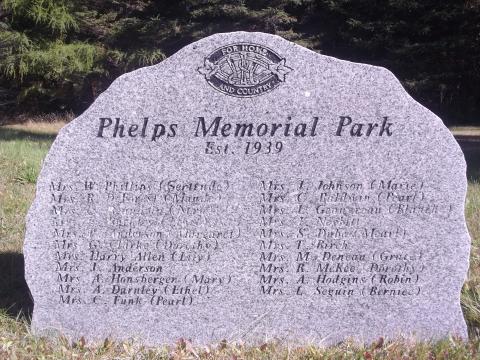
FOR HOME
AND COUNTRY

PHELPS MEMORIAL PARK
Est. 1939

  • Mrs. W. Phillips (Gertrude)
  • Mrs. R. DeForest (Maude)
  • Mrs. C. Beaudoin (Nora)
  • Mrs. E Buckley (Ethel)
  • Mrs. P. Anderson (Margaret)
  • Mrs. G. Clarke (Dorothy)
  • Mrs. Harry Allen (Lily)
  • Mrs. J. Anderson
  • Mrs. A. Honsberger (Mary)
  • Mrs. A. Darnley (Ethel)
  • Mrs. C. Funk (Pearl)
  • Mrs. J. Johnson (Marie)
  • Mrs. C. Baldwin (Pearl)
  • Mrs. L. Geauvreau (Blanch)
  • Mrs. J. Nesbitt
  • Mrs. S. Dube (Mearl)
  • Mrs. T. Birch
  • Mrs. M. Deneau (Grace)
  • Mrs. R. McKee (Dorothy)
  • Mrs. A. Hodgins (Robin)
  • Mrs. L. Seguin (Bernice)
Image
Photo Credit
Carol Langill
Caption
Memorial Park marker
1 of 4 images
Image
Photo Credit
Carol Langill
Caption
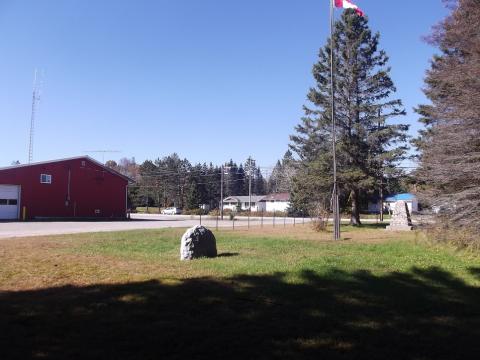
surroundings
1 of 4 images
Image
Photo Credit
Phelps Women's Institute Tweedsmuir History
Caption
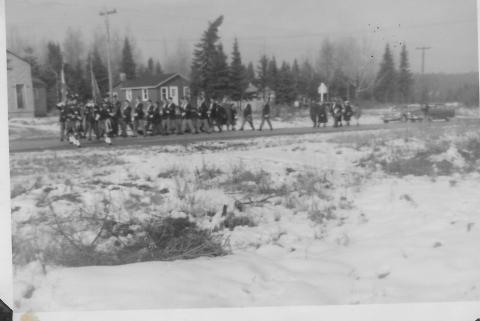
Veteran's Parade November 11, 1960.
1 of 4 images
Image
Photo Credit
Phelps Women's Institute Tweedsmuir History
Caption
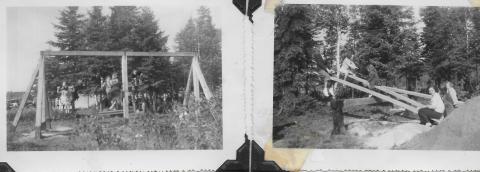
Newly built playground 1950.
1 of 4 images
Province
!4v1666375769357!6m8!1m7!1skx0xDPHmXUmEV9OlIQfCvA!2m2!1d46.40199776234243!2d-79.23399375186013!3f127.39767769244698!4f0.08782174736671777!5f1.0490539264145955
Body Content

In 1939, the Phelps Women’s Institute was formed. When the men and women of the township returned home in 1946, the Phelps Women’s Institute wanted to honour them. They decided to develop and maintain a community centre and public playground to commemorate the services of these men and women. They obtained a charter from Ontario Department of Municipal Affairs and seven trustees were elected from the branch's institute members. Early in 1947, a 6-acre parcel of land was purchased for $150. It was bordered on two sides by the North River and had a nice swimming hole. The third side had frontage on Highway 63.

Local residents cleaned the land. All labour was donated, and many “bees” were held. In 1947, sufficient land was cleared and levelled for a ball diamond and a back stop and games commenced. A local Athletic Association was organized, and ball games and hockey games were started with outside teams participating.

Picnics and school fairs were organized, and the park became a centre for all township activities. Swings and seesaws were built as a result of a generous donation by Rosamond Deneau who had been crippled by polio and confined to a wheelchair. In spite of that, she managed to raise enough money for this purpose.

In 1950 work on the erection of a hall was started. Before the hall was built all activities were held outside or in tents. Plans for the hall were drawn by a branch member. All labour, except for the man in charge who worked for $0.50 an hour, were given for free.

Around 1959, the Phelps Cenotaph was built to honour the Phelps War Dead and the many, many people who went to war to fight for our freedom and fortunately returned home. At this time, the park was renamed to Phelps Memorial Park to honour all Veterans, especially those who were killed in action.

City
Phelps
Country
Type Description
Park
Memorial CF Legacy ID
11063
City/Municipality
New Tecumseth (Alliston)
Memorial Number
35078-060
Type
Address
5116 Sir Frederick Banting Road
Location
Banting Heritage Park
in Canada
Yes
GPS Coordinates
44.1671365, -79.8461711
Inscription

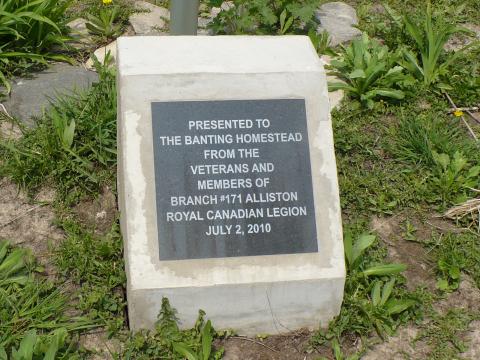
[dedication plaque/plaque commémorative]

PRESENTED TO
THE BANTING HOMESTEAD
FROM THE
VETERANS AND
MEMBERS OF
BRANCH #171 ALLISTON
ROYAL CANADIAN LEGION
JULY 2, 2010

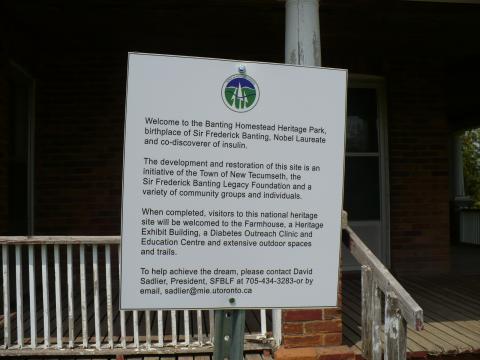
[plaque]

Welcome to the Banting Homestead Heritage Park,
birthplace of Sir Frederick Banting, Nobel Laureate
and co-discoverer of insulin.

The development and restoration of this site is an
initiative of the Town of New Tecumseth, the
Sir Frederick Banting Legacy Foundation and a
variety of community groups and individuals.

When completed, visitors to this national heritage
site will be welcomed to the Farmhouse, a Heritage
Exhibit Building, a Diabetes Outreach Clinic and
Education Centre and extensive outdoor spaces
and trails.

Image
Photo Credit
Tim Laye, Ontario War Memorials
Caption
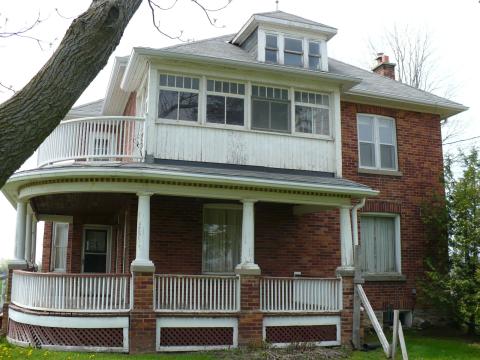
Banting Homestead
1 of 4 images
Image
Caption
dedication plaque
1 of 4 images
Image
Caption
plaque
1 of 4 images
Image
Caption
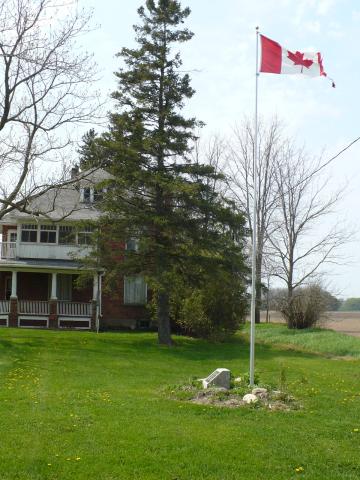
Banting Homestead
1 of 4 images
War or Conflict Term
Province
!4v1635951043490!6m8!1m7!1skp_X3Ep6T3wcHuZy15WepA!2m2!1d44.16713908832393!2d-79.84614406380602!3f261.0232235472769!4f-6.903794450195704!5f1.508516269641107
Body Content

In 1975, a cairn was erected on the Banting property to mark the birthplace of Sir Frederick Grant Banting. In 2008, the Town of New Tecumseth purchased the property and named it the Banting Heritage Park. The farmhouse officially opened to the public at the annual Banting Day/World Diabetes Day celebration held on November 10, 2012. A new Heritage Exhibit building was completed and officially opened on Banting Day, November 9, 2013. The park includes interior exhibits and a Banting Legacy exercise trail.

Banting also had an artistic career and the Banting Legacy Collection of artifacts including wood carvings, sketches, oil paintings and various memorabilia can be viewed in the historic Banting farmhouse.

Frederick Grant Banting was born on November 14, 1891, in Alliston, Ontario. He was the youngest of five children of William Thompson Banting and Margaret Grant. He began his studies at the University of Toronto intending to enter the ministry, but instead switched to medicine and received his M.B. in 1916 accelerated because of the war. After graduating, he joined the Royal Canadian Army Medical Corps and served as a medical officer during the First World War. In August of 1918, he was wounded at the Battle of Cambrai and in September took over treatment of his own forearm wound to avoid its amputation. In 1919, he was awarded the Military Cross for heroism under fire, attending to wounded soldiers even while he himself was wounded.

After the war, he was Resident Surgeon at the Hospital for Sick Children, Toronto. From 1920 until 1921, he taught orthopaedics part-time at the University of Western Ontario, besides his general practice, and from 1921 until 1922 he was a Lecturer in Pharmacology at the University of Toronto. In 1922, he was awarded his M.D. degree, along with a gold medal.

Earlier, Banting had become interested in diabetes and determined to investigate it, Banting discussed it with various people. J.J.R. Macleod, Professor of Physiology at the University of Toronto, gave him facilities for the experimental work. Dr. Charles Best, a medical student at the time, was appointed as Banting’s assistant. Together, they started the work which led to the discovery of insulin.

In 1922, Banting was appointed Senior Demonstrator in Medicine at the University of Toronto and in 1923, he was elected to the Banting and Best Chair of Medical Research. He was appointed Honorary Consulting Physician to the Toronto General Hospital, the Hospital for Sick Children, and the Toronto Western Hospital.

In addition to his medical degree, in 1923, Banting obtained the LL.D. degree (Queens) and the D.Sc. degree (Toronto). The same year, he shared the Nobel Prize in Physiology or Medicine for 1923 with Macleod. He received the Reeve Prize from the University of Toronto (1922). In 1923, the Canadian Parliament granted him a Life Annuity of $7,500. In 1928 Banting gave the Cameron Lecture in Edinburgh. He was appointed member of numerous medical academies and societies in his country and abroad, including the British and American Physiological Societies, and the American Pharmacological Society. He was knighted in 1934.

Banting married Marion Robertson in 1924 and they had one child, William in 19228. In 1932 they divorced and in 1937 Banting married Henrietta Ball.

Banting was head of the University of Toronto's Banting and Best Institute for Medical Research and following the Munich conference in 1938, Banting asked his staff to familiarize themselves with problems in the field of war aviation medicine. Major A. A. James of the Royal Canadian Army Medical Corps, persuaded the very busy Banting that a research program was needed because the aircraft of had exceeded the physical capabilities of the aircrews. Banting realized the ability to fly at high altitudes would give Allied crews a tactical advantage in war, started a fund-raising program, and brought his research team together with James to focus on the most urgent medical problems.

Banting's colleague at the University of Toronto, Wilbur Franks, was researching cancer before the war and heard James explain the fighter pilots were blacking out during high-speed manoeuvres. This research led to making the first anti-gravity suit for pilots.

Sir Frederick Banting died during the Second World War, while serving as a liaison officer between the British and North American medical services.  A plane crashed in a snowstorm near a frozen lake in Newfoundland. Two people on board died, Banting and the pilot, Joseph Mackey, suffered serious injuries. Mackey went for help, but Banting died before the pilot returned. Banting was on his way to England for British military support to continue development of the Franks Flying Suit. He was reportedly carrying a copy of the suit on the plane with him. 

City
New Tecumseth (Alliston)
Country
Type Description
Park, homestead
Photo Credit
Tim Laye, Ontario War Memorials
Memorial CF Legacy ID
10369
City/Municipality
CFB Borden
Memorial Number
35078-059
Type
Address
620 Ortona Road
Location
Canadian Forces Base Borden
in Canada
Yes
GPS Coordinates
44.26301, -79.90156
Inscription

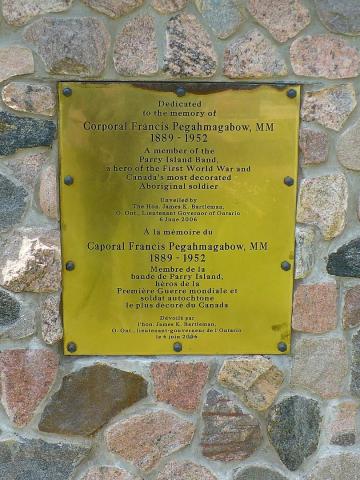
Dedicated
to the memory of
Corporal Francis Pegahmagabow, MM
1889 - 1952
A member of the
Parry Island Band,
a hero of the First World War and
Canada's most dedicated
Aboriginal Soldier

Unveiled by
The Hon. James K. Bartleman.
O. Ont., Lieutenant-Governor of Ontario
6 June 2006


À la mémoire du
Caporal Francis Pegahmagabow, MM
1889 - 1952
Membre de la
bande de Parry Island,
héros de la
Première Guerre mondiale et
soldat autochotone
le plus décoré du Canada's

Dévoilé par
l'hon. James K. Bartleman.
O. Ont., lieutenant-governeur de l'Ontario
le 6 juin 2006

Image
Caption
inscription
1 of 4 images
Image
Caption
surroundings
1 of 4 images
Image
Photo Credit
Tim Laye, Ontario War Memorials
Caption
Corporal Francis Pegahmagabow Memorial
1 of 4 images
Image
Photo Credit
Indigenous War Heroes Project
Caption
Corporal Francis Pegahmagabow
1 of 4 images
Province
!4v1669118817462!6m8!1m7!1sKmgtKvoIV6TpbgyxXckTFA!2m2!1d44.26238737473496!2d-79.90126875279185!3f4.455287457781811!4f3.617839887067987!5f0.7820865974627469
Body Content

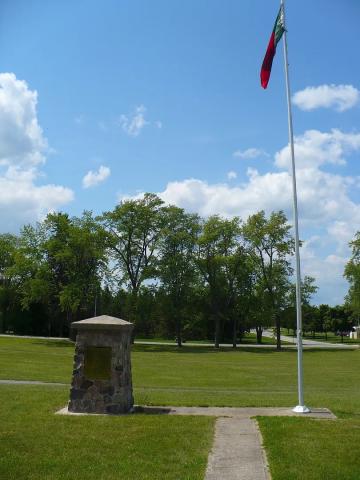
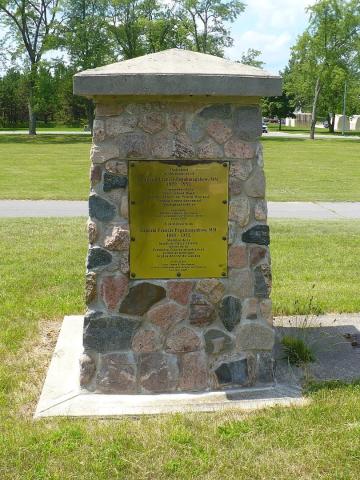
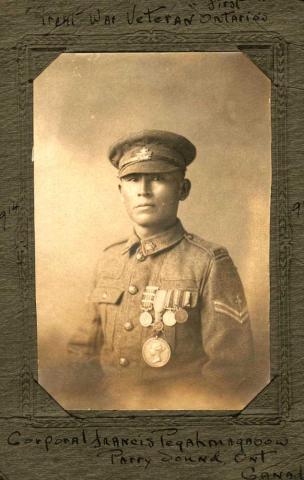
Corporal Francis Pegahmagabow, the Ojibwe soldier from Wasauksing First Nation, was not only one of the most effective snipers and scouts in the Canadian Expeditionary Force, but of the Indigenous peoples in the First World War, he is the most decorated. Recognized three times for bravery and devotion under fire in Belgium and France, he is one of only 38 Canadians to earn the Military Medal with two bars, each bar representing an act of valour.

Francis Pegahmagabow was born on March 9, 1889. His father, a member of Wasauksing First Nation on Parry Island, died of an illness when Pegahmagabow was just a baby. His mother also fell ill, so he was raised by his Shawanaga relatives. As a young man, he worked as a seaman on boats in Georgian Bay. At 21, he learned to read and write English, a rare skill of Pegahmagabow’s generation. He was among the first recruits in the First World War, signing up on August 13, 1914, despite an early prohibition against the enlistment of Indigenous peoples.

Pegahmagabow served with the 23rd Northern Pioneers Regiment, based in Parry Sound, which amalgamated into the 1st Battalion of the Canadian Expeditionary Force. He fought on the Western Front during all four years of the Great War, attaining the rank of Corporal on November 1, 1917. Nicknamed “Peggy” by his Army buddies, he soon proved that his courage and abilities were second to none. In 1916, he was one of the first Canadians to be awarded the Military Medal. He received the first of his three commendations for facing enemy fire repeatedly while carrying vital messages along the lines during the battles at Ypres, Festubert and Givenchy.

A spiritual man, Pegahmagabow carried an Ojibwe medicine pouch which he believed would help keep him safe. He faced constant danger, including being present at the Second Battle of Ypres, where the German Army first used chlorine gas as a weapon. Dr. McInnes said after the war, his great-grandfather developed breathing issues which became so severe he eventually had to sit up to sleep.

Wounded in the leg while fighting in France in September 1916, he returned to action in time to take part in the bloody assault on Passchendaele. During a battle so intense the Allies lost some 16,000 men, he earned his first bar to his Military Medal. His commendation reads:

“At Passchendaele Nov. 6th/7th, 1917, this NCO [non-commissioned officer] did excellent work. Before and after the attack he kept in touch with the flanks, advising the units he had seen, this information proving the success of the attack and saving valuable time in consolidating. He also guided the relief to its proper place after it had become mixed up.”

Following his actions during the Battle of Scarpe in August 1918, Pegahmagabow received his second bar. This commendation reveals again his courage under fire:

“During the operations of August 30, 1918, at Orix Trench, near Upton Wood, when his company were almost out of ammunition and in danger of being surrounded, this NCO went over the top under heavy MG [machine gun] and rifle fire and brought back sufficient ammunition to enable the post to carry on and assist in repulsing heavy enemy counter-attacks.”

His record as a sniper is equally impressive. Although difficult to substantiate as he worked alone, the expert marksman is credited with 378 kills. His great-grandson, Dr. McInnes pointed out his great-grandfather never spoke of his record as a sniper to his family.

Pegahmagabow’s great-grandfather fought for the British in the War of 1812 and he hoped his willingness to serve in the First World War would help change perceptions about Indigenous peoples. Pegahmagabow made the point himself in a 1919 interview with the Toronto Evening Telegram, saying, “I went to war voluntarily just as quick as the white man.” Ending the war at the rank of corporal, the Veteran returned home in 1919 to a political landscape that was as restrictive for Indigenous peoples as it had been before the war.

Pegahamagabow, married Eva Nanibush Tronche, had eight children, became a political activist and served as councilor and band chief for Wasauksing First Nation. He was elected the Supreme Chief of the National Indian Government and was also a member of the National Indian Brotherhood, an early precurser to the current Assembly of First Nations.

In the mid-1920s, he re-enlisted in the Militia and served in “A” Company of the 23rd Northern Pioneers Non-Permanent Active Militia (NPAM). The decorated Veteran died in the community of Wasauksing on August 5, 1952 of a heart attack. He has been honoured by being entered into the Indian Hall of Fame, as well as having the 3rd Canadian Ranger Patrol Group’s headquarters at Canadian Forces Base Borden in Ontario renamed in his honour in 2006.

City
CFB Borden
Country
Type Description
Cairn
Memorial CF Legacy ID
10352
City/Municipality
Borden (CFB)
Memorial Number
35078-056
Type
Address
Ortona Road
Location
Canadian Forces Base Borden
in Canada
Yes
GPS Coordinates
44.2623055, -79.9012739
Inscription

needs further research/recherche incomplète

War or Conflict Term
Province
!4v1718383789921!6m8!1m7!1slJPC1ae2mdPC0UoJ0zFNTA!2m2!1d44.26230551785506!2d-79.90127387795118!3f14.859204968746553!4f-0.8879057094635954!5f0.7820865974627469
Body Content

This street commemorates those who fought at Ortona in the Second World War. The mediaeval town of Ortona, with its castle and stone buildings, was situated on a ledge overlooking the Adriatic Sea. Its steep, rubble-filled streets limited the use of tanks and artillery and thus made this an infantryman's struggle. During several days of vicious street fighting, the Canadians smashed their way through walls and buildings—"mouseholing" as they called it. This was Christmas 1943. Meanwhile, a subsidiary attack had been launched to the northwest and the Germans, in danger of being cut off, withdrew from Ortona. The city officially fell on December 28.

City
Borden (CFB)
Country
Type Description
Street
Memorial CF Legacy ID
10007
City/Municipality
Borden
Memorial Number
35078-055
Type
Address
118 Hangar Street
Location
Canadian Forces Base Borden
in Canada
Yes
GPS Coordinates
44.26834, -79.91305
Inscription

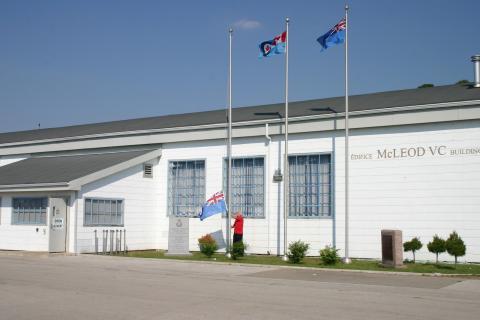
ÉDIFICE McLEOD VC BUILDING

Image
Caption
McLeod VC building
Province
!4v1669118817462!6m8!1m7!1sKmgtKvoIV6TpbgyxXckTFA!2m2!1d44.26238737473496!2d-79.90126875279185!3f4.455287457781811!4f3.617839887067987!5f0.7820865974627469
Body Content

The McLeod Hangar honours Lieutenant Alan McLeod, VC. The hanger dates from the Great War Flying Corps, 1917.

City
Borden
Country
Type Description
Building
Photo Credit
Tim Laye, Ontario War Memorials
Memorial CF Legacy ID
9951
City/Municipality
New Tecumseth (Alliston)
Memorial Number
35078-054
Type
Address
111 Dufferin Street South
Location
Royal Canadian Legion Branch 171
in Canada
Yes
GPS Coordinates
44.1500497, -79.8628628
Inscription

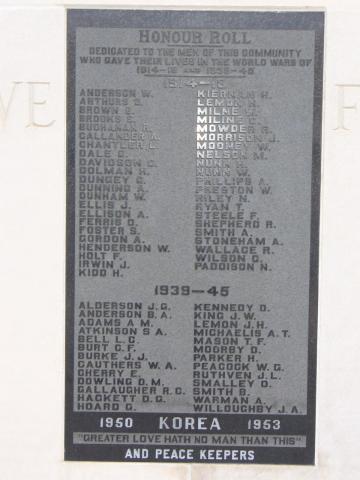
HONOUR ROLL

DEDICATED TO THE MEN OF THIS COMMUNITY WHO GAVE THEIR LIVES IN THE WORLD WARS 1914-18 1939-45

1914-18
Anderson W, Arthurs C, Brown B, Brooks S, Buchanan R, Callander A, Chantler L, Dale G, Davidson C, Dolman H, Dungey G, Dunning A, Dunham W, Ellis J, Ellison A, Ferris D, Foster S, Gordon A, Henderson W, Holt F, Irwin J, Kidd H, Kiernan H, Lemon H, Milne W, Miline G, Mowder R, Morrison J, Mooney W, Nelson M, Nunn H, Nunn W, Phillips A,
Preston W, Riley N, Ryan T, Steele F, Shepherd R, Smith A, Stoneham A, Wallace R, Wilson C, Paddison N

1939-45
Alderson J.G., Anderson B.A., Adams A.M., Atkinson S.A., Bell L.C., Burt C.F., Burke J.J., Cauthers W.A., Cherry E., Dowling D.M., Gallaugher R.C., Hackett D.G., Hoard G., Kennedy D., King J.W., Lemon J.H., Michaelis A.T., Mason T.F., Moorby D., Parker H., Peacock W.G., Ruthven J.L., Smalley D., Smith B., Warman A., Willoughby J.A.

1950 KOREA 1953

"GREATER LOVE HATH NO MAN THAN THIS"

AND PEACE KEEPERS

Image
Caption
surroundings
1 of 3 images
Image
Caption
Alliston Honour Roll
1 of 3 images
Image
Caption
inscription
1 of 3 images
Province
!4v1622649690514!6m8!1m7!1svmURjl5bATWW5ll-mdzuHQ!2m2!1d44.15004966730924!2d-79.86286279963905!3f61.35120854986883!4f-1.3027614189198289!5f2.8599753582850957
Body Content

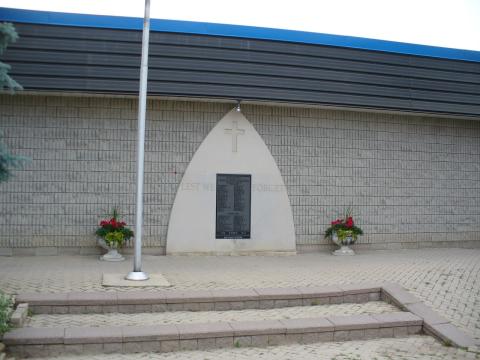
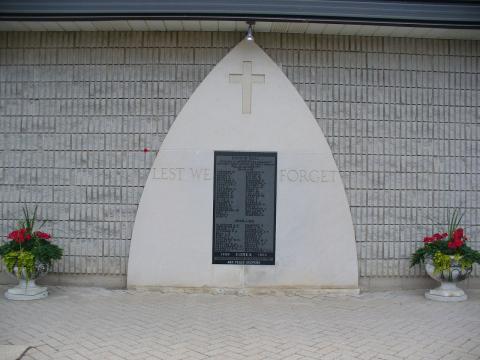
The honour roll was dedicated to the men of this community who gave their lives in the World Wars 1914-1918, 1939-1945.

City
New Tecumseth (Alliston)
Country
Type Description
Honour Roll
Photo Credit
Tim Laye, Ontario War Memorials
Memorial CF Legacy ID
9822
City/Municipality
New Tecumseth (Alliston)
Memorial Number
35078-053
Type
Address
17 Victoria St E
in Canada
Yes
GPS Coordinates
44.1540731, -79.8686819
Inscription

[front/devant]
MEMORIAL LIBRARY

[plaque]
MEMORIAL LIBRARY
ERECTED BY THE
WOMEN'S INSTITUTE OF ALLISTON
1923.

[plaque]
REBUILT
1981

Image
Photo Credit
Walter Guccino
Caption
Memorial Library
1 of 3 images
Image
Photo Credit
Walter Guccino
Caption
plaque
1 of 3 images
Image
Photo Credit
Walter Guccino
Caption
plaque
1 of 3 images
War or Conflict Term
Province
!4v1644422333346!6m8!1m7!1s3d-35YGg1GBprsPv-cPwIA!2m2!1d44.15407306774187!2d-79.8686819044468!3f164.686225115452!4f6.108816246488132!5f0.7820865974627469
Body Content

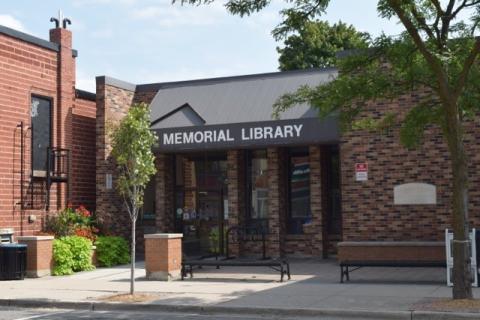
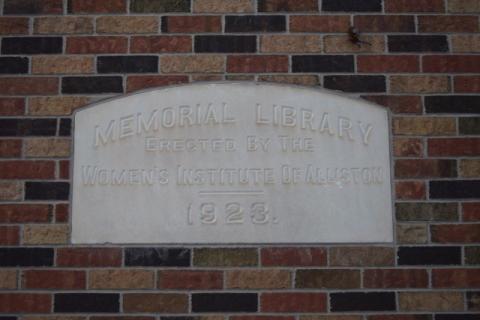
Following the First World War, members of the Alliston Branch of the Women’s Institute (WI) announced their interest in building a memorial library. The Alliston WI was constituted in June 1914 and had played a leading role in the local war effort through accomplishing what many within the community deemed impossible. Their resolve was often viewed by others as courageous.

In the fall of 1919, the WI opened a small library in temporary quarters on the second floor of a general store while reiterating their commitment to erect a permanent library building as a lasting memorial to Alliston’s fallen soldiers. As a show of support, a private citizen offered them a centrally located site at a reduced rate for the new building.

Despite a lack of municipal support, the women held steadfast in their belief that the town must remember the Alliston boys. Buoyed by their reputation of tenacity and driven by their continuing commitment to the boys, the women of the WI proceeded to fund-raise over the next three years.

During that time, the WI learned of a funding source available from Andrew Carnegie who was funding library construction throughout the United States and Canada. Grants from his foundation came with two provisos: building plans were to conform to designs approved by the Carnegie Foundation and any building erected under the grant program was to be known as a Carnegie Library. The WI members voiced serious concerns that the mandatory design would appear too grandiose and that any name without "memorial” defeated their original purpose. Despite their need for financial assistance, they announced that Alliston’s library was not to be a Carnegie Institute but a small building of chaste design, the outstanding feature of which would be a perpetuation of the memory of the boys of Alliston and District whose lives had been sacrificed overseas during the great war.

Alliston Memorial Library was officially opened at 17 Victoria Street East on February 14, 1924. As reported in the February 21 Alliston Herald, several hundred onlookers applauded as Alliston’s famous native son and First World War Veteran Dr. F.G. Banting inserted a golden key in the lock, turned the key, pulled open the door and announced that "it gives me very real pleasure to declare this memorial library open and ready for use. ”

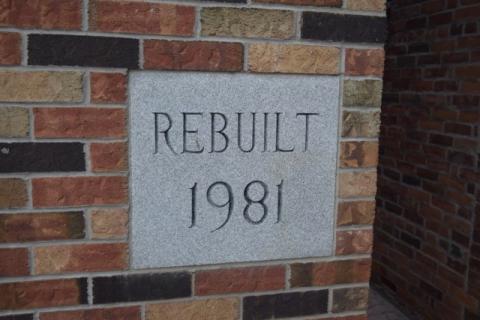
By the 1970s, the aging building was unable to adequately serve the growing population. In August 1978, the WI regretfully sold the library to the Town. Unsuitable for renovation, the original structure was demolished and a new and expanded library opened on site in 1982. Alliston Memorial Library continues to serve the public as a lasting memorial to the boys.

City
New Tecumseth (Alliston)
Country
Type Description
Building - library
Memorial CF Legacy ID
10761
City/Municipality
Angus
Memorial Number
35078-052
Type
Address
12 Commerce Road
in Canada
Yes
GPS Coordinates
44.3300477, -79.8895434
Inscription

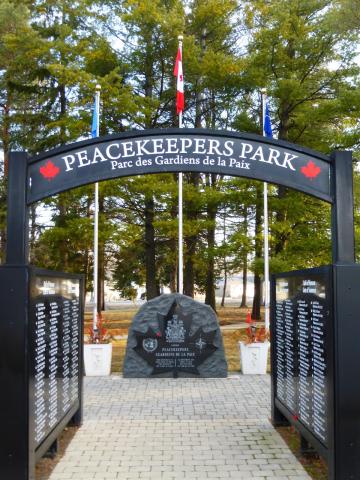
[arch/arche]
PEACEKEEPERS PARK
Parc des Gardiens de la Paix 

[stone/pierre]
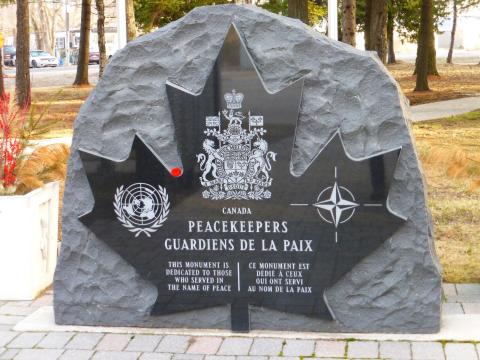
CANADA
PEACEKEEPERS
GUARDIENS DE LA PAIX

THIS MONUMENT IS
DEDICATED TO THOSE
WHO SERVED IN
THE NAME OF PEACE

CE MONUMENT EST
DEDIE A CEUX
QUI ONT SERVI
AU NOM DE LA PAIX

[plaque]
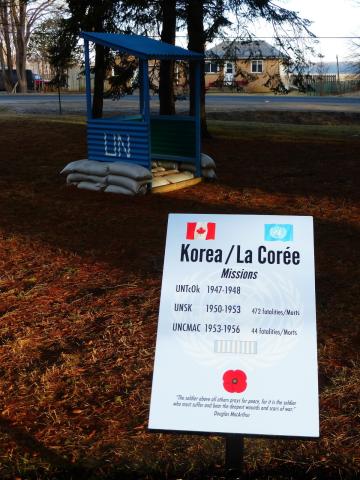
Korea/La Corée
Missions

UNTcOK  1947-1948  
UNSK 1950-1953 472 fatalities/Morts
UNCMAC 1953-1956 44 fatalities/Morts

"The soldier above all others prays for peace, for it is the soldier
who must suffer and bear the deepest wounds and scars of war."
Douglas MacArthur

Image
Caption
arch
1 of 5 images
Image
Caption
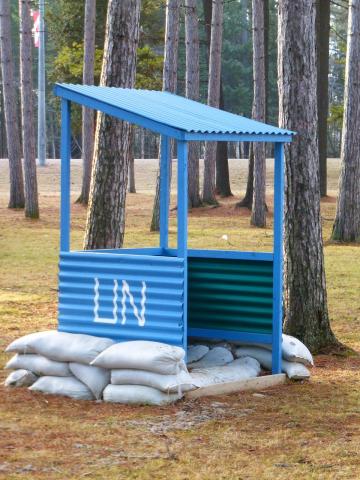
United Nations guard post
1 of 5 images
Image
Caption
Peacekeepers stone
1 of 5 images
Image
Caption
Korea missions plaque
1 of 5 images
Image
Caption
Peacekeepers Park entrance
1 of 5 images
War or Conflict Term
Province
!4v1703249061280!6m8!1m7!1sgL2ecexSidtMWrcJcjG9Gg!2m2!1d44.3300477101788!2d-79.88954339928792!3f93.54684006591302!4f-7.773697975275482!5f1.2198034663891222
Body Content

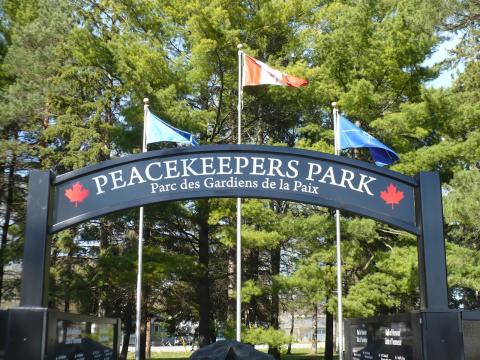
In 2008, this land was leased from the township by the Jerry Tremblay, CD, Central Ontario Chapter, Canadian Association of Veterans in United Nations Peacekeeping. A solid granite commemorative stone was imported from Pakistan and a maple leaf carved into its face in honour of all who served in peace. Peacekeepers Park is dedicated to the 160,000+ Canadians who have served on United Nations sanctioned missions since 1947.

The stone path was installed in 2016 and is lined with 18 mounted pedestals which detail the 59 United Nations missions since 1949. The first eight plaques describe peacekeeping and peacemaking missions, while the last 10 depict aid and observer missions. Also along the path are the Buffalo Nine Memorial and Bringing Their Faces Into The Light—walls mounted with renditions and short biographies of the faces of the fallen.

Included in the park are the Wall of Honour, Lynx reconnaissance vehicle (donated in part by Canadian Forces Base Borden), LAV III Monument, Korea missions plaque and a United Nations guard post.

City
Angus
Country
Type Description
Park
Photo Credit
Tim Laye, Ontario War Memorials
Memorial CF Legacy ID
9691
City/Municipality
Borden (CFB)
Memorial Number
35078-050
Type
Address
620 Ortona Road
Location
Inside the Canadian Forces Military Police Academy (building O-169), CFB Borden
in Canada
Yes
GPS Coordinates
44.26296, -79.90138
Inscription

[front/devant]

"MILITARY POLICEWOMAN" 1990

War or Conflict Term
Province
Body Content

This sculpture, “MILITARY POLICEWOMAN”, depicts a Canadian Military Policewoman with the uniform, weapons, and accoutrements c. 1990. The model chosen was Corporal L.M.M. Monette, a member of 2e Military Police Platoon, who was the first woman MP sent to a dangerous UN Peacekeeping mission: NAMIBIA, where assignments had been previously restricted to male MPs. The sculpture was unveiled in 1990, and is dedicated to current and past members of the Canadian Forces Military Police.

City
Borden (CFB)
Country
Type Description
sculpture - epoxy
Memorial CF Legacy ID
9251