Ontario

Province Code
ON
City/Municipality
Ottawa
Memorial Number
35059-263
Type
Address
355 Cooper Street
Location
Dominion-Chalmers United Church
in Canada
Yes
GPS Coordinates
45.4170283, -75.6950717
Inscription

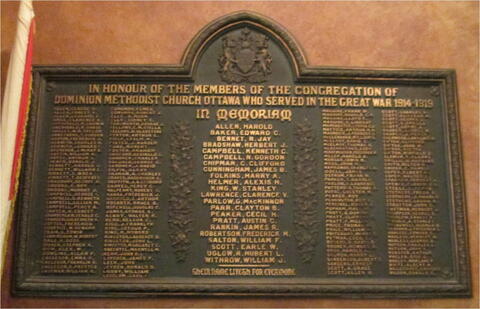
In honour of the members of the Congregation of

Dominion Methodist Church Ottawa who served in the Great War 1914 - 1919

Allen, Claude O.

Edmunds, Elmer

In Memoriam

Maguire, Frank W.

Scott, Charles M.

Allen, Ernest V.

Edmunds, Robert J.


Maguire, Harold C.P.

Scott, Clifford M.

Allen, Leonard E.

Ells, R. Hugh

Allen, Harold

Maguire, Lloyd E.

Scott, George D.

Ames, Clarence B.

Ells, Sidney C.

Baker, Edward C.

Maguire, S. Lindsay

Scott, G. Orville

Archibald, W. Godwin

Farnworth, George J.

Bennet, R. Jay

Manchester, Louisa S.A.

Scott, Lorne A.

Archibald, V. David

Fellows, E.M. Stella

Bradshaw, Herbert J.

Mattice, Arthur H.H.

Shaver, George M.

Arkley, W.H. Taylor

Fellows, H. Gladstone

Campbell, Kenneth C.

Maunder, J. Forrest C.

Shaver, J. Percy

Armstrong, T. Gordon

Fenton, Arthur E.

Campbell, N. Gordon

McClenahan, William S.

Sherwood, Lawrence H.

Ashton, Frederick G.

Field, Leslie H.

Chipman, C. Clifford

McElroy, David C.

Sifton, Clifford

Askwith, Charles H.

Fixter, J. Harold

Cunningham, James B.

McElroy, Thomas H.

Sifton, John W.

Askwith, Leonard F.

Ford, Robert

Folkins, Harry A.

McKerracher, Essie

Sifton, Victor

Atcheson, J. McKay B.

Foster, Graham

Helmer, Alexis H.

Merryweather,Frederick W

Sifton, Winfield B.

Austin, William N.

Gaisford, Reginald C.

King, W. Stanley

Miller, Harold A.

Sleman, T. Clarke

Bayes, Arthur S.

Gardner, Charles

Lawrence, Clarence V.

Morgan, Irwin M.

Smillie, H. Maynard

Beach, Donald J.

Gardner, George C.

Parlow, G. MacKinnon

Moss, John H.

Smith, Milton H.

Bennett, Harold O.

Gardner, J. David

Parr, Clayton B.

Narraway, Charles A.

Snider, E. Harold

Bennett, Willard E.

Gilpin, Harry

Peaker, Cecil H.

O Dell, James

Soper, Elbert N.

Birkett, E. Wren

Graham, A. Charles

Pratt, Austin C.

Ostrom, Frank H.

Soper, Walter E.

Birkett, T. Geoffrey

Graves, Hasbrouck C.

Rankin, James R.

Parker, T. Harold

Sparham, Herbert A.

Bradbury, George H.

Griffith, J.A. Leonard

Robertson, Frederick M.

Parlow, A. Laurence

Spence, Clarence D.

Brooks, C. Roy

Groves, Percy C.

Salton, William F.

Patterson, Thomas G.

Steele, E. Frank

Brooks, Murray J.

Halpenny, Robert B.

Scott, Earle W.

Payne, Chester H.

Stothers, Freda R.

Campbell, George I.

Hanna, Frederick J.

Uglow, R. Hubert L.

Peaker, Roy

Stothers, J. Harold

Campbell, G. Kenneth

Harrold, E. Arthur

Withrow, William J.

Pennington, Roy V.

Stothers, Laura R.

Campbell, Lillian M.

Hogarth, Bruce B.


Percival, Roger S.

Stratton, John S.

Campbell, Percy A.

Hopewell, Douglas C.

Their name liveth for

evermore

Popham, Hall H.

Swetman, Herbert J.

Carter, H. Ernest

James, George S.

Pratt, A. Osmond

Thompson, George O.

Chamberlain, Gerald C.

Kenny, Walter R.


Pratt, Clifford F.

Thurlow, Ernest R.

Chamberlain, Kenneth H.

Kerr, Nelson C.


Pratt, F. Millen

Tindale, A. Stanley

Cottee, Frederick

Kidd, J. Franklin


Price, Thomas H.

Treadwell, Norman H.

Courtice,, W. Howard

King, Arthur P.


Price, William H.

Vaughan, J. Frederick S

Crain, G. Edwin

King, R. Howard


Pritchard, McKay E.

Wanless, Edward C.

Cunningham, W. Robert

Kingston, Laurence B.


Putman, Cecil E.

Wanless, Herbert M.

Dale, H. Ross

Kingston, John L.


Rogers, G. Harold

Wanless, George A.

Disher, Stephen A.

Kingston, Margaret L.


Rooney, Howard B.

Watson, Charles E.

Dow, Alex. W.

Knechtel, Maxwell M.


Rose, Harold A.

Watson, John S.

Dowling, Allan P.

Kerr, John B.


Salmon, Harry L.

Webster, Arthur

Eagleson, Emma G.

Laycock, James P.


Sanderson, Albert E.

Whelen, Otis G.

Eagleson, Franklin B.

Leek, John


Sanders, Ernest

Whelen, Morland P.

Eagleson, S. Preston

Leyden, Donald B.


Scott, A. Grace

White, Albert H.

Eastman, William R.

Lilsby, William


Scott, Allen N.

Willoughby, Graydon


Laidlaw, Basil F.


Wilson, Donald D.

Image
Photo Credit
Richard Turcotte
Caption
plaque
1 of 4 images
Image
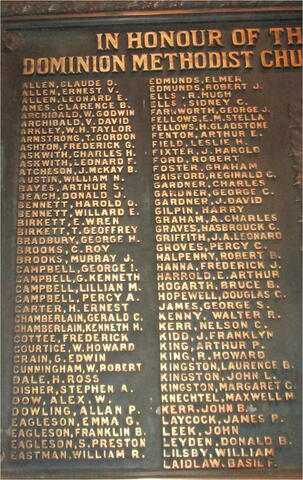
Photo Credit
Richard Turcotte
Caption
inscription columns 1 & 2
1 of 4 images
Image
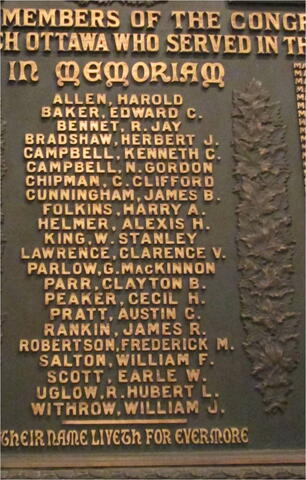
Photo Credit
Richard Turcotte
Caption
inscription column 3
1 of 4 images
Image
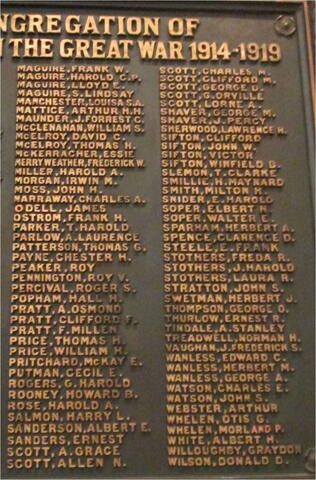
Photo Credit
Richard Turcotte
Caption
inscription columns 4 & 5
1 of 4 images
War or Conflict Term
Province
!4v1625863110942!6m8!1m7!1sHQSIRRSUu1SeOHLs0Ph0rg!2m2!1d45.41702834382596!2d-75.69507165545224!3f249.59!4f4.989999999999995!5f0.7820865974627469
Body Content

This memorial was unveiled in honour of the members of the Dominion Methodist Church who served in the First World War.

City
Ottawa
Country
Type Description
Plaque
Photo Credit
Richard Turcotte
Memorial CF Legacy ID
9526
City/Municipality
Ottawa
Memorial Number
35059-262
Type
Address
232 Rideau Place
Location
Eastern end of Rideau Street before it crosses the Rideau River
in Canada
Yes
GPS Coordinates
45.4337147, -75.6734103
Inscription

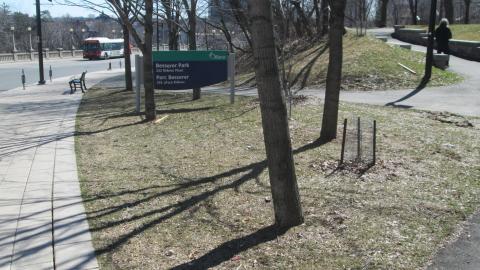
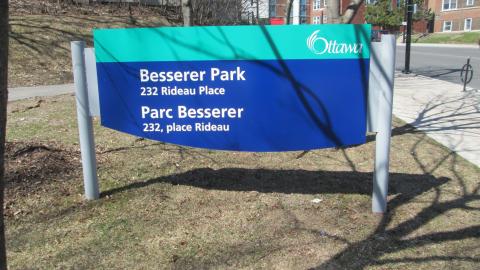
Besserer Park

232 Rideau Place

Parc Besserer

232, place Rideau

Image
Photo Credit
Richard Turcotte
Caption
sign
1 of 3 images
Image
Photo Credit
Richard Turcotte
Caption
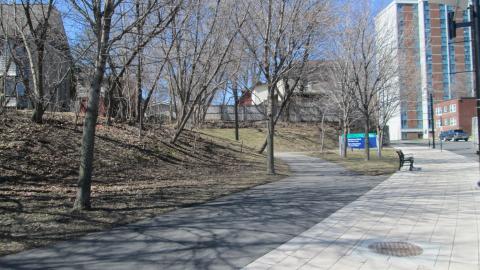
Besserer Park- Looking towards Rideau Street
1 of 3 images
Image
Photo Credit
Richard Turcotte
Caption
Besserer Park- Looking towards bridge over Rideau River
1 of 3 images
Province
!4v1625862861533!6m8!1m7!1sg95cs5EhP3y4sCD10CTEfQ!2m2!1d45.43371472744528!2d-75.67341027608724!3f190.03811208899464!4f8.462049331987245!5f1.5060118669434636
Body Content

Besserer Park is named in honour of Louis-Théodore Besserer, a veteran of the War of 1812.

Louis-Théodore Besserer was born in Château-Richer near Quebec City in January 1785. Following completion of classical studies, he became a notary and opened his own office in Quebec City. During the War of 1812, Besserer serveed first as a lieutenant in the Quebec City militia and later as a captain.

In 1845, he moved to Bytown/Ottawa where he became a succesful businessman, owning large tracts of land in the Sandy Hill area. Besserer dies in Ottawa on 03 February 1861.

City
Ottawa
Country
Type Description
Park
Photo Credit
Richard Turcotte
Memorial CF Legacy ID
9454
City/Municipality
Ottawa
Memorial Number
35059-261
Type
Address
229 Wellington Street
Location
Parliament Hill, Confederation Building
in Canada
Yes
GPS Coordinates
45.4216544, -75.7021384
Inscription

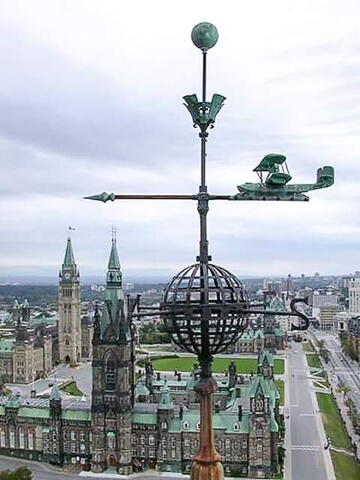
Vickers Vidette

North, South, East, West

Image
Photo Credit
Wings Magazine
Caption
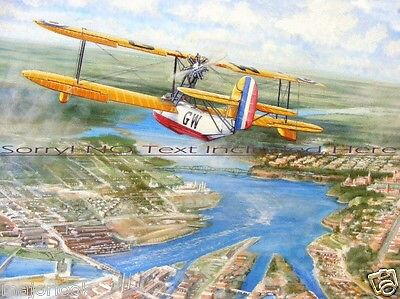
Vickers Vedette weathervane, Confederation Building 2009
1 of 2 images
Image
Photo Credit
Victoria Edwards
Caption
Vickers Vedette flying over Ottawa
1 of 2 images
War or Conflict Term
Province
!4v1625862460436!6m8!1m7!1s34yMyCUqt397XPvcftWY2A!2m2!1d45.42165437530992!2d-75.70213841279813!3f287.99757583332785!4f26.315025388964898!5f1.147033140187602
Body Content

In 1931, the Department of Public Works was searching for a distinctive weathervane to crown the Confederation Building's tallest tower. The Vickers Vedette was chosen when the designer saw the aircraft in a show.

The Royal Canadian Air Force gifted the Government of Canada 140 pound copper model of a Vickers Vedette flying boat with a wingspan and fuselage length of over five feet. Vickers Vedette flying boats were used in Canada for aerial mapping and surveying from 1920s-1930s.

The model was mounted over a globe at 265 feet above Wellington Street and used as a weathervane from 1931 until 2009, when it was removed for cleaning and restoration. It is currently in storage by Public Works and will be reinstalled when the building restoration project is complete.

With the development of aircraft during the First World War, provincial governments, forestry, shipping and hydroelectric companies all lobbied the federal government to use them to survey Canada’s interior. Using flying boats donated by the British and United States Navy, the Royal Canadian Air Force agreed to take on the mission. This provided training for the Canadian air force and detailed topographic maps to expedite planning and development of Canada's hydroelectric, mining and forestry. Five bases were created across Canada which carried out experimental aerial photography beginning in the early 1920s.

First World War flying boats were not designed to carry heavy cameras in their nose cockpits, and by 1924 they were unsuitable. The British Vickers company adapted its Viking for Canadian use, but it was underpowered and the amount of water its hull absorbed made it rot quickly. The Society of Forest Engineers and Royal Canadian Air Force designed the ideal aircraft for forest patrol and aerial surveying and Vickers built the aircraft at its Montreal plant. The flying boat was powered by a single 200-horsepower Wright J-4 Whirlwind engine, cockpits were enlarged and hulls strengthened for conditions in the bush. By 1930, there were 36 Vickers Vedettes for survey operations across Canada.

In the late 1920s, the Royal Canadian Air Force quickly expanded to 70 or 80 bases (most of them temporary) located across the country. These supported both aerial photography and forestry patrol activity. Setting up bases proved invaluable at the outset of the Second World War when the Royal Canadian Air Force quickly implemented the British Commonwealth Air Training Plan in the early 1940s.

City
Ottawa
Country
Type Description
Sculpture
Memorial CF Legacy ID
9443
City/Municipality
Ottawa
Memorial Number
35059-258
Type
Address
3500 Carling Avenue
Location
National Defence Headquarters
in Canada
Yes
GPS Coordinates
45.350537, -75.851606
Inscription

204 plaques that honour Canadian Forces members who died as well as Foreign Affairs official Glyn Berry, Calgary Herald journalist Michelle Lang, and Marc Cyr, a civilian from a company under contract to the Department of National Defence. Other plaques honour U.S. military personnel and a civilian member who died while serving under Canadian command. 

Image
Photo Credit
Victoria Edwards
Caption
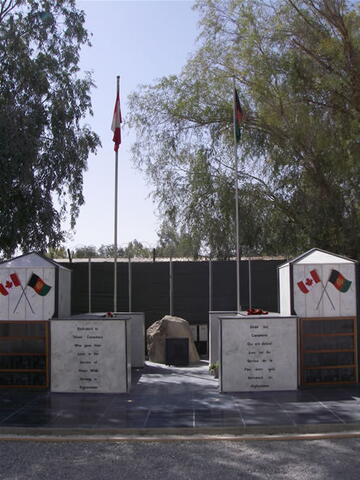
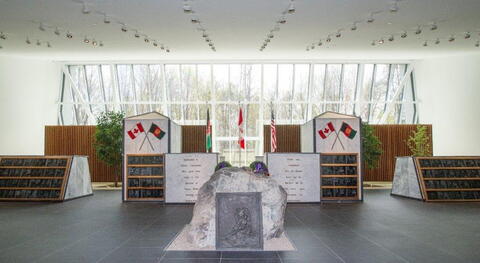
Kandahar Cenotaph
1 of 4 images
Image
Photo Credit
Sgt Norm McLean, Canadian Forces Combat Camera/Caméra de combat des Forces canadiennes
Caption
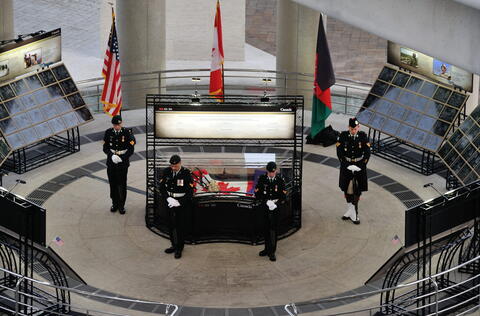
Canadian Embassy, Washington DC, May 22, 2014
1 of 4 images
Image
Photo Credit
Victoria Edwards
Caption
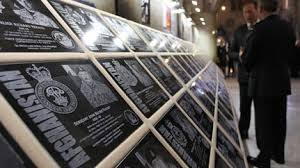
plaques
1 of 4 images
Image
Photo Credit
Department of National Defence
Caption
Afghanistan Memorial Hall
1 of 4 images
War or Conflict Term
Province
Body Content

The Kandahar Cenotaph rests within the Afghanistan Memorial Hall and consists of 204 plaques representing each of the 204 fallen. Originally, the plaques were part of the Kandahar Air Field Cenotaph, now called the Kandahar Cenotaph, – a memorial structure built in 2006 for soldiers, by soldiers, to commemorate their fallen comrades while deployed in Afghanistan. Canadian Forces personnel and Afghan employees added to the memorial over time. It is constructed of marble and slate, the plaques are etched with photographs of those who died, and it weighs about 225,000 kilograms.

On November 10, 2011, the Department of National Defence announced that the memorial would be brought home to Canada. The memorial travelled across Canada and the United States between May 3 and October 26, 2014. The memorial was refurbished in 2016 on the new site for the National Defence Headquarters in Ottawa's west end. The Afghanistan Memorial Hall, home of the Kandahar Cenotaph and Kabul Cenotaph was unveiled on May 13, 2019 and rededicated on August 17, 2019.

The Department of National Defence and the Canadian Armed Forces (CAF) held a dedication service at the new Afghanistan Memorial Hall at the National Defence Headquarters (Carling) on May 13, 2019. The event was attended by the Minister of National Defence, the Chief of the Defence Staff, the Deputy Minister of National Defence, General and Flag Officers, Chief Petty Officers and Chief Warrant Officers, and Assistant Deputy Ministers.

The focal point of the hall is the Kandahar Cenotaph battlefield memorial, built by deployed CAF members over the course of their mission to honour the military and civilian fallen who made the ultimate sacrifice during Canada’s long campaign in Afghanistan.

The hall and memorial are open to the general public, and the memorial is accessible to families of the fallen upon request.

Canada’s military engagement in Afghanistan came at a significant cost: 158 Canadian Armed Forces personnel, a Canadian diplomat, a DND contractor, a Canadian journalist who was embedded with the CAF, and 42 United States Armed Forces members, and 1 American civilian contractor who were under Canadian command were killed during our military engagement in Afghanistan. Thousands of others were injured in the line of duty.

A national memorial to commemorate the Afghanistan mission is being planned for Ottawa, to serve as a point of reflection for the Canadian public as a whole. 

City
Ottawa
Country
Type Description
Plaques
Memorial CF Legacy ID
9377
City/Municipality
Ottawa
Memorial Number
35059-257
Type
Address
Elgin and Wellington Streets
Location
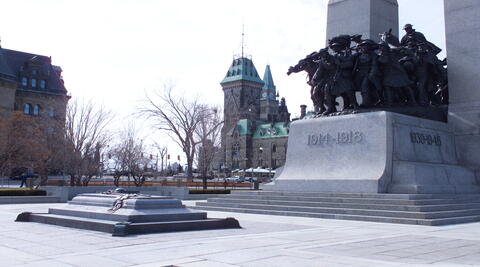
Confederation Square, next to the National War Memorial
in Canada
Yes
GPS Coordinates
45.4236321, -75.6948853
Inscription

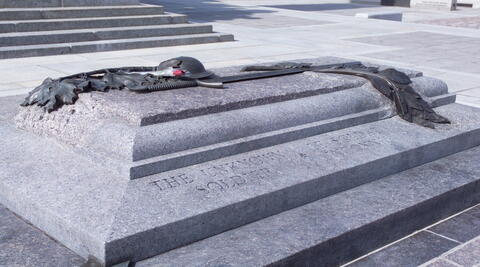
THE UNKNOWN
SOLDIER

LE SOLDAT
INCONNU

Image
Photo Credit
Veterans Affairs Canada/Anciens Combattants Canada
Caption
surroundings
1 of 6 images
Image
Photo Credit
Veterans Affairs Canada/Anciens Combattants Canada
Caption
inscription
1 of 6 images
Image
Photo Credit
Veterans Affairs Canada/Anciens Combattants Canada
Caption
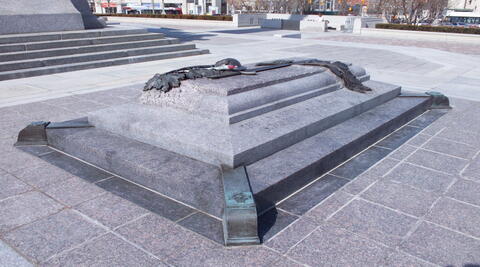
front
1 of 6 images
Image
Photo Credit
Veterans Affairs Canada/Anciens Combattants Canada
Caption
branches of maple and laurel leaves
1 of 6 images
Image
Photo Credit
Veterans Affairs Canada/Anciens Combattants Canada
Caption
sword
1 of 6 images
Image
Photo Credit
Veterans Affairs Canada/Anciens Combattants Canada
Caption
helmet
1 of 6 images
War or Conflict Term
Province
!4v1625859023347!6m8!1m7!1sY1o0JN3f-UkNq6qJ5SjsiQ!2m2!1d45.42363207631919!2d-75.69488531337707!3f309.9063753429084!4f1.2380349354248068!5f3.325193203789971
Body Content

On May 23, 2000, a Canadian Forces aircraft flew to France to bring the Unknown Soldier back to Canada. On board was a delegation consisting of a Canadian Forces contingent including a 45-person guard, a bearer party, and a chaplain. The Veterans Affairs contingent contained Veterans and civilians, including two representatives of Canadian youth.

The Commonwealth War Graves Commission, responsible for the care of graves and memorials of the Commonwealth forces members who died in the First and Second World Wars, selected an unidentified Canadian soldier from Cabaret Rouge British Cemetery in the vicinity of Vimy Ridge, the site of a famous Canadian battle of the First World War.

On May 25, at a ceremony at the Canadian National Vimy Memorial, the Commonwealth War Graves Commission turned over the remains to Canada. At that point the Canadian Forces took over responsibility for the safekeeping and transport of the soldier's remains. Immediately after the ceremony, the Canadian delegation returned to Ottawa with a casket containing the soldier's remains on board the aircraft.

On the evening of May 25, the casket carrying the remains of the Unknown Soldier was transported to Parliament Buildings, where it was placed in the Hall of Honour in the Centre Block. The remains lay in state there for three days, until the morning of May 28, so that Canadians could view the casket and pay their respects.

In the afternoon of May 28, the Unknown Soldier was transported from Parliament Hill to the National War Memorial on a horse-drawn gun carriage provided by the Royal Canadian Mounted Police. The funeral cortege included Their Excellencies, the Right Honourable Adrienne Clarkson, Governor General of Canada and John Ralston Saul, the Right Honourable Jean Chrétien, Prime Minister of Canada, Veterans, Canadian Forces personnel and members of the RCMP. In a ceremony which aired on national television, the Unknown Soldier was laid to rest in a specially-designed sarcophagus directly in front of the National War Memorial.

From that point on, the Tomb of the Unknown Soldier became a focal point of commemoration for all memorial events at the National War Memorial. It is a memorial in Canada for Canadians. The Tomb is a fitting way to honour the sacrifices on which our freedoms were built.

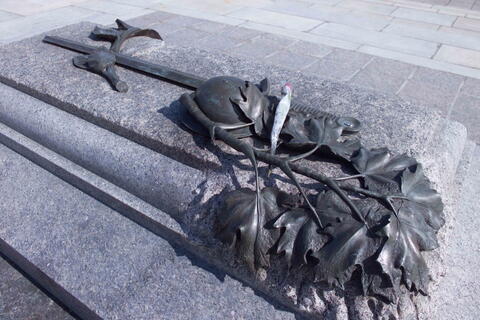
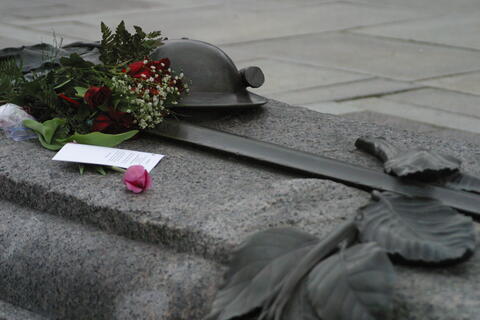
Located on the upper plaza of the National War Memorial, in front of the existing monument, the Tomb consists of a granite sarcophagus enclosing a casket containing the remains of the unknown soldier. A bronze relief sculpture is secured to the top with stainless steel pins. The four corner pieces of the sarcophagus also have bronze relief work.

The three-tiered sarcophagus is 12 feet long, 8 feet wide and 3 feet high. Dark Caledonia granite, quarried in Rivière à Pierre, Québec, was selected to complement the paler-coloured stone used in the National War Memorial. While it is patterned after the stone altar of the Canadian National Vimy Memorial, the severe Ottawa climate, as well as the bronze and stone makeup of the National War Memorial, led to the decision to produce the relief work in bronze.

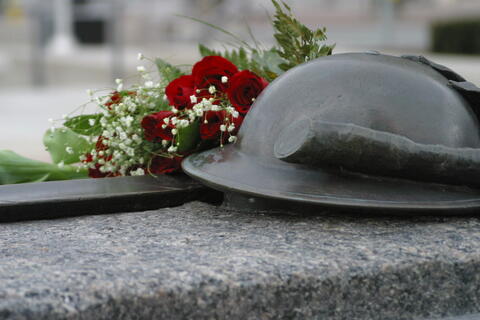
The bronze relief sculpture, cast in Roberts Creek, British Columbia, includes the key elements of the stone carving on the Canadian National Vimy Memorial altar; a medieval sword, a helmet of the type worn in the First World War, with branches of maple and laurel leaves. The laurel leaves symbolize both victory and death. Four bronze corner pieces containing symbolic mementos of mourning enhance the sculpture.

Three of the corner pieces are decorated with large replicas of the Memorial Cross. First instituted in 1919, the Cross is presented to the family of those who gave their lives while serving Canada in war or on peacekeeping missions. The three Crosses are slightly different; each has the Royal Cypher of one of the successive monarchs since its inception (George V, George VI, and Elizabeth II). On the fourth corner piece there is a replica of a poppy, representing those who may fall in future conflicts. The curved shape of the corner pieces echos the curve of the top of the National War Memorial.

The sculpture was created by Mary-Ann Liu, a well-known Canadian artist from Mission, British Columbia, who works with a variety of materials. A sculptor and designer for 15 years, her work has been exhibited as far away as Japan.

The design selected for the bronze relief was the unanimous choice of the selection committee. It was one of six submissions received from internationally renowned Canadian artists from across the country who were invited to submit their designs. The selection committee was comprised of representatives from Public Works and Government Services Canada, Veterans Affairs Canada, the Department of National Defence, the National Capital Commission, the Royal Canadian Legion, a former Dominion Sculptor, a sculpture restoration specialist and a design consultant.

City
Ottawa
Country
Type Description
Sarcophagus
Memorial CF Legacy ID
9367
City/Municipality
Ottawa
Memorial Number
35059-256
Type
Address
Sussex Drive and St. Patrick Street
in Canada
Yes
GPS Coordinates
45.4289232, -75.6962455
Inscription

[right side/côté droit]    

RECONCILIATION
RÉCONCILIATION

  • RECONCILIATION
  • "We need action not only
    to end the fighting but to make peace...
    My own government would be glad
    to recommend Canadian participation
    in such a United Nations force,
    a truly international peace and police force."

    Lester B. Pearson
    November 2, 1956.
  • RÉCONCILIATION
  • « Nous devons agir non seulement
    Afin de mettre fin à la guerre,
    Mais aussi pour rétablir la paix…
    Mon gouvernement serait heureux de
    recommander la participation canadienne
    à une force internationale des Nations Unies »

    Lester B. Pearson
    Le 2 novembre 1956

[left side/côté gauche]

  • IN THE SERVICE
    OF PEACE
  • AU SERVICE
    DE LA PAIX
  • Canadians have
    served in each
    of the missions
    inscribed on
    this wall.
  • Des Canadiens
    on particpé a
    chaque mission dont
    le nom est gravé sur
    ce mur.

(list of missions)

[corridor/couloir]

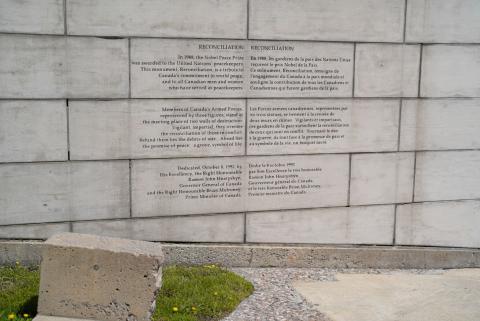
  • RECONCILIATION

    In 1988, the Nobel Peace Prize 
    was awarded to the United Nations' peacekeepers. 
    This monument, Reconciliation, is a tribute to 
    Canada's commitment to world peace,
    and to all Canadian men and women 
    who have served as peacekeepers.

    Members of Canada's Armed Forces, 
    represented by three figures, stand at 
    the meeting place of two wall of destruction.
    Vigilant, impartial, they oversee 
    the reconciliation of those in conflict.
    Behind them lies the debris of war. Ahead lies 
    the promise peace: a grove, symbol of life.

    Dedicated, October 8, 1992, by 
    His Excellency, the Right Honourable 
    Ramon John Hnatyshyn, 
    Governor General of Canada 
    and the Right Honourable Brian Mulroney, 
    Prime Minister of Canada.
  •  
  • RÉCONCILIATION

    En 1988, le gardiens de la paix des Nations Unies
    reçurent le prix Nobel de la paix.
    Ce monument, Réconciliation, témoigne de
    l’engagement du Canada à la paix mondiale et
    souligne la contribution de tous les Canadiens et
    Canadiennes qui furent gardiens de la paix.

    Les Forces armées canadiennes, représentées par
    les trois statues, se tiennent à la croisée de
    deux murs en ruines. Vigilants et impartiaux,
    ce gardiens de la paix surveillent la réconciliation
    de ceux qui sont en conflit. Tournant le dos
    à la guerre, ils font face à la promesse  de paix et
    au symbole de la vie, un bosquet sacré.

    Dédié le 8 octobre 1992
    par Son Excellence le très honorable
    Ramon John Hnatyshyn,
    Gouverneur général du Canada.
    et les très honorable Brian Mulroney,
    Premier ministre du Canada.
Image
Photo Credit
Veterans Affairs Canada
Caption
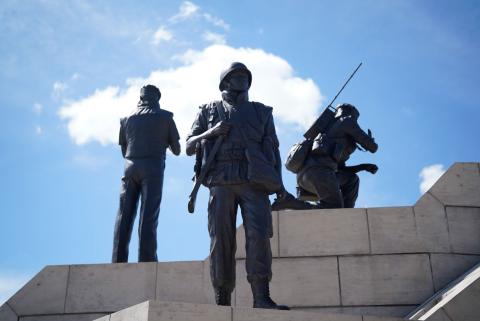
Statues - three uniformed figures in alert.
1 of 4 images
Image
Photo Credit
Veterans Affairs Canada
Caption
Statues - three uniformed figures in alert.
1 of 4 images
Image
Photo Credit
Veterans Affairs Canada
Caption
Reconciliation inscription.
1 of 4 images
Image
Caption
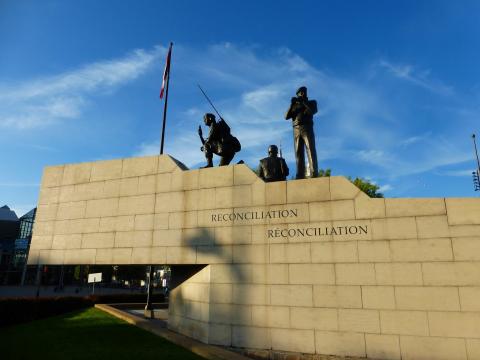
The Reconciliation
1 of 4 images
War or Conflict Term
Province
!4v1671547535134!6m8!1m7!1sAeyc7r3ePPCvCZNtqUoQHg!2m2!1d45.42856197386863!2d-75.69678613883671!3f3.111287221730011!4f6.085028910564475!5f1.9930530828918491
Body Content

The Peacekeeping Monument was a joint venture between the Department of National Defence and the National Capital Commission. In 1990, the Department of National Defence launched the Peacekeepers Monument competition, managed by a committee consisting of representatives from the Department of National Defence, National Capital Commission, and Public Works Canada. The winning submission was entitled The Reconciliation, though many people know it as the Peacekeeping monument. Reconciliation means that the warring sides have settled their differences peacefully and are ready to get along again.

Members of the winning design team from British Columbia were: Jack Kenneth Harman, sculptor; Richard G. Henriquez, architect and urban designer; and Cornelia H. Oberlander, landscape architect. The team also included Gabriel Design, lighting design, and J.L. Richards and Associates, engineering services, both of Ottawa. V.K. Mason Construction Ltd. built the monument. Their design includes a corridor of concrete and steel debris inside two solid granite walls. The corridor is best viewed from the south-east, where the eye is drawn into the narrow opening by a pattern of floor tiles that was modelled on the Green Line bisecting Nicosia, the capital of Cyprus. The tiles curve around chunks of sawn and drilled concrete littering the corridor floor. 

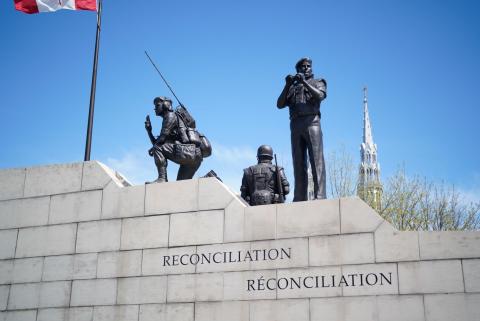
Artist Jack Harman, created a model out of wood and wax representing members of the Canadian Armed Forces. Harman depicted three uniformed figures in alert, active stances to stress that peacekeeping is dangerous. These three figures were later cast in bronze and stand on top of the walls. Two peacekeepers look into the distance, watching what the soldiers on each side are doing. The third peacekeeper crouches beside a Canadian flag, holding a radio to update headquarters with the situation and ensure people are safe.

Broken-up concrete below the walls represent the destruction caused by wars. The walls rise and form a point to symbolize pointing toward the future, when the war is over and there is peace again. Over to one side of the monument are 12 Oak trees in a circle. The number of trees represents the 10 provinces and two territories that comprised Canada when the monument was created in 1992. Oak trees represent the promise of peace; a grove, symbol of life. Adjacent to the trees is a semi-circular ceremonial space.

The Reconciliation was dedicated on 8 October 1992. This special monument commemorates Canada's role in international peacekeeping and the soldiers, both living and dead, who have participated or are currently participating in peacekeeping operations. Since 1947, Canadian peacekeepers have served overseas in a variety of United Nations peacekeeping and peace support missions. Canada played a leading role in the peacekeeping movement from the outset. Canadian Lester B. Pearson won the 1957 Nobel Peace Prize for his pioneering vision in helping establish a United Nations force during the Suez Crisis of the 1950s. Since then, Canada's commitment to international peace efforts and other overseas military actions has continued.

City
Ottawa
Country
Type Description
Monument
Memorial CF Legacy ID
9365
City/Municipality
Ottawa
Memorial Number
35059-255
Type
Address
111 Wellington Street
Location
Parliament Hill, Centre Block, Hall of Honour
in Canada
Yes
GPS Coordinates
45.4252655, -75.7000892
Inscription

[base]

ERECTED BY THE NURSES OF CANADA IN REMEMBRANCE OF THEIR SISTERS WHO GAVE THEIR LIVES IN THE GREAT WAR, NINETEEN FOURTEEN-EIGHTEEN, AND TO PERPETUATE A NOBLE TRADITION IN THE RELATIONS OF THE OLD WORLD AND THE NEW.

LED BY THE SPIRIT OF HUMANITY ACROSS THE SEAS WOMAN BY HER TENDER MINISTRATIONS TO THOSE IN NEED HAS GIVEN TO THE WORLD THE EXAMPLE OF AN HEROIC SERVICE EMBRACING THREE CENTURIES OF CANADIAN HISTORY.

[plaque 1]

ERECTED BY THE NURSES OF CANADA IN REMEMBRANCE OF THEIR SISTERS WHO GAVE THEIR LIVES IN THE GREAT WAR, NINETEEN FOURTEEN-EIGHTEEN, AND TO PERPETUATE A NOBLE TRADITION IN THE RELATIONS OF THE OLD WORLD AND THE NEW.

[plaque 2]

PLAQUE ÉRIGÉE PAR LES INFIRMIÈRES DU CANADA EN SOUVENIR DE LEURS SŒURS QUI ONT DONNÉ LEUR VIE AU COURS DE LA GRANDE GUERRE DE 1914-1918 ET POUR PERPÉTUER UNE NOBLE TRADITION DANS LES RELATIONS ENTRE L'ANCIEN MONDE ET LE NOUVEAU.

[plaque 3]

LED BY THE SPIRIT OF HUMANITY ACROSS THE SEAS WOMAN BY HER TENDER MINISTRATIONS TO THOSE IN NEED HAS GIVEN TO THE WORLD THE EXAMPLE OF AN HEROIC SERVICE EMBRACING THREE CENTURIES OF CANADIAN HISTORY.

[plaque 4]

GUIDÉE AU-DELÀ DES MERS PAR UN SENTIMENT D'HUMANITÉ, LA FEMME, PAR LES SOINS QU'ELLE A PRODIGUÉS À CEUX QUI ÉTAIENT DANS LE BESOIN, A DONNÉ AU MONDE L'EXEMPLE D'UN DÉVOUEMENT HÉROÏQUE EMBRASSANT TROIS SIÈCLES D'HISTOIRE CANADIENNE.

Image
Caption
Sculpture
War or Conflict Term
Province
!4v1714997230377!6m8!1m7!1sUt5kI0mb3Up8C53x7N03IA!2m2!1d45.42526551820731!2d-75.70008922459876!3f245.6546159723784!4f1.2380591314323794!5f0.7820865974627469
Body Content

In the years immediately following the Armistice of 1918, Canadian Nursing Association provincial affiliates pondered how best to remember their fallen sisters. Local nursing groups raised $32,000. The national memorial committee negotiated space in Centre Block, on Parliament Hill and commissioned designs. The advisory committee included Toronto architect Frank Darling (an assessors to the Canadian Battlefields. Memorials Commission), artists Lawren Harris and James Hervey MacDonald selected sculptor George William Hill, R.C.A., of Montreal.

Mr. Hill worked in Italy where he found a beautiful piece of marble from the Carara quarries. The completed panel was mounted in the Hall of Honour during the summer of 1926 and unveiled August 24, 1926.

Eight hundred nurses from across Canada had assembled in Ottawa that week, for the thirteenth general meeting of the Canadian Nurses' Association. In a preliminary ceremony on Parliament Hill, in front of the centre block,the President of the Association, Miss Jean Browne, presented the memorial to the acting Prime Minister, Sir Henry Drayton, who accepted it in the name of the people of Canada. Dame Maud McCarthy, the wartime Matron-in-Chief, British troops in France and Flanders, addressed the assembly. She was followed by Matron-in-Chief Margaret Macdonald, who read the roll of honour containing the names of thirty-nine matrons and nursing sisters of the Canadian Army Medical Corps Nursing Service and eight others who had been seconded to Queen Alexandra's Imperial Military Nursing Service Reserve, or who had service with the American Army Nurse Corps.

After the observance of two minutes of silence the Canadian nursing sisters and the invited guests on the platform moved indoors to the Hall of Honour, where Miss Macdonald unveiled the memorial panel. There followed the sounding of the last post. The poignantly familiar notes of the bugle echoing through the corridors of the Parliament building must have recalled to the silent sisters the passing not only of loved comrades in the nursing service but of many a soldier patient so seriously wounded that all the care they could give him had not been enough to save his life. The singing of the national anthem brought the moving ceremony to a close. -- from the "Report of the Unveiling Ceremony of the Memorial to the Canadian Nursing Sisters", The Canadian Nurse (October 1926).

In the Programme of the Unveiling Ceremony of the Canadian Nurses' Memorial, the artist interprets the sculptured panel:

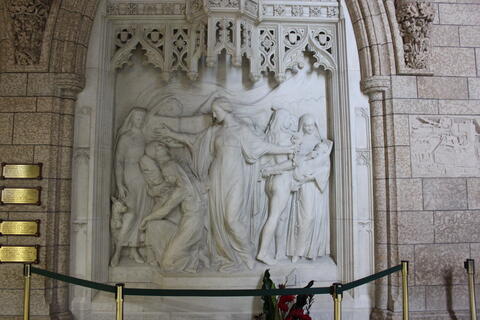
"The design for the sculptured panel embraces the history of the nurses of Canada from the earliest days to the First World War. The right-hand side of the bas-relief represents the contribution made by the religious sisters who came to Canada from France during l'ancien régime, and depicts a sister nursing a sick Indian child while an Iroquois warrior looks on suspiciously.

To the left a group of two nursing sisters in uniform tending a wounded soldier symbolizes the courage and self-sacrifice of the Canadian nurses who served in the war.

In the centre stands the draped figure of "Humanity" with outstretched arms. In her left hand she holds the caduceus, the emblem of healing; with the other hand she indicates the courage and devotion of nurses through the ages.

In the background, "History" holds the book of records containing the deeds of heroism and sacrifice of Canadian nurses through almost three centuries of faithful service."

For more information visit Parliament of Canada.


City
Ottawa
Country
Type Description
Sculpture
Memorial CF Legacy ID
9363
City/Municipality
Ottawa
Memorial Number
35059-254
Type
Address
154 Somerset Street West
Location
St John the Evangelist Anglican Church
in Canada
Yes
GPS Coordinates
45.4177277, -75.6903138
Image
Photo Credit
Victoria Edwards
Caption
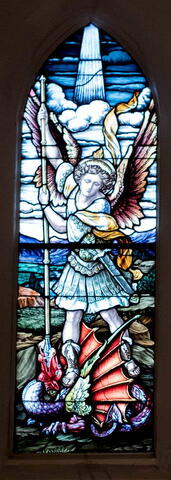
stained glass window
War or Conflict Term
Province
!4v1625857004894!6m8!1m7!1sMU65vzvRz2I352bbp99S9A!2m2!1d45.41772771310202!2d-75.69031382377244!3f71.98352469614896!4f8.114184847378211!5f1.4942891176956143
Body Content

St. George slaying the dragon from the Warriors' Chapel in St. John the Evangelist at Somerset and Elgin.

City
Ottawa
Country
Type Description
Stained glass window
Photo Credit
Victoria Edwards
Memorial CF Legacy ID
9343
City/Municipality
Ottawa
Memorial Number
35059-253
Type
Address
3924 Russell Road
Location
St. George's Cemetery, Hawthorne
in Canada
Yes
GPS Coordinates
45.3850915, -75.5956411
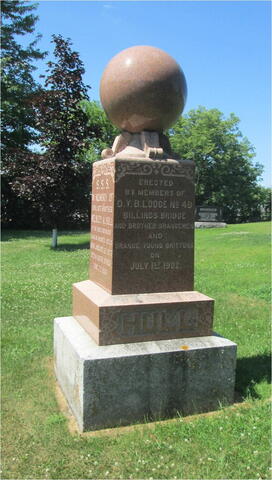
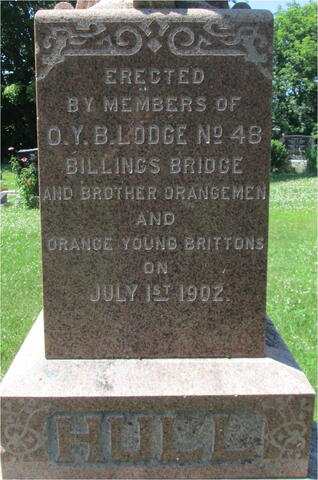
Inscription

[front/devant]

ERECTED
BY THE MEMBERS OF
O.Y.B. LODGE NO. 48
BILLINGS BRIDGE
AND BROTHER ORANGEMEN
AND
ORANGE YOUNG BRITTONS
ON
JULY 1ST 1902. HULL.

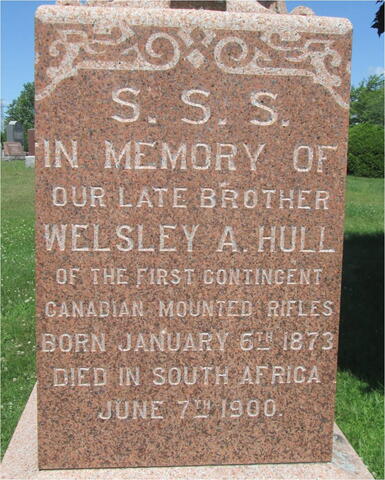
[left side/côté gauche]

S.S.S.
IN MEMORY OF
OUR LATE BROTHER
WELSLEY A. HULL
OF THE FIRST CONTINGENT
CANADIAN MOUNTED RIFLES
BORN JANUARY 6TH 1873
DIED SOUTH AFRICA JUNE 7TH 1900.

[right side/côté droit]

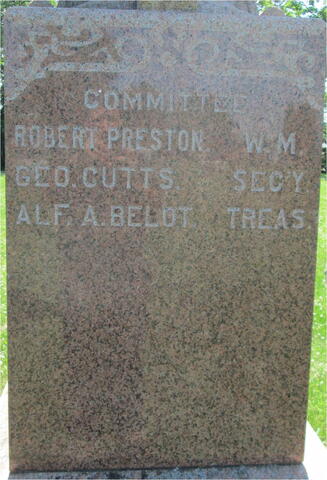
COMMITTEE
ROBERT PRESTON W.M.
GEO. CUTTS SEC'Y
ALF. A. BELOT TREAS.

Image
Photo Credit
Richard Turcotte
Caption
front
1 of 4 images
Image
Photo Credit
Richard Turcotte
Caption
front inscription
1 of 4 images
Image
Photo Credit
Richard Turcotte
Caption
left side
1 of 4 images
Image
Photo Credit
Richard Turcotte
Caption
right side
1 of 4 images
War or Conflict Term
Province
!4v1625856233366!6m8!1m7!1s_GtkS8Bqzdhc3bYu2lSeAQ!2m2!1d45.38509148067339!2d-75.59564106205484!3f221.97294174200437!4f4.654446654180916!5f1.1652553860105938
Body Content

This memorial was erected in memory of Private Wellesley Alexander Hull. It should be noted that Wellesley Alexander Hull's name is variously spelled "Wellesley", "Welsley" or "Wesley", in different documents.

Wellesley Alexander Hull was born in January 1873 and grew up in a prominent family of Billings Bridge, a small village that was located near the present-day intersection of Bank Street and Riverside Drive in Ottawa. As a young man, he joined the 43rd Rifles, a militia unit based in Ottawa. He later transferred to the Princess Louise Dragoon Guards. He deployed to South Africa, as part of the first contingent of the Canadian Mounted Rifles, arriving in Cape Town in February 1900. Hull took part in the Battalion's early operations, but fell ill and died on June 7, 1900. Wellesley Alexander Hull is buried at the Kroonstad Garden of Remembrance, next to the Kroonstad hospital on Du Toit Street, South Africa.

This memorial was originally located next to the Orangemen's Lodge at the intersection of Bank Street and Riverside Drive, in the then village of Billings Bridge. In 1960, it was removed to allow for the widening of Riverside Drive and was placed in storage until 1997. After numerous petitions from the Lodge members, the City of Ottawa rededicated the monument at St. George's Hawthorne Anglican Cemetery, as many Hull family members are interred there.

City
Ottawa
Country
Type Description
Shaft (or stone shaft)
Photo Credit
Richard Turcotte
Memorial CF Legacy ID
9336
City/Municipality
Ottawa
Memorial Number
35059-252
Type
Address
1 Vimy Place
Location
Temporary Exhibit gallery, Canadian War Museum
in Canada
Yes
GPS Coordinates
45.4164025, -75.7175424
Inscription

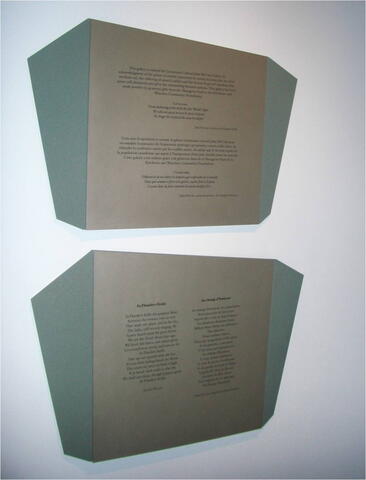
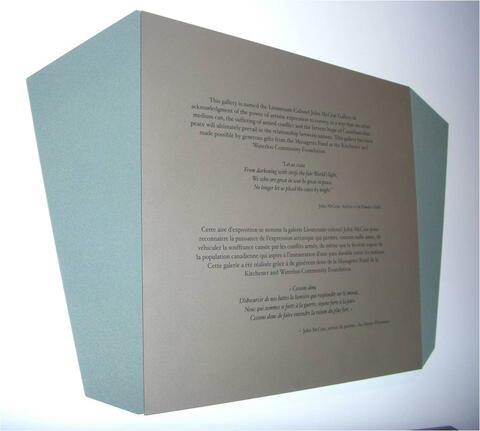
Top Plaque

This gallery is named the Lieutenant-Colonel John McCrae Gallery in acknowledgement of the power of artistic expression to convey, in a way that no other medium can, the suffering of armed conflict and the fervent hope of Canadians that peace will ultimately prevail in the relationship between nations. This gallery has been made possible by generous gifts from the Musagetes Fund at the Kitchener and Waterloo Community Foundation.

“ Let us cease
From darkening with strife the fair World’s light,
We who are great in war be great in peace.
No longer let us plead the cause of might.”

                                             John McCrae, Author of In Flanders Fields


Cette aire d’exposition se nomme la galerie Lieutenant-colonel-John-McCrae pour reconnaitre la puissance de l’expression artistique qui permet, comme nulle autre, de véhiculer la souffrance causée par les conflits armés de même que le fervent espoir de la population canadienne qui aspire à l’instauration d’une paix durable entre les nations. Cette galerie a été réalisée grâce à de généreux dons de la Musagetes Fund de la Kitchener and Waterloo Community Foundation.


« Cessons donc
D’obscurcir de nos luttes la lumière qui resplendit sur le monde,
Nous qui sommes si forts à la guerre, soyons forts à la paix.
Cessons donc de faire entendre la raison du plus fort. »

                                             - John McCrae, auteur du poème « Au champ d’honneur »

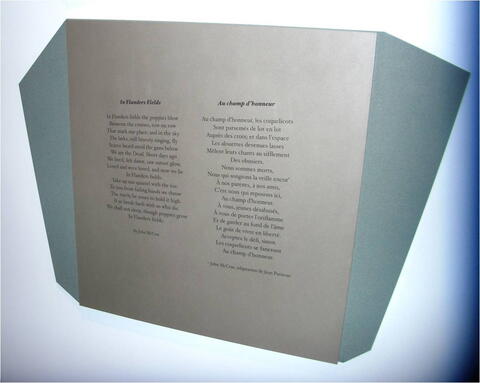
Bottom plaque

In Flanders fields the poppies blow
Between the crosses, row on row,
That mark our place; and in the sky
The larks, still bravely singing, fly
Scarce heard amid the guns below.
We are the Dead. Short days ago
We lived, felt dawn, saw the sunset glow,
Loved, and were loved, and now we lie
In Flanders fields.
Take up our quarrel with the foe:
To you from failing hands we throw
The torch, be yours to hold it high.
If ye break faith with us who die
We shall not sleep though poppies grow
In Flanders fields

                              By John McCrae


Au Champ d’Honneur

Au champ d’honneur, les coquelicots
Sont parsemés de lot en lot
Auprès des croix; et dans l’espace
Les allouettes devenues lasses
Mêlent leurs chants au sifflement
Des obusiers.
Nous sommes morts
Nous qui songions la veille encor’
À nos parents, à nos amis,
C’est nous qui reposons ici
Au champ d’honneur.
À vous jeunes désabusés
À vous de porter l’oriflamme
Et de garder au fond de l’âme
Le goût de vivre en liberté.
Acceptez le défi, sinon
Les coquelicots se faneront
Au champ d’honneur.

                              - John McCrae, adaptation de Jean Pariseau

Image
Photo Credit
Richard Turcotte
Caption
Plaques
1 of 3 images
Image
Photo Credit
Richard Turcotte
Caption
Close up top plaque
1 of 3 images
Image
Photo Credit
Richard Turcotte
Caption
Close up bottom plaque
1 of 3 images
War or Conflict Term
Province
!4v1625861022926!6m8!1m7!1scUTqE4s-d_Ngl4zDekdu-g!2m2!1d45.41640245341227!2d-75.71754237978423!3f10.84869135591623!4f2.688510098046038!5f0.7820865974627469
Body Content

This gallery is named in honour of Lieutenant-Colonel John McCrae, author of “In Flanders Fields”.

City
Ottawa
Country
Type Description
Gallery and plaques
Memorial CF Legacy ID
9331