Ontario

Province Code
ON
City/Municipality
Kingston
Memorial Number
35036-064
Type
Address
4 Passchendale Drive
Location
Royal Military College of Canada Museum
in Canada
Yes
GPS Coordinates
44.22775, -76.46967
Inscription

[front/devant]

"WINTER PATROL" 1975 ANDRE GAUTHIER

Image
Photo Credit
Victoria Edwards
Caption
Winter Patrol 1975 at RMC
Province
Body Content

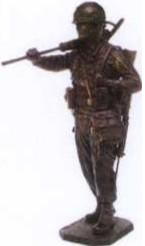
This sculpture, “WINTER PATROL”, depicts an infantryman in winter gear with his rifle at the ready as he is trudging through snow on snowshoes. The uniform, weapons, and accoutrements are circa 1975. This sculpture was unveiled in March 2013 by the Royal Military College of Canada, and is dedicated to current and past members of the Canadian infantry.

City
Kingston
Country
Type Description
Sculpture; epoxy
Memorial CF Legacy ID
9274
City/Municipality
Kingston
Memorial Number
35036-063
Type
Address
4 Passchendale Drive
Location
Royal Military College of Canada Museum
in Canada
Yes
GPS Coordinates
44.22775, -76.46967
Inscription

[front/devant]

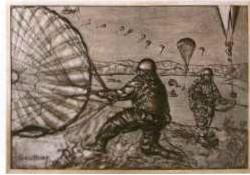
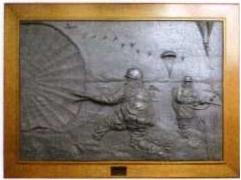
"PARA DROP" 1979 ANDRE GAUTHIER

Image
Photo Credit
Victoria Edwards
Caption
Para drop 1979 at RMC
1 of 2 images
Image
Caption
Para drop 1975 at RMC
1 of 2 images
Province
Body Content

This sculpture, “PARA DROP” depicts a Drop Zone in winter with a jumper collapsing his chute in the foreground, other jumpers at various stages of parachute descent, and a Hercules C-130 aircraft in the distant sky dropping another string of jumpers into the Drop Zone. It was unveiled in March 2013 and is dedicated to current and past paratroopers/members of the Canadian Airborne Regiment.

City
Kingston
Country
Type Description
Sculpture; epoxy
Memorial CF Legacy ID
9243
City/Municipality
Kingston
Memorial Number
35036-062
Type
Address
4 Passchendale Drive
Location
Royal Military College of Canada Museum
in Canada
Yes
GPS Coordinates
44.22775, -76.46967
Inscription

[front/devant]

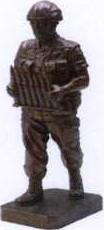
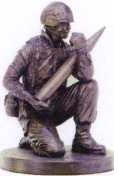
"AIR DEFENCE GUNNER" 1999 ANDRE GAUTHIER

Image
Photo Credit
Victoria Edwards
Caption
Air Defence Gunner 1999 at RMC
1 of 4 images
Image
Caption
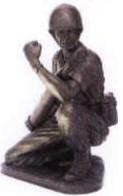
Kneeling Gunner 1997 at RMC
1 of 4 images
Image
Caption
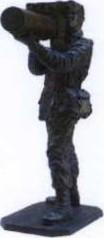
Blowpipe Gunner 1984 at RMC
1 of 4 images
Image
Caption
Kneeling gunner 1970 at RMC
1 of 4 images
Province
Body Content

This sculpture, “AIR DEFENCE GUNNER”, depicts an Air Defence Gunner holding a seven-round, 35mm ammunition clip he is about to load into the rack of the twin barrel Low Level Air Defence gun mount. This sculpture was unveiled in March 2013 by the Royal Military College of Canada, and is dedicated to current and past members of the Royal Canadian Artillery (Air Defence).

City
Kingston
Country
Type Description
Sculptures; epoxy
Memorial CF Legacy ID
9265
City/Municipality
Kingston
Memorial Number
35036-061
Type
Address
4 Passchendale Drive
Location
Royal Military College of Canada Museum
in Canada
Yes
GPS Coordinates
44.22775, -76.46967
Inscription

[front/devant]

"SAPPER" 1979 ANDRE GAUTHIER

Image
Photo Credit
Victoria Edwards
Caption
Sapper 1986 at Royal Military College
1 of 2 images
Image
Caption
Sapper 1981 at Royal Military College
1 of 2 images
Province
Body Content

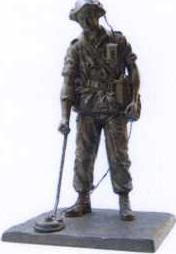
This sculpture, “SAPPER”, depicts a Combat Engineer Sapper with a mine detector. It was unveiled in March 2013, and is dedicated to current and past Combat Engineers.

City
Kingston
Country
Type Description
Sculpture; epoxy
Memorial CF Legacy ID
9245
City/Municipality
Kingston
Memorial Number
35036-060
Type
Address
4 Passchendale Drive
Location
Royal Military College of Canada Museum
in Canada
Yes
GPS Coordinates
44.22775, -76.46967
Inscription

[front/devant]

"VEHICLE MECHANIC" 1983 ANDRE GAUTHIER

Image
Province
Body Content

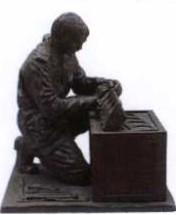
This sculpture, “VEHICLE MECHANIC”, depicts a Vehicle Mechanic cleaning a Jeep cylinder head before re-installing it on the Jeep’s engine. The model was a vehicle mechanic (Master Corporal) from the Electrical Mechanical Engineering (EME) workshop at Canadian Forces Base Winnipeg. This sculpture was unveiled in March 2013 by the Royal Military College of Canada, and is dedicated to current and past members of the Electrical Mechanical Engineering Branch.

City
Kingston
Country
Type Description
Sculpture; epoxy
Memorial CF Legacy ID
9266
City/Municipality
Kingston
Memorial Number
35036-059
Type
Address
15 Valour Drive
Location
Currie Hall, Royal Military College of Canada
in Canada
Yes
GPS Coordinates
44.23019, -76.46795
Inscription

[front/devant]

This window was erected in August, 1967 by surviving Ex-Cadets who participated in the Dieppe Raid in memory of others from the College who lost their lives as a result of the Raid.

Image
Photo Credit
Victoria Edwards
War or Conflict Term
Province
Body Content

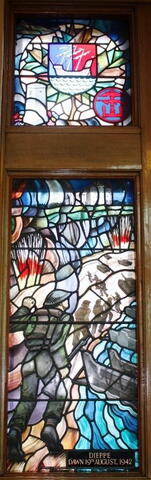
This stained glass window (on the passageway leading to Sir Arthur Currie Hall at the RMC), the Dieppe Window, is a memorial dedicated by Ex-cadets who participated in the Dieppe Raid in memory of others from the College who lost their lives as a result of the Raid. It was unveiled in 1967, the 15th anniversary of the graduation of the Class of 1952 and the 25th anniversary of Dieppe.

Following the Remembrance Service of 1967, this memorial stained glass window was unveiled by the Commandant, 2576 Commodore W. P. Hayes, CD. The Dieppe Window was presented to the College by 1620 Lt Col. Bob Labatt, DSO, ED, President of the RMC Club in 1953 – 1954, on behalf of the donors. The funds were raised by the survivors of the Dieppe Raid.

City
Kingston
Country
Type Description
Windows; stained glass
Memorial CF Legacy ID
9043
City/Municipality
Kingston
Memorial Number
35036-058
Type
Address
15 Valour Drive
Location
Currie Hall, Royal Military College of Canada
in Canada
Yes
GPS Coordinates
44.23019, -76.46795
Inscription

[front/devant]

This window was erected in August, 1967 in memory of Colonel E. Geoffrey Brooks DSO OBE CD

Image
Photo Credit
Victoria Edwards
War or Conflict Term
Province
Body Content

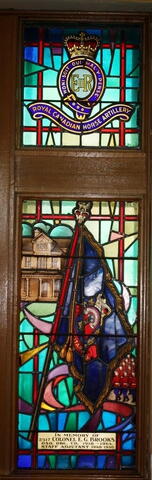
This stained glass window (on the passageway leading to Sir Arthur Currie Hall at the RMC), the Colonel E. G. Brooks Window, is a memorial to 2517 Colonel E. Geoffrey Brooks DSO, OBE, CD (RMC 1952). It was unveiled in 1967, the 15th anniversary of the graduation of the Class of 1952.

Following the Remembrance Service of 1967, this memorial stained glass window was unveiled by the Commandant, 2576 Commodore W. P. Hayes, CD. The Colonel E. G. Brooks Window was presented to the College by 2859 Dr. John Pike, a member of the New One Hundred, on behalf of the donors. The funds for the Brooks window came from the Class of 1952 (otherwise known as the New One Hundred). 2517 Colonel E. Geoffrey Brooks DSO, OBE, CD (1918 – 1964)(RMC 1952) was a gallant officer, stern but fair, decorated for leadership during the Second World War, and later in Korea. Brooks lived at Panet House while serving as RMC’s Staff Adjutant 1948 – 1950 and is still well remembered by those who knew him, especially from the first post-war Class. Brooks went from the RMC to Korea to command the “Guns” and for that was awarded his OBE. His appointment as Director of Artillery was for the Canadian Army.

City
Kingston
Country
Type Description
Windows; stained glass
Memorial CF Legacy ID
9042
City/Municipality
Kingston
Memorial Number
35036-057
Type
Address
Passchendaele Drive
Location
Royal Military College of Canada
in Canada
Yes
GPS Coordinates
44.22795, -76.46983
Inscription

[front/devant]

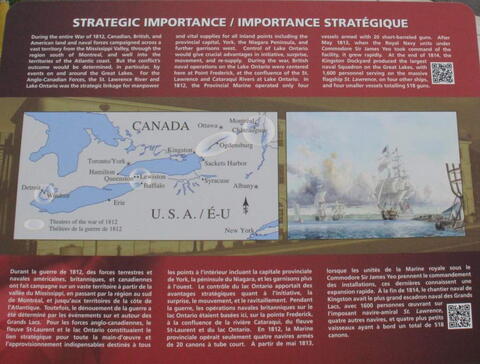
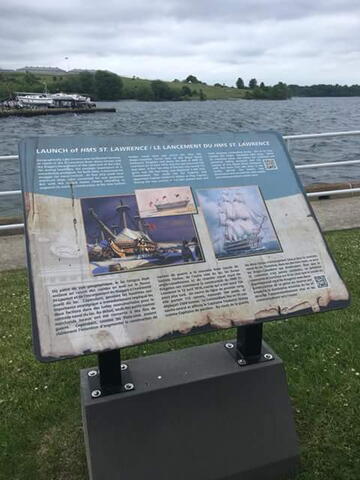
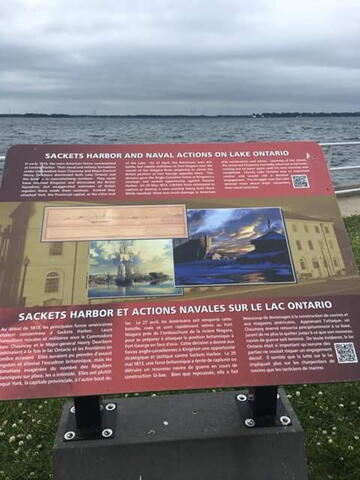
"Strategic importance: During the entire War of 1812, Canadian, British and American land and naval forces campaigned across a vast territory from the Mississippi Valley, through the region south of Montreal, and well into the territories of the Atlantic coast. But the conflict’s outcome would be determined, in particular, by events on and around the Great Lakes. For the Anglo-Canadian Forces, the St. Lawrence River and Lake Ontario was the strategic linkage for manpower and vital supplies for all inland points including the provincial capital, York, the Niagara Peninsula, and further garrisons west. Control of Lake Ontario would give crucial advantages in initiative, surprise, movement and re-supply. During the war, British naval operations on Lake Ontario were centered here at Point Frederick, at the confluence of the St. Lawrence and Cataraqui Rivers at Lake Ontario. In 1812, the Provincial Marine operated only four vessels armed with 20 short-barreled guns. After May 1813, when the Royal Navy units under Commodore Sir James Yeo took command of the facility, it grew rapidly. At the end of 1814, the Kingston Dockyard produced the largest naval Squadron on the Great Lakes, with 1,600 personnel serving on the massive flagship St. Lawrence, on four other ships, and four smaller vessels totaling 518 guns."

Image
1 of 3 images
Image
Caption
Launch of HMCS St Lawrence
1 of 3 images
Image
Caption
Sockets Harbour and Lake Ontario
1 of 3 images
Province
Body Content

These twelve illustrated story boards were erected by the Royal Military College of Canada Museum Committee (Marine Museum) on September 5, 2013. It is dedicated to the memory of the officers and seamen of the Royal Navy and Provincial Marine; and the officers and soldiers of the Royal Marines, Royal Newfoundland, Kings 8th, and 100th Regiments, who served on Lake Ontario in Defences of Canada in 1812 – 14.

In the latter part of the Eighteenth Century, the Provincial Marine established a shipbuilding facility on the Point Frederick, making it the first Canadian naval establishment in Canada, which might, therefore, be claimed as the birthplace of the Royal Canadian Navy.

City
Kingston
Country
Type Description
Storyboards
Memorial CF Legacy ID
9041
City/Municipality
Kingston
Memorial Number
35036-056
Type
Address
948 Johnson Street
Location
Queen's University, Richardson Stadium
in Canada
Yes
GPS Coordinates
44.2275366, -76.516005
Inscription

Richardson
Stadium

Image
Photo Credit
Queen's University
Caption
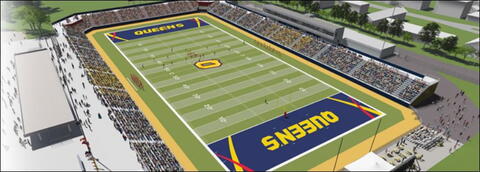
Rendering of Richardson Memorial Stadium 2016
1 of 4 images
Image
Photo Credit
Queen's University
Caption
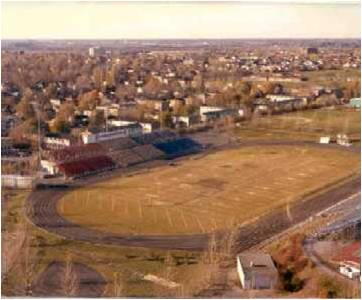
Richardson Memorial Stadium circa 1970's
1 of 4 images
Image
Photo Credit
Queen's University
Caption
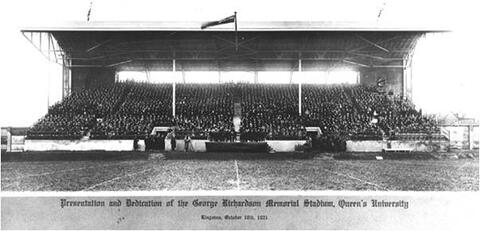
Dedication of Richardson Memorial Stadium Oct 1921
1 of 4 images
Image
Caption
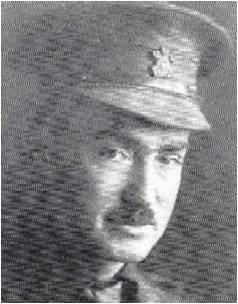
Captain George Richardson
1 of 4 images
Province
!4v1628175110406!6m8!1m7!1sCAoSLEFGMVFpcFBVblhQTlRva2xnTVEtR0FuUGpsVDlCQTJSbTlUZEZKb0ZSdi13!2m2!1d44.2275366!2d-76.51600499999999!3f12.59605050347402!4f5.629371212372945!5f0.4000000000000002"
Body Content

Richardson Stadium is named in honour of Captain George Taylor Richardson, student and athlete at Queen’s University and member of the 2nd Battalion, who was killed in action on February 9, 1916.

The original Richardson Stadium, known as George Taylor Richardson Memorial Stadium, was opened in 1921 on the site now occupied by Mackintosh-Corry Hall and Tindall Field, at the corner of Union Street West and University Avenue, on the Queen’s University main campus. The stadium included a football field and running track, as well as a grandstand accommodating 1,900 people and bleachers for an additional 1,500 fans. The stadium was dedicated in the presence of Mr. James Richardson, Queen's alumni and brother of Captain Richardson.

Shortly after its inauguration, the stadium played host to the 1922 Grey Cup which saw Queen’s defeat the Edmonton Elks 13-1.  In the late 60’s- early 70’s, Queen’s University acquired the West Campus lands (between Johnson and Union streets, and Sir John A. MacDonald Blvd) and built a new, larger stadium which opened in 1971. To perpetuate the memory of Captain Richardson’s selfless sacrifice, the university retained the name of the original stadium and named the new facility “Richardson Stadium”. In 2015, the stadium underwent an important renovation, but steadfast work allowed the facility to be ready for the 2016 football season.

George Taylor Richardson was born in 1886 in Kingston and after completing his early education, he entered Queen’s University, graduating in 1909. By then he had already joined the 14th Princess of Wales Own Regiment (1907) and was well known as an excellent athlete and hockey player. With his BSc in hand, he joined the family business and assumed increasing responsibilities.

On the outbreak of the First World War, he volunteered for service overseas and was assigned to the 2nd Canadian Infantry Battalion. After training at Valcartier and on Salisbury Plain, the battalion landed in France in February 1915, and then entered the trenches around Armentieres. Shortly thereafter it advanced to Ypres where it suffered losses amounting to “virtual annihilation.” Having already experienced the most intense conflict, Richardson, now a Captain, led a courageous but ultimately futile attempt to retake Saint-Julien before emerging as the sole surviving officer of No. 2 Company, of which he then assumed command.

Richardson was known as a man who would never give an order he would not readily obey himself, and often used his own money to buy extra supplies, such as warm boots, for his troops. On the night of February 8-9, 1916, having entered No Man’s Land near Wulverghem, Belgium to supervise the withdrawal of a raiding party, Richardson was shot through the hips and died shortly thereafter. He is buried in Bailleul, France, and was posthumously awarded the “Legion d’honneur Croix de Guerre” by the President of the French Republic in March, 1916.

City
Kingston
Country
Type Description
Building - stadium
Memorial CF Legacy ID
8934
City/Municipality
Kingston
Memorial Number
35036-055
Type
Address
87 Union Street
Location
Queen's University, John Deutsch University Centre
in Canada
Yes
GPS Coordinates
44.2278276, -76.4947879
Inscription

[perimeter of the room]

We must be free or die who speak the tongue that Shakespeare spake/The faith and morals hold which Milton held

[window/vitrail]

FREEDOM IS THE SURE
POSSESSION OF THESE ALONE
WHO HAVE COURAGE TO DEFEND IT.

Image
Photo Credit
Victoria Edwards
Caption
Student memorial union building window
1 of 3 images
Image
Photo Credit
Victoria Edwards
Caption
Memorial window
1 of 3 images
Image
Photo Credit
Queen's University
Caption
Memorial Room
1 of 3 images
War or Conflict Term
Province
!4v1628173578164!6m8!1m7!1sLxHRjIsSJ-F2YrusQoibzA!2m2!1d44.22782763309554!2d-76.49478793571083!3f341.24572500039466!4f9.84304184961617!5f1.5357967634026584"
Body Content

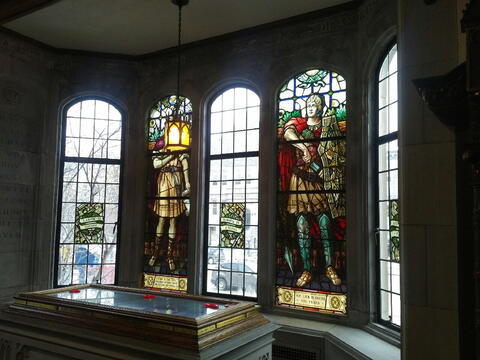
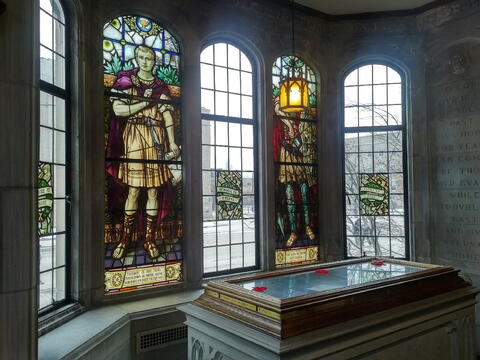
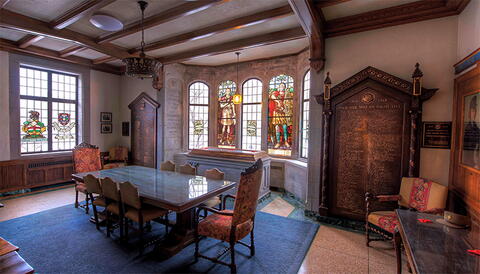
The Memorial Room commemorates the 351 Queen's students and alumni who died in the First and Second World Wars. It features two large bronze plaques inscribed with the names of those who died, a stone altar, stained glass windows, and seven oil paintings of men and women from each branch of the Canadian Forces, painted by Toronto artist Marion Long.

In 1929, Queen’s University inaugurated their student union building, naming it the “Students’ Memorial Union Building” as a war memorial to Queen’s university soldiers. The building was destroyed by fire in 1947, but reconstructed shortly afterwards on the same site. Following extensive renovations and expansions in the mid 1970’s, it was renamed for former Principal John Deutsch, a renaming that has been controversial among some alumni over the years. Nevertheless, the “memorial” function of the student union building was never lost, and was perpetuated over the years through the Memorial Room and Remembrance Room, within the John Deutsch University Centre. The Memorial Room is the original Union building Memorial Hall. Intended as a quiet room where the memory of the fallen would be preserved, it houses the brass scrolls of names of Queen’s university causalities from the armed forces during the First and Second World Wars, a stone altar, stained glass windows, and seven oil paintings of men and women from each branch of the Canadian Forces. The Remembrance Room houses photos of the 177 members of the Queen’s community who died in active service in the Second World War. The room also has a display case holding a Union Jack, and the flag of the Canadian Officers Training Corps, which was an important part of Queen’s life during the Second World War.

City
Kingston
Country
Type Description
Memorial room
Memorial CF Legacy ID
8933