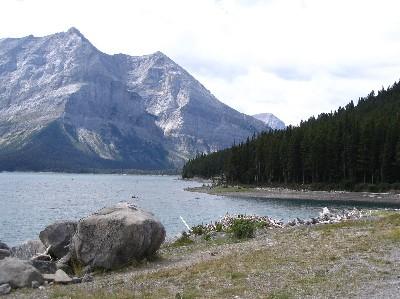
This mountain was named in 1920 in honour of the village of St. Julien. Canadian troops fought near this village in Belgium in 1915 during the First World War.
St. Julien Mountain
no inscription/aucune inscription
My VAC Account
My VAC Accountno inscription/aucune inscription
This mountain was named in 1920 in honour of the village of St. Julien. Canadian troops fought near this village in Belgium in 1915 during the First World War.
no inscription/aucune inscription
This mountain was named in 1917 in honour of HMS Turbulent. HMS Turbulent was a destroyer which was engaged in the Battle of Jutland during the First World War.
no inscription/aucune inscription
This mountain was named in 1920 in honour of a small village near Lens which was captured by Canadian troops in 1917 during the First World War.
no inscription/aucune inscription
This peak was named in 1979 in honour of General Dwight D. Eisenhower. Eisenhower was the Commander of Allied Forces in Europe during the latter stages of the Second World War.
no inscription/aucune inscription
This mountain was named in 1917 in honour of HMS Aurora. HMS Aurora was a Royal Navy light cruiser which engaged in a battle in the North Sea on 24 January 1915, during the First World War.
no inscription/aucune inscription
This peak was named in 1917 in honour of HMS Marvel. HMS Marvel was a destroyer involved in the Battle of Jutland during the First World War.
no inscription/aucune inscription
This mountain was named in 1918 in honour of General G. Leman. General Leman led the defence of Liege, Belgium during the First World War.
no inscription/aucune inscription
This mountain was named in 1918 in honour of Viscount Julian H.G. Byng. Byng served in the South African War and as a General in the First World War where he commanded the Canadian Corps. He served as Governor General from 1921 until 1926.
no inscription/aucune inscription
This mountain was named in 1918 in honour of General Arthur William Currie K.C.B. K.C.M.G. During the First World War, Gen. Sir Arthur Currie became the first Canadian commander of the Canadian Corps and later the Canadian Army in June 1917. Throughout his command, Currie successfully argued for the retention of the Canadians as a single coherent fighting force. The victory at Vimy Ridge was largely a result of his insistence on meticulous planning and thorough removal of barbed wire obstacles. Currie is said to have been a capable commander who enjoyed a consistently successful run of victories throughout the war. He was one of the few First World War generals who were determined to keep casualty rates as low as possible. Later he became principal of McGill University.
[plaque/plaque]
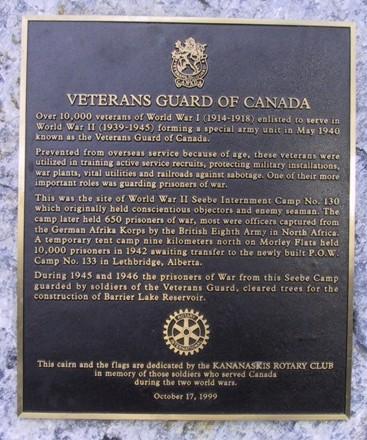
VETERANS GUARD OF CANADA
Over 10,000 veterans of World War I (1914-1918) enlisted to serve in
World War II (1939-1945) forming a special army unit in May 1940
known as the Veterans Guard of Canada.
Prevented from overseas service because of age, these veterans were
utilized in training active service recruits, protecting military installations,
war plants, vital utilities and railroads against sabotage. One of their more
important roles was guarding prisoners of war.
This was the site of World War II Seebe Internment Camp No. 130
which originally held conscientious objectors and enemy seaman. The
camp later held 650 prisoners of war, most were officers captured from
the German Afrika Korps by the British Eighth Army in North Africa.
A temporary tent camp nine kilometers north on Morley Flats held
10,000 prisoners in 1942 awaiting transfer to the newly built P.O.W.
Camp No. 133 in Lethbridge, Alberta.
During 1945 and 1946 the prisoners of War from this Seebe Camp
guarded by soldiers of the Veterans Guard, cleared trees for the
construction of Barrier Lake Reservoir.
This caird and the flags are dedicated by the KANANASKIS ROTARY CLUB
in memory of those soldiers who served Canada
during the two world wars
October 17, 1999
See plaque inscription.