
This plaque was dedicated on May 2, 2010, the 100th anniversary of the founding of the Canadian Navy, to honour those from Windsor and Essex County who served in the Navy.
Sign in to My VAC Account
Sign in to My VAC AccountNAVY
MARINE
100 1910 - 2010
ON THE 100TH ANNIVERSARY OF THE FOUNDING
OF THE CANADIAN NAVY THIS PLAQUE
IS DEDICATED TO THE MEN AND WOMEN FROM
WINDSOR AND ESSEX COUNTY WHO
VOLUNTEERED TO SERVE
PROVINCIAL MARINE
BOYS NAVAL BRIGADE
ROYAL CANADIAN NAVY
ROYAL CANADIAN NAVY RESERVE
WOMEN'S ROYAL CANADIAN NAVY VOLUNTEER RESERVE
CANADIAN MERCHANT NAVY
ROYAL CANADIAN SEA CADETS
CANADIAN FORCES MARITIME COMMAND
DEDICATED
AT THE BATTLE OF THE ATLANTIC MEMORIAL SERVICE
MAY 2, 2010
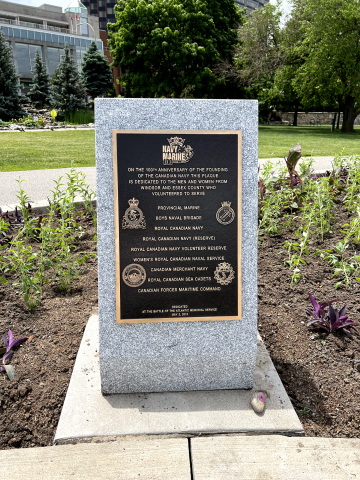
This plaque was dedicated on May 2, 2010, the 100th anniversary of the founding of the Canadian Navy, to honour those from Windsor and Essex County who served in the Navy.
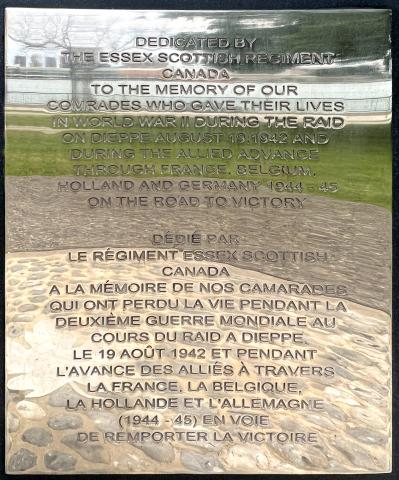
[front/devant]
DEDICATED BY
THE ESSEX SCOTTISH REGIMENT
CANADA
TO THE MEMORY OF OUR
COMRADES WHO GAVE THEIR LIVES
IN WORLD WAR II DURING THE RAID
ON DIEPPE AUGUST 19, 1942 AND
DURING THE ALLIED ADVANCE
THROUGH FRANCE, BELGIUM,
HOLLAND AND GERMANY 1944 - 45
ON THE ROAD TO VICTORY
DÉDIÉ PAR
LE RÉGIMENT ESSEX SCOTTISH
CANADA
À LA MÉMOIRE DE NOS CAMARADES
QUI ONT PERDU LA VIE PENDANT LA
DEUXIÈME GUERRE MONDIALE AU
COURS DU RAID A DIEPPE
LE 19 AOÛT 1942 ET PENDANT
L'AVANCE DES ALLIÉS À TRAVERS
LA FRANCE, LA BELGIQUE,
LA HOLLANDE ET L'ALLEMAGNE
(1944 - 45) EN VOIE
DE REMPORTER LA VICTOIRE
[back/arrière]
THE
ESSEX SCOTTISH
REGIMENT
10TH AUGUST 1942
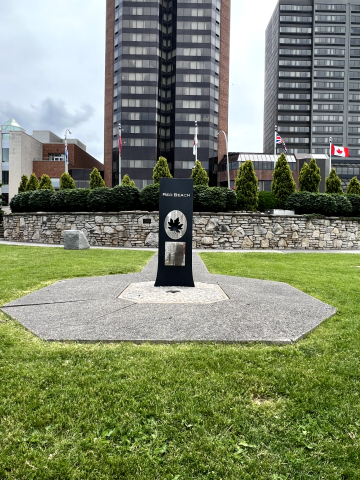
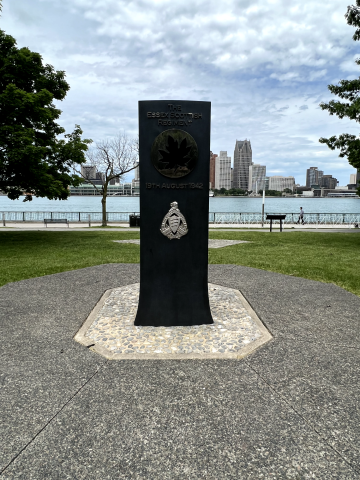
In 2006, members of the Windsor community raised money for a monument dedicated to reservists from the Windsor-based Essex and Kent Scottish Regiment who took part in the Raid on Dieppe. That monument was erected in Dieppe's Red Beach, France, where the regiment landed and dedicated on August 19, 2006. On January 4, 2010, City of Windsor officials approved construction of a duplicate monument to be built much closer to home in Dieppe Gardens.
The $60,000, 2.4-metre-high monument is made of black granite and features a cutout of a large maple leaf. It was designed and placed so that on August 19 at 1pm — the exact hour that the regiment stormed the beach — if the sun shines, it will cast a perfect shadow of that maple leaf on the stainless steel leaf installed on the ground below. Designer Rory O'Connor, a local art student, thought it would be great to use the sundial idea to tell about the time and retreat of these soldiers. The beach stones around this monument were collected from the beach at Dieppe.
The monument commemorates the Essex and Kent Scottish Regiment's sacrifices in Dieppe, but also those that made it throughout northwest Europe until final victory in 1945. The engineering, construction and fundraising was undertaken by the auspices of The Essex and Kent Scottish by Delta Company, the civilian affiliate of the Regiment.
THIS MEMORIAL DEDICATED IN
THE CENTENNIAL YEAR 1967
IN MEMORY OF
W.O.I. PIPE MAJOR
J. (JOCK) COPLAND M.B.E.
OF THE ESSEX AND KENT SCOTTISH
REGIMENT, 1ST BATTALION
BY THE
WARRANT OFFICER'S AND
CHIEF PETTY OFFICER'S ASSOCIATION
OF ESSEX COUNTY.
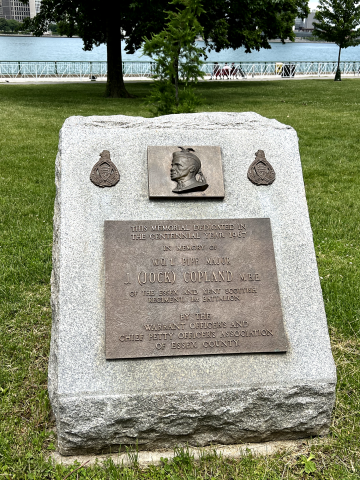
This memorial was dedicated in 1967 in memory of WO1 Pipe Major J. (Jock) Copland MBE of the Essex and Kent Scottish Regiment 1st Battalion. It was erected by the Warrant Officers and Chief Petty Officers Association of Essex County.
Born in Glasgow, Scotland, he was a piper with the Seaforth Highlanders and the Royal Engineers Territorial Force in Great Britain before coming to Galt, Ontario, in 1911. In Galt, he founded what became the Pipe Band of The Highland Light Infantry. In 1916, the 241st Canadian Scottish Borderers invited him to Windsor to form a pipe band and Copland went overseas with this unit. After the war, the band continued as the Border Cities Pipe Band. These Veteran pipers formed the core of the Essex Scottish Regiment pipe band when the Essex Fusiliers officially became a Highland Regiment in 1927.
Copland also instructed young pipers at the Walkerville High School Army Cadet Pipe Band, many followed him to Europe during the Second World War. Two of his sons, James and Robert, went with him as well. Jock was sixty when the war broke out in 1939, fifteen years too old to enlist. He had been with the Essex Scottish for over twenty years, had two sons in the band and served in the First World War. Determined to serve his regiment in this war as well, he lied about his age, claiming he was 45, so he would be accepted for service.
He became ill in Britain and was sent back to Windsor in January 1941. Jock, however, retained his ties with the Essex Scottish as Pipe Major for the reserve 2nd Battalion. After forty years of service with the Essex Scottish, he retired in December 1957. The regiment paid its final tribute to Jock with a parade on 7 March 1958. His son, Pipe Sergeant James Copland, succeeded his post, while his other son, Robert, served as the regiment's Drum Major.
Jock died at the age of 86 on 29 April 1966. His sons, James and Robert, retired from the pipe band the following year, closing the half century the Copland family had spent as pipers for the Essex and Kent Scottish. Serving more than 60 years with the military, he was awarded the Member of the Order of the British Empire and held the Efficiency Medal and bars for long service.
[right plaque/plaque de droite]
AS LONG AS WE LIVE
YOU WILL LIVE.
AS LONG AS WE LIVE
YOU WILL BE REMEMBERED.
AS LONG AS WE LIVE
YOU WILL BE LOVED.
THEY ARE NOT FORGOTTEN.
[centre stele/stèle du centre]
(list of names/liste de noms)
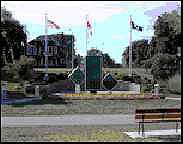
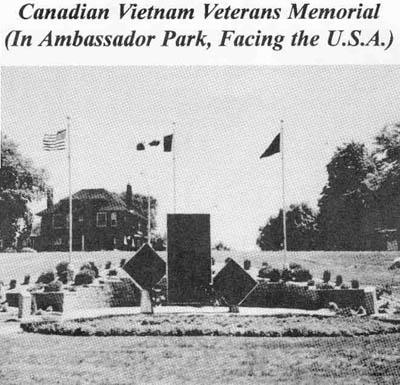
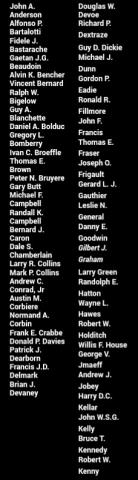
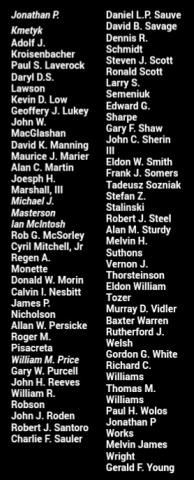
The black granite Canadians in Vietnam Memorial remembers the 103 Canadians who were killed in Vietnam and seven missing in action. This memorial was donated to the city of Windsor by a small group of American Vietnam War veterans. Unveiled on 2 July 1995, it is dedicated to all Canadians who served in the American Armed Forces during the Vietnam War.
[south side/côté sud]
1914 - 1918
In memory of the men of Sandwich who gave their lives for humanity in the Great War and in honour of those who daring to die survived.
In Memoriam [list of names]
Honour Roll [list of names]
Erected by the Baby Chapter I.O.D.E.
[north side/côté nord]
"Do you wonder why we're here to-day and why we stand so still.
Do you wonder why we gather here and why we always will.
We're here to-day to honour those who gave their live, their all.
We're here to-day to honour those who've answered God's last call.
They've done their part. They paid the price so you and I are free.
Let's pray to God that that's the way it will always be."
Dedicated by Branch 143 Royal Canadian Legion
November 11, 1993
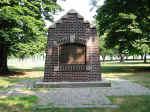
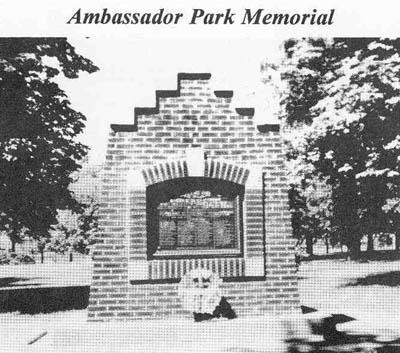
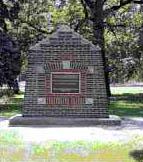
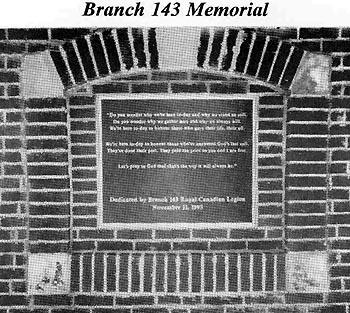
This memorial to the veterans and war dead of the First World War from Sandwich was erected by the Honourable James Baby Chapter of the Imperial Order of the Daughters of the Empire (I.O.D.E.) after the First World War. It was refurbished by the Windsor Veterans Memorial Services Committee in 1980 and, again, in 1993 by Royal Canadian Legion Branch No. 143 and the City of Windsor. The memorial was rededicated on 11 November 1993.
IN MEMORY OF
THE SERVICE PERSONNEL OF
WORLD WARS I, II,
KOREA AND PEACEKEEPING
FROM WINDSOR AND ESSEX COUNTY
WHO GAVE THEIR TODAY FOR OUR TOMORROW
SPONSORED BY
WINDSOR CHAPTER REMEMBRANCE ASSOCIATION
SILVER CROSS WOMEN OF CANADA
RE-DEDICATED 1997
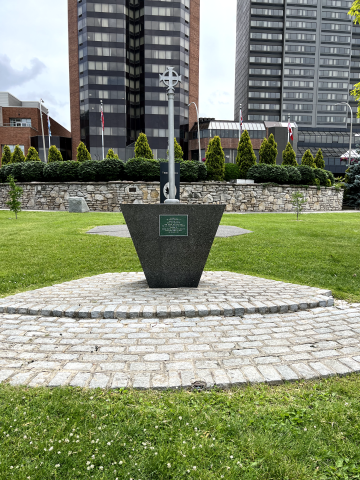
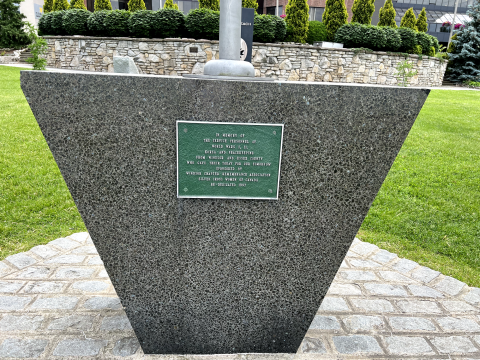
The Service Personnel Monument was dedicated on June 28, 1959, by the Windsor Chapter of the Remembrance Association Silver Cross Women of Canada and is dedicated to Windsor and Essex County war dead from the two World Wars and Korean War. More than 100 mothers and wives of the war dead attended the dedication. The nine foot monument was unveiled by Lieutenant Colonel F. K. Jasperson, DSO, ED, QC, the commanding officer of the Essex Scottish Regiment of Windsor during the Dieppe Raid. Three Army padres who took part in the commemoration ceremonies in Dieppe, France, during the Second World War officiated the service.
The base of the monument was replaced in 1962 by the Air Force Club in Windsor due to deterioration. The memorial also had to be refaced due to vandalism. This was financed by the Windsor Veterans Memorial Service Committee. The monument was re-dedicated in 1997.
[plaque/plaque]
INSCRIBED ON THIS TABLET ARE THE NAMES OF VOLUNTEERS, RESIDENTS OF THE COUNTY OF ESSEX WHO SERVED IN THE BRITISH ARMY DURING THE WAR IN SOUTH AFRICA A.D. 1899-1902. FIRST, SECOND AND THIRD CONTINGENTS AND THE NAMES OF THE VARIOUS BATTLES
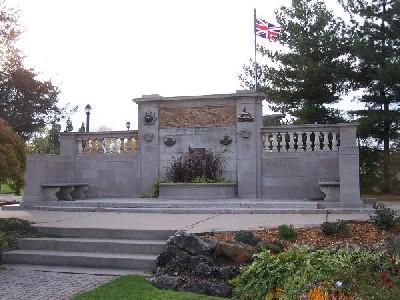
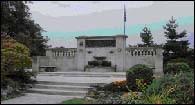
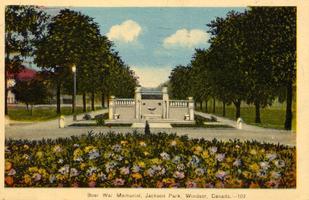
This memorial to the South African War veterans of Essex County was dedicated in 1906 outside the former Post Office. It was relocated to Jackson Park in 1932. Ouellette Avenue was extended in 1961, which forced the monument to be moved and re-dedicated that year. It now rests in the park's sunken gardens.
John Scott well-known architect in Detroit, Michigan (John Scott & Co.) designed the Windsor Memorial Fountain, honouring veterans from the Boer War in South Africa, 1903-04. The firm's best known work in Canada was the refined Beaux-Arts design for the Carnegie Library in Windsor, Ont. (1902-03).
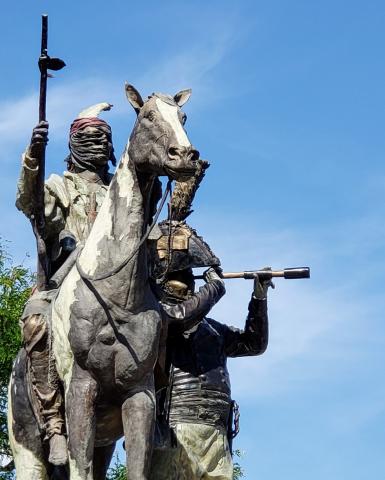
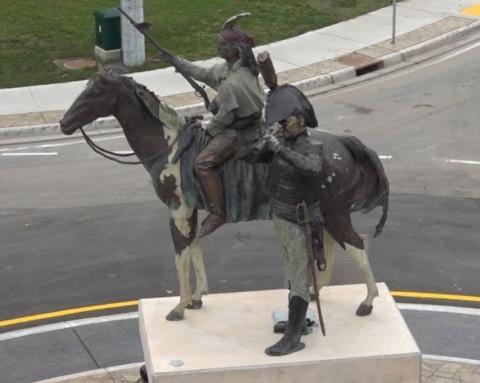
Two bronze sculptures stand together on a tall plinth at the centre of Sandwich Towne roundabout. The location is very close to where Chief Tecumseh and his men would have crossed for the battle of Fort Detroit. General Brock is depicted as looking to the Canadian side of the battle where cannon shots would have been fired from. Tecumseh, on his horse, sits tall and strong while Brock stands at his side peering through a telescope. This monument by artist Mark Williams and community builder John Muir, commemorates the historic friendship between General Sir Isaac Brock, commander of the British Forces in Canada, and Shawnee Chief Tecumseh during the War of 1812.
The life size sculptures were created by local artist Mark Williams who spent two years on the piece. It weighs about one ton and the bronze work was completed by Hopper Foundry of Forest Ontario. The monument commemorates the historic moment when General Brock and Chief Tecumseh met in Windsor during the War of 1812. A meeting that helped shape the future of Canada. The concept was generated from historical facts of the battle presented by long-time resident and vice-principal of General Brock Public School, John Muir. In John’s vision Chief Tecumseh was to sit tall on his horse as the leader of his people.
The presentation of gifts the night before the battle was added after Mark spoke with Scott Finlay of Parks Canada who had a wealth of information for both Chief Tecumseh and General Brock. He spoke of the kind of men they were, which led to the covering of half of Chief Tecumseh’s face with his hair. Indigenous people never wanted their souls taken, so you could not take a picture, make sketches or anything like that. Mark has hidden Tecumseh's face to protect his soul.
The night before the battle, Brock and Tecumseh met in Amherstburg at Fort Malden and General Brock presented Chief Tecumseh with a holster of guns that was on his horse's neck. Chief Tecumseh in return gave General Brock the sash he was wearing. Tecumseh was not a colourful leader in the way he appeared to others and did not need for any drapery. If presented with anything, he would quickly pass them on to his followers and not use them as a badge of honour for himself. This was another reason for showing the exchange between the two men, as Tecumseh surely would have passed on his gift of saddle pistols to one of his men.
When Americans declared war against Britain in an attempt to remove them from North America, the commander of the British forces in Canada was General Sir Isaac Brock. He formed an alliance with Shawnee Chief Tecumseh, who also wanted to hinder American expansion. Tecumseh joined his 600 men with Brock’s 700 men and together they presented a united front that made the Americans believe they were badly outnumbered and led to the capture of Detroit.
John Muir understood the significance of Tecumseh and Brock and began lobbying for a monument back in 2012 on the 200th anniversary of the War of 1812. John passed away in 2016, but thanks to his dedication this project was well underway by that time. He did get to see his vision for Chief Tecumseh on horseback and General Brock in finished clay. The monument was supposed to be completed in September 2017, but was delayed after Indigenous artifacts were found during excavation, prompting archeologists to study the area. Some of the artifacts found go back 2,600 years.
The Tecumseh and Brock Monument was unveiled on September 7, 2018, and John's son attended the ceremony to see his dad's dream finally come to be.
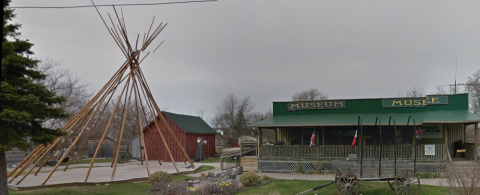
The 1812 Peace Garden, which commemorates the War of 1812, was erected by the Tecumseh Area Historical Society Thursday 06/21/2012. The town was named in honour of Tecumseh, Shawnee chief, who was leader of a First Nations confederacy and military leader in the War of 1812. The 1812 Peace Garden is a component of the Tecumseh Parkway, driving route running along the Thames River that will connect many sites of cultural, historic, natural and commercial interest. The parkway includes a number of stops at significant sites along the route, including the Tecumseh monument near Thamesville which marks the site of the Battle of the Thames, in which the legendary Shawnee Chief was killed. Along the route are various sites, including Tecumseh Park in Chatham, where encamped British troops successfully skirmished with the advancing Americans.
The Tecumseh Mural was unveiled on 3 July 2022. The mural honours the Canadian Armed Forces, the poppy, and Colonel Paul Poisson - the Town of Tecumseh's first mayor.