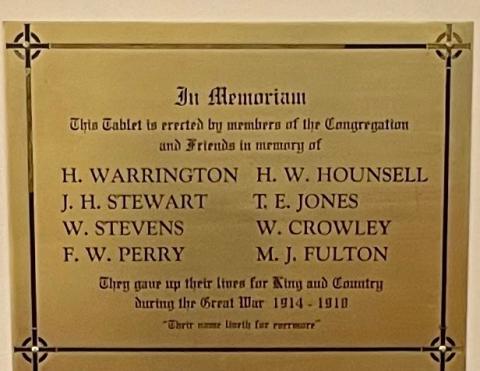
In December of 1920, at St. John’s York Mills Church, a tablet was dedicated in honour all of its parishioners who served in the First World War.
First World War Tablet
My VAC Account
My VAC Account
In December of 1920, at St. John’s York Mills Church, a tablet was dedicated in honour all of its parishioners who served in the First World War.
On January 9, 1921, at St. John’s Church, a credence table was dedicated to the memory of Captain John Egerton Ryerson, youngest brother of the Vicar, and Lieutenant Bertram Tschudi Nevitt, youngest brother of Mrs. Ryerson. Both were members of the congregation and lost their lives in the First World War.
John Egerton Ryerson was born June 7, 1887, to Charles Egerton Ryerson and Emily Ryerson in Toronto, Ontario. He was the grandson of well-known Ontario politician and educator, Egerton Ryerson; his cousin, Dr. George Ansel Sterling Ryerson was surgeon general. John was educated at the Upper Canada College, a member of The Queen’s Own Rifles of Canada for ten years and was working as a banker at the Wychwood branch of the Canadian Bank of Commerce when he enlisted with the Canadian Expeditionary Force on January 3, 1915. Upon enlisting, he received a commission to command the 58th Battalion as captain. On September 19, while engaged at the Somme, he was killed in action.
Bertram Tschudi Nevitt was born on August 25,1895, in Toronto, Ontario; the son of Richard B. and Elizabeth E. Nevitt. He was a student and a member of The Queen’s Own Rifles of Canada when he enlisted with the Canadian Expeditionary Force on September 22, 1914. He was a lieutenant in the 1st Battalion. While at the Somme, he was reported missing on September 22, 1916, later presumed to have been killed in action.
Robert Allan, M.M., M.C., Leonard Allan, Robert Boustead, Albert Boustead, Reginald Conron, Laurence France, Henry Holmes, Frederick J. Howard, Gwynnyd McRea, Oscar Mousley, Thomas H. Saunders, Allan Wade, John Wilkinson
On January 9, 1921, at St. John’s Church, a tablet was dedicated to the memory of the 14 members of the congregation who had lost their lives in the First World War. The ceremonial unveiling was performed by Lieutenant John P. Allan, Secretary of the Great War Veterans’ Association, whose two brothers were killed in the war.
On April 2, 1922, at St. John the Evangelist (Garrison Church), the Royal Canadian Dragoons Colours were deposited in the church for safe keeping during a ceremony that filled the building. Convoyed to the church by detachments of the Dragoons, Royal Canadian Regiment, and Governor General’s Body Guard, the Colours were handed over by Lieutenant-Colonel F. Gilman, DSO and placed on the altar by the Reverend Russell McLean.
St. John the Evangelist (Garrison Church) was located at the corner of Portland and Wellington Streets. The church was filled with row after row of smartly uniformed soldiers who always left the church before the rest of the congregation. By 1963, the building needed serious repairs and it was decided to demolish the building. It was replaced by a modern building that served the congregation until 1985 when the church property was sold. The Royal Canadian Dragoons Colours and military items in the church were transferred to Canadian Forces Camp Borden.
In earlier times, Colours played a prominent part in many battles. They served to identify units in battle, often marking the focal point of a struggle. Captured Colours were a prized trophy and attracted enemy attention and inspired much gallantry. By the late 19th and 20th Century, however, they were no longer carried in battle, but their status as the heart and soul of a Regiment continued, and the laying up of Colours signifies and helps keep holy the memories of the men who sacrificed their lives.
Lieut.-Col. Charles Turner Van Straubeazie, Victor A. Nordheimer, Captain Prince Antônio Gastão of Orléans-Braganza MC, Lieut. A. B. Irving, Lieut. H. D. Cunningham, Lieut. Evan E. Pierce, Lieut. D. S. Gwyn MC, Lieut. G. C. Hilliard, Lieut. John Melkie, Lieut. S. Booth.
On April 2, 1922, at St. John the Evangelist (Garrison Church), a tablet was dedicated to the memory of ten officers of the Royal Canadian Dragoons who lost their lives in the First World War. The tablet was unveiled by Major-General V.A.S. Williams and dedicated by Reverend MacLean.
St. John the Evangelist (Garrison Church) was located at the corner of Portland and Wellington Streets. The church was filled with row after row of smartly uniformed soldiers who always left the church before the rest of the congregation. By 1963, the building needed serious repairs and it was decided to demolish the building. It was replaced by a modern building that served the congregation until 1985 when the church property was sold.
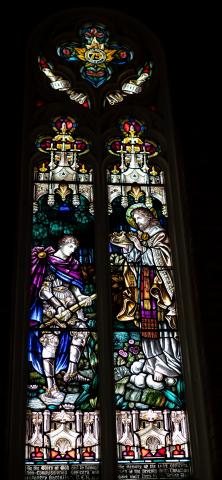
On April 2, 1922, stained glass windows at St. John the Evangelist (Garrison Church) were dedicated to parishioners who lost their lives in the First World War.
St. John the Evangelist (Garrison Church) was located at the corner of Portland and Wellington Streets. The church was filled with row after row of smartly uniformed soldiers who always left the church before the rest of the congregation. By 1963, the building needed serious repairs and it was decided to demolish the building. It was replaced by a modern building that served the congregation until 1985 when the church property was sold.
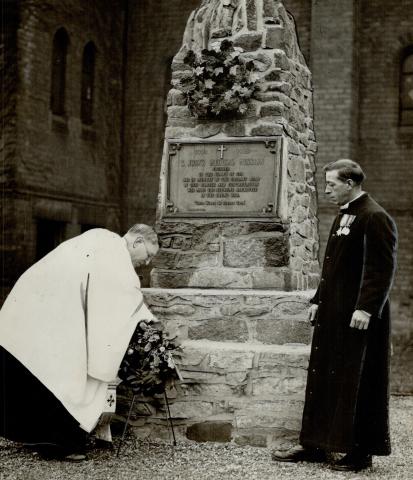
[monument]
1914 1918
S. JOHN'S MEDICAL MISSION
FOUNDED
TO THE GLORY OF GOD
AND IN MEMORY OF THE GALLANT DEAD
OF THIS PARISH AND CONGREGATION
WHO MADE THE SUPREME SACRIFICE
IN THE GREAT WAR.
"THEIR WORKS DO FOLLOW THEM"
[plaque]
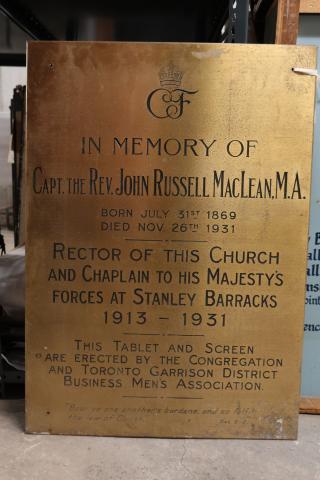
IN MEMORY OF
CAPT. THE REV. JOHN RUSSELL MACLEAN, M.A.
BORN JULY 31ST 1869
DIED NOV. 26TH 1931
RECTOR OF THIS CHURCH
AND CHAPLAIN TO HIS MAJESTY'S
FORCES AT STANLEY BARRACKS
1913 - 1931
THIS TABLET AND SCREEN
ARE ERECTED BY THE CONGREGATION
AND TORONTO GARRISON DISTRICT
BUSINESS MEN'S ASSOCATION.
"Bear ye one another's burdens, and so fulfil
the law of Christ."
Gal. 6-2.
On March 4, 1922, a ceremony was held at St. John the Evangelist (Garrison Church) for the formal opening of a Medical Mission in honour of members of the congregation and parishioners who lost their lives in the First World War. It was established under the leadership of the rector, Captain the Reverend John Russell MacLean, and ran until sometime after the Second World War. Four hundred men from the parish answered the call during the First World War. Of these, 40 paid the supreme sacrifice. The ceremony was conducted in the crypt by Bishop James Fielding Sweeny where the brass tablet erected to the gallant dead was blessed.
Reverend MacLean was the rector of this Garrison Church and Chaplain to his Majesty's Forces as Stanly Barracks. In organizing the medical mission, he worked closely with two prominent Toronto doctors: John Taylor Fotheringham and Herbert Ernest Clutterbuck. Dr. Fotheringham was the postwar commander, as a major general, of the Militia component of the Canadian Army Medical Corps and, in the civilian world, on the faculty of the University of Toronto. He had joined the Militia as a student at the university and served as Surgeon Lieutenant of the 12th York Rangers and later the Queen’s Own Rifles. Fotheringham went overseas with the 2nd Canadian Division and was appointed the formation’s senior medical officer in 1915. Dr. Herbert Ernest Clutterbuck, a friend and colleague, was chief surgeon at St. John’s Hospital and later chief surgeon of Toronto Western Hospital. Clutterbuck was a graduate of the University of Toronto and had served as a medical officer with the British army during the war. He also taught at the university. Dr. Alex D. McKelvy, another experienced physician, volunteered to be the ear, nose and throat specialist.
St. John the Evangelist (Garrison Church) was located at the corner of Portland and Wellington Streets. The church was filled with row after row of smartly uniformed soldiers who always left the church before the rest of the congregation. By 1963, the building needed serious repairs and it was decided to demolish the building. It was replaced by a modern building that served the congregation until 1985 when the church property was sold.
The cairn remained in place until about 1982. It is not known what happened to the cairn or its plaque.
OVERSEAS BATTALION
75
1914 1918
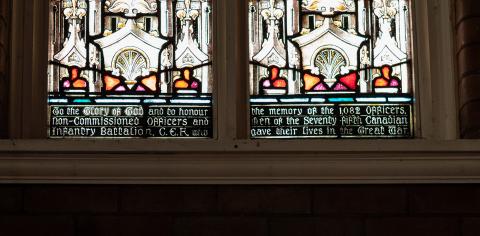
To the Glory of God and to honour the memory of the 1,082 Officers,
non-Commissioned Officers and men of the Seventy-fifth Canadian
Infantry Battalion, C.E.G., who gave their lives in the Great War.
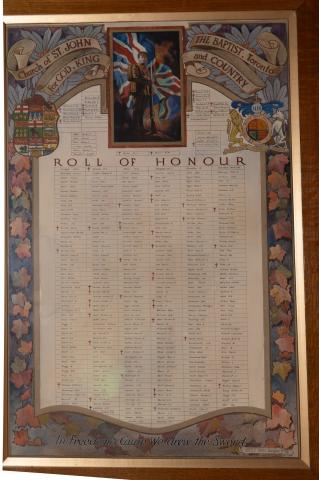
At St. John the Baptist Norway Church, three stained glass windows were unveiled in memory of those who served in the First World War and one was dedicated to the 75th Battalion, Canadian Expeditionary Force.
Authorized in the summer of 1915, the 75th Battalion was made up of recruits from Southern Ontario and arrived in Europe in the spring of 1916. They were engaged in the following operations: Battle of the Somme, Ancre Heights, Ancre, Arras, Vimy Ridge, Hill 70, Ypres, Passchendaele, Amiens, Scarpe, Drocourt-Quéant, Hindenburg Line, Canal du Nord, Valenciennes and Sambre.
needs further research/recherche incomplète
The St. John the Baptist Norway Church First World War Roll of Honour was designed by Harold James.
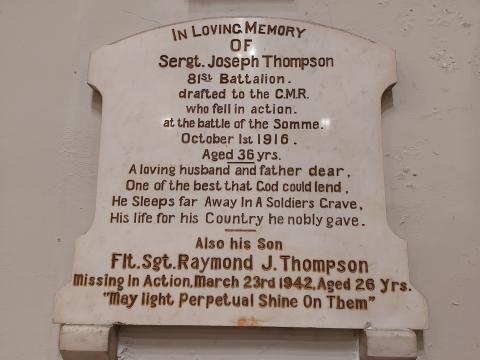
IN LOVING MEMORY
OF
Sergt. Joseph Thompson
81st Battalion.
drafted to the C.M.R.
who fell in action.
at the battle of the Somme.
October 1st 1916.
Aged 36 yrs.
A loving husband and father dear,
One of the best that God could lend,
He Sleeps far Away In A Soldiers Grave,
His life for his Country he nobly gave.
Also his Son
Flt. Sgt. Raymond J. Thompson
Missing In Action, March 23rd 1942, Aged 26 Yrs.
"May light Perpetual Shine On Them"
This plaque was erected in memory of Sergeant Joseph Thompson, who died in the First World War, and his son Flight Sergeant Raymond Thomson, who died in the Second World War.