This street commemorates those who fought at the Battle of the Somme in the First World War.
Somme Boulevard
needs further research/recherche incomplète
My VAC Account
My VAC Accountneeds further research/recherche incomplète
This street commemorates those who fought at the Battle of the Somme in the First World War.
needs further research/recherche incomplète
This street commemorates those who fought at the Battle of Cambrai in the First World War.
needs further research/recherche incomplète
This street commemorates those who fought in the Dieppe Raid in the Second World War. Although extremely valuable lessons were learned in the Dieppe Raid, a steep price was paid. Of the 4,963 Canadians who embarked for the operation, only 2,210 returned to England, and many of these were wounded. There were 3,367 casualties, including 1,946 prisoners of war; 916 Canadians lost their lives.
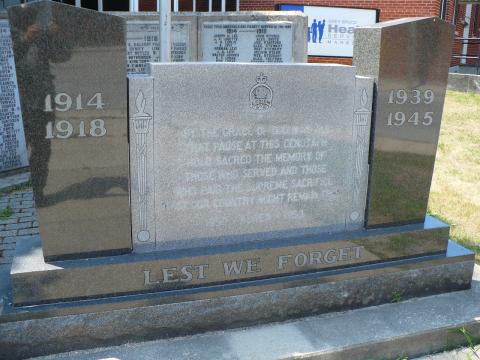
1914
1918
1939
1945
BY THE GRACE OF GOD MAY ALL
THAT PAUSE AT THIS CENOTAPH
HOLD SACRED THE MEMORY OF
THOSE WHO SERVED AND THOSE
WHO PAID THE SUPREME SACRIFICE
THAT OUR COUNTRY MIGHT REMAIN FREE
1950 KOREAN 1953
LEST WE FORGET
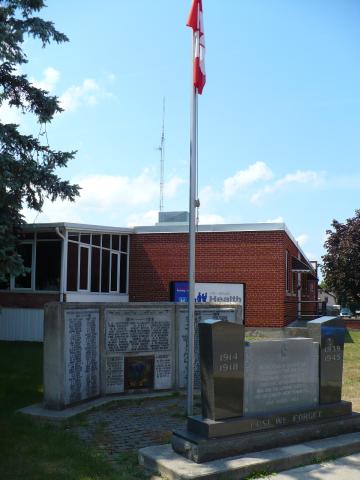
In 1923, the first memorial (a vault) was erected in the Markdale Public Cemetery. Interested citizens arranged for three large stone plaques which listed the names of the men from Markdale who joined the active forces. One plaque listed the 33 names of those who paid the supreme sacrifice in the First World War. The remaining two plaques listed the 142 names of those who joined the forces in Markdale and were fortunate enough to return home.
The Royal Canadian Legion was founded in 1925-26 and Veterans paraded to the cemetery on November 11 for their service honouring the First World War Veterans. In 1971, the vault was removed and a new one was erected further back in the cemetery grounds. Its placement was questioned and through the efforts of a local Veteran, who is now deceased, the three plaques were carefully taken down and stored at the Royal Canadian Legion Headquarters. A smaller brass plaque was created and erected in the Carnegie Library and still hangs to this day.
The same local Veteran and his committee began fundraising and sought approval from the local hospital to erect a new memorial to honour the men and women from the First and Second World Wars and the Korean War. Through hard work and the approval from the Centre Grey Hospital Board for land, a new memorial was constructed and placed on the Southeast corner of the hospital in 1979. In 1983, the Hospital Board gave approval for more ground to be given to install the three plaques with the First World War Veterans, behind the existing memorial. The new memorial was moved to its current location at the Royal Canadian Legion - Branch 333 Flesherton-Markdale.
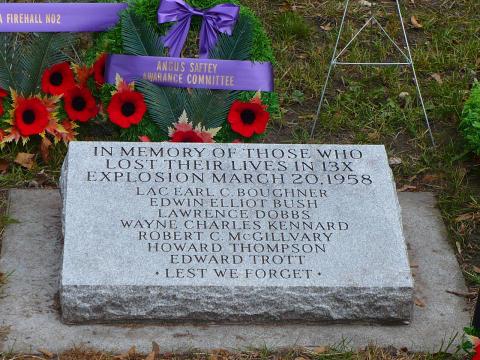
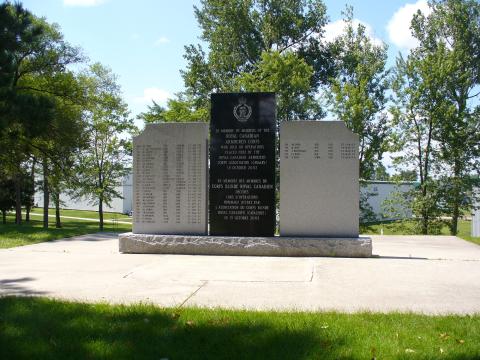
IN MEMORY OF THOSE WHO
LOST THEIR LIVES IN 13X
EXPLOSION MARCH 20, 1958
LAC EARL C. BOUGHNER
EDWIN ELLIOT BUSH
LAWRENCE DOBS
WAYNE CHARLES KENNARD
ROBERT C. McGILLVARY
HOWARD THOMPSON
EDWARD TROTT
LEST WE FORGET
On March 20, 1958, at approximately 4 o'clock in the afternoon, an explosion demolished building Number 20, the receipts and issues building, located near the entrance to the depot's explosive storage area, killing six civilian employees and one airman. This was one of the worst peacetime munitions explosions in Canada. The resulting fire was fought by the Depot fire brigade, along with firefighters from the Army Fire Service in Camp Borden. Along with fighting the fire, which is dangerous under normal circumstances, the fire brigade had to deal with munitions exploding, including a bullet that struck a nearby ambulance.
In August 2005, 47 years after the tragedy, a ceremony was held at the Angus Cenotaph to dedicate a memorial stone plaque to the victims the RCAF 13 "X” Depot explosion.
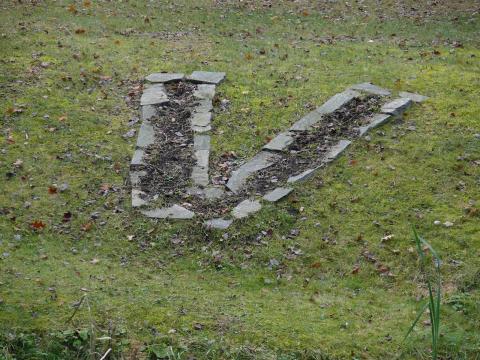
After the Second World War, a “V” for Victory was created across the bank of a small stream behind the Vespra Boys Memorial. The original configuration was made of Yew trees, and later changed to a V-shaped stone garden.
The Frederick Campbell VC School at Canadian Forces Base Borden opened its doors in 1956. When the school closed in 2010, the school's plaque was presented to the Royal Canadian Legion Branch 134 in Mount Forest, Ontario.
Frederick William Campbell was born in Mount Forest, Ontario on 15 June 1869. As a young man, he joined a unit of the Canadian Militia, and later served in during the South African War with a machine gun section of the 2nd Battalion, The Royal Canadian Regiment. At the beginning of the First World War he was commissioned as an officer in the Canadian Expeditionary Force.
Lieutenant Campbell was serving with the 1st Battalion, Canadian Expeditionary Force when he earned the Victoria Cross in an action near Givenchy in France on 15 June 1915, his 48th birthday. Employing two Colt machine guns, Campbell led an assault on a German trench line considered to be nearly impregnable. Arriving at the German line, Campbell maintained his lodgement for some time under heavy fire despite the fact that nearly all of his men became casualties. In order to cover the withdrawal of those of his men who were still capable of escaping, Campbell and another soldier advanced to an exposed position and succeeded in holding back an enemy counterattack. It was as he withdrew that Captain Campbell received the mortal wound from which he died on 19 June 1915.
needs further research/recherche incomplète
needs further research
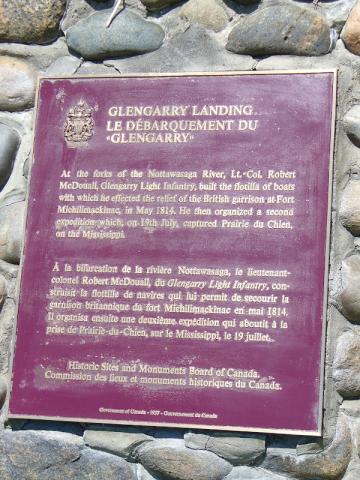
At the forks of the Nottawasaga River, Lt.-Col. Robert
McDouall, Glengarry Light Infantry, built the flotilla of boats
with which he effected the relief of the British garrison at Fort
Michilimackinac, in May 1814. He then organized a second
expedition which, on 19th July, captured Prairie du Chien,
on the Mississippi.
À la bifurcation de la rivière Nottawasaga, le lieutenant-
colonel Robert McDouall, du Glengarry Light Infantry, a cons-
truit la flottille de navires qui lui permit de scourir la
garnison britannique du fort Michillimakinac en mai 1814.
Il organisa ensuite une deuxième expédition qui aboutit à la
prise de Prairie-du-Chien sur le Mississipi le 19 juillet.
Historic Sites and Monuments Board of Canada
Commission des lieux et monuments hitoriques du Canada.
Government of Canada -19??- Gouvernement du Canada
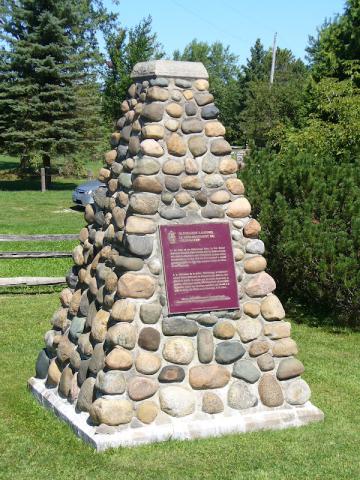
This memorial honours Lieutenant-Colonel Robert McDouall, Glengarry Light Infantry. He built the flotilla of boats with which he effected the relief of the British garrison at Fort Michilimackinac, in May 1814. He then organized a second expedition which, on July 19, 1814, captured Prairie du Chien, on the Mississippi.