La France prend le contrôle de la région qui deviendra plus tard le Mali.
1915-1916
Des révoltes de grande ampleur ont lieu contre la domination française.
1960
Le Mali obtient son indépendance de la France.
1968
Un coup d’État militaire destitue le premier président du Mali.
1991
Une révolution prodémocratique renverse le régime militaire.
1992
Un nouveau président est élu.
2012
Une rébellion se déclenche dans le nord du Mali. Un nouveau coup d’État militaire renverse le gouvernement.
2013
Commencement de la Mission multidimensionnelle intégrée des Nations Unies pour la stabilisation au Mali (MINUSMA)
2018
Des hélicoptères, des équipes médicales et du personnel de soutien des Forces armées canadiennes arrivent au Mali.
2019
Des policiers civils canadiens sont envoyés pour participer à la mission de maintien de la paix de l’Organisation des Nations Unies (ONU) au Mali.
2023
Le Mali demande aux forces de maintien de la paix de l’ONU de se retirer du pays.
Mali
2018 – 2023
Le Canada participe depuis longtemps à des opérations internationales de maintien de la paix. L’une de ces missions de paix s’est déroulée au Mali de 2018 à 2023. Plus de 1 250 membres des Forces armées canadiennes ont apporté une contribution importante aux efforts de l’Organisation des Nations Unies (ONU). Leur travail a permis de stabiliser le pays après des années d’agitation.
Le Mali est un vaste pays du nord-ouest de l’Afrique. Sa superficie est de plus de 1,2 million de kilomètres carrés, ce qui est un peu plus petit que la province de Québec. Les parties septentrionales du Mali se trouvent dans le désert du Sahara et dans la région semi-aride du Sahel. La majorité des quelque 22 millions d’habitants du pays vivent dans les savanes herbeuses du sud où le climat est moins rude. Cette région plus peuplée du pays comprend la capitale Bamako.
Colonisation
Le Mali a une histoire riche. Avant la colonisation, il a fait partie de plusieurs puissants empires africains. Les puissances européennes ont rapidement pris le contrôle de la majeure partie du continent à la fin du 19e siècle. La France a revendiqué de vastes portions du nord-ouest de l’Afrique, et la région qui est devenue le Mali est progressivement tombée sous sa domination entre les années 1880 et 1910. Le gouvernement colonial lui a donné différents noms officiels au fil des ans, notamment le « Soudan français » et le « Haut-Sénégal-Niger ».
Le peuple malien a tenté de se débarrasser de cette domination étrangère. Il a lancé un grand soulèvement contre les Français en 1915-1916. La France a vaincu la rébellion et a gardé le contrôle du pays pendant plusieurs décennies.
Indépendance et agitation
Le Mali est devenu un pays indépendant en 1960. La transition ne s’est pas faite sans heurts et le Mali est rapidement tombé sous le joug d’un parti unique. Après des années de déclin économique, un coup d’État militaire a renversé le gouvernement initial en 1968. D’autres troubles politiques et tentatives de coup d’État ont suivi. De graves sécheresses et famines ont aggravé la situation politique et économique du Mali. La situation a atteint son paroxysme en 1991 lorsque des manifestations de masse ont mené à une révolution prodémocratique victorieuse.
Le régime militaire a été renversé et le Mali a rapidement adopté une nouvelle constitution. Des élections multipartites ont eu lieu en 1992. Les dirigeants démocratiquement élus ont réussi à maintenir une certaine stabilité dans le pays pendant les deux décennies suivantes.
Guerre civile
Des troubles importants ont éclaté au Mali au début de l’année 2012. Des rebelles ont pris le pouvoir dans la moitié nord du pays dans le but d’obtenir l’indépendance de la région. Ces combats ont mené à un autre coup d’État au Mali. La situation était complexe et les divers groupes insurgés avaient des objectifs différents.
Ce soulèvement a entraîné la montée en puissance de forces liées au groupe terroriste Al-Qaida. Au cours des premiers mois de 2013, les troupes maliennes et françaises ont repris le territoire dont les rebelles s’étaient emparés. Malheureusement, cela n’a pas abouti à une paix durable. De fortes tensions et des conflits se sont poursuivis dans le nord et le centre du Mali.
La réponse des Nations Unies
Lorsque les combats à grande échelle se sont calmés au début de l’année 2013, les autorités maliennes ont demandé l’aide de la communauté internationale. Elles souhaitaient la mise en place d’une opération de maintien de la paix pour venir en aide à la population du pays. La Mission multidimensionnelle intégrée des Nations Unies pour la stabilisation au Mali (MINUSMA) a rapidement été déclenchée.
Cette importante mission de maintien de la paix comportait un vaste mandat. Des opérations de sécurité ont été menées pour protéger les civils et les principales agglomérations. Une surveillance a été exercée à l’égard des violations des droits de la personne et de l’aide humanitaire a été acheminée. La mission a en outre permis de superviser le retour des personnes déplacées et de soutenir la tenue d’élections libres.
Plus de 15 000 gardiens de la paix des Nations Unies, originaires de dizaines de pays, ont servi au Mali au cours des dix années suivantes. Parmi eux, plus de 1 250 Canadiens.
Soutien des Forces armées canadiennes
Une membre de l’Équipe médicale canadienne d’intervention d’urgence donne des instructions au cours d’un exercice militaire, à bord d’un hélicoptère Chinook. Mali, mars 2019. Photo : ministère de la Défense nationale TM02-2019-0033-0072
En 2018, l’ONU a demandé au Canada un soutien urgent à la mission de maintien de la paix au Mali. L’ONU avait besoin d’aide dans le cadre de ses opérations afin d’assurer le transport aérien et l’évacuation des blessés, et de fournir des traitements médicaux.
Trois CH-147F Chinook ont évacué des gardiens de la paix et des civils blessés. Ils ont également aidé à transporter du matériel de l’ONU dans ce vaste pays. Ces gros hélicoptères sont devenus des salles d’urgence volantes lors des évacuations médicales. Des équipages qualifiés ont piloté les hélicoptères dans l’environnement difficile du Mali. À bord, un médecin de l’air, un infirmier en soins intensifs et deux techniciens médicaux prodiguaient des soins. Une équipe de protection de la force les accompagnait pour surveiller l’hélicoptère au sol.
D’août 2018 à août 2019, un contingent canadien d’environ 250 personnes a rempli ces rôles importants. Opération PRESENCE (Mali) est le nom que les Forces armées canadiennes ont donné aux efforts militaires du Canada dans ce pays.
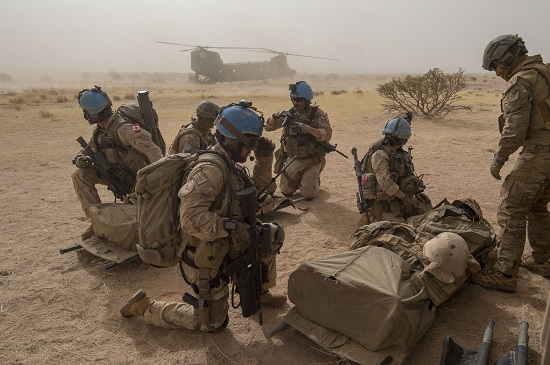
Les membres d’une équipe de protection de la force d’un CH-147 Chinook surveillent la zone d’atterrissage. Cet exercice d’évacuation médicale s’est déroulé près de Gao, au Mali. 2018. Photo : ministère de la Défense nationale (cplc Jennifer Kusche)
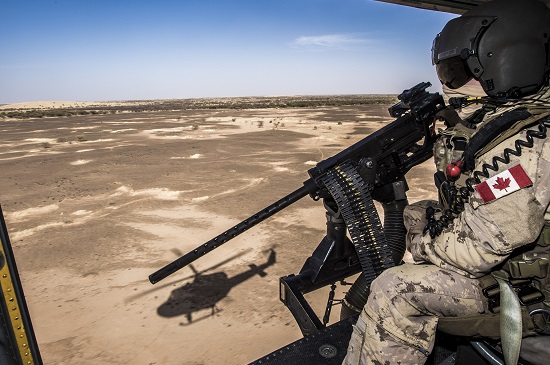
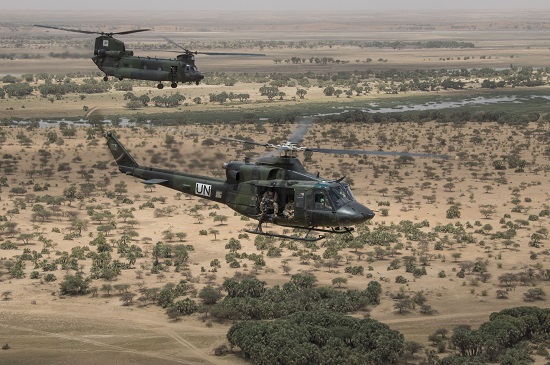
Cinq hélicoptères CH-146 Griffon ont également été déployés au Mali. Ils ont escorté les Chinook pour les protéger contre d’éventuelles attaques. Ces hélicoptères plus petits et armés ont aussi apporté leur soutien à d’autres efforts de l’ONU. Ils ont notamment participé à des opérations de sécurité à longue distance dans des régions reculées du pays.
Autres contributions militaires du Canada
La Force opérationnelle Bamako est un autre moyen par lequel les membres des Forces armées canadiennes ont soutenu les efforts de maintien de la paix de l’ONU au Mali. Jusqu’à 10 Canadiens ont travaillé au quartier général de la MINUSMA à Bamako, la capitale du Mali. Certains d’entre eux ont aussi servi au sein d’une force de reconnaissance britannique basée à Gao, dans l’est du pays.
Les aéronefs de transport des Forces armées canadiennes, notamment le CC-130 Hercules, ont également rendu de précieux services. Ils ont transporté du personnel, du ravitaillement et du matériel pour les efforts de l’ONU au Mali et dans toute l’Afrique.
Police civile canadienne chargée du maintien de la paix
Les militaires ne sont pas les seuls Canadiens en uniforme à participer à des opérations de paix internationales. Les agents de la Gendarmerie royale du Canada et d’autres policiers civils mettent également à profit leurs précieuses compétences.
Au début de 2019, un contingent de 30 policiers canadiens a servi au Mali. Ils ont contribué à la mise en œuvre de l’accord de paix et de réconciliation du Mali et à la réforme des services de sécurité du pays. Les policiers chargés du maintien de la paix ont accompli de nombreuses tâches importantes pour atteindre ces objectifs, notamment en assurant la sécurité et la protection des civils. Ils ont aussi apporté un leadership en ce qui concerne le maintien de l’ordre, les droits de la personne et l’égalité entre les hommes et les femmes. Enfin, ils ont formé les forces de police locales au Mali et dans les pays voisins.
La surintendante Kelly Bradshaw de la GRC a été commandante de la police civile canadienne au Mali au cours de la mission de maintien de la paix dans ce pays. 2019. Photo : Gendarmerie royale du Canada
La fin de la mission
Les opérations de paix de l’ONU n’ont lieu qu’à la demande du pays hôte. Au milieu de 2023, le gouvernement malien a demandé aux forces de maintien de la paix de l’ONU de quitter le pays. Il a affirmé que la mission MINUSMA n’avait pas réussi à stabiliser le pays. Après une décennie d’efforts de maintien de la paix, l’effort multinational au Mali a pris fin.
La détermination et la bravoure des Canadiens
Le Mali a été un environnement éprouvant pour nos militaires. Les conditions extrêmement chaudes et arides sont monnaie courante. Les gardiens de la paix des Forces armées canadiennes ont accompli des tâches essentielles dans ce climat difficile.
Les Canadiens participant à des missions de maintien de la paix se surpassent souvent pour mener à bien leur mission. Parfois, ce service remarquable est reconnu de manière particulière. Par exemple, trois officiers supérieurs des Forces armées canadiennes ont reçu la Croix du service méritoire au Mali. Le colonel Christopher McKenna, le colonel Travis Morehen et le lieutenant-colonel Christopher Morrison ont tous reçu cette médaille en reconnaissance de leur leadership exceptionnel au cours de la mission de l’ONU au Mali.
Sacrifice
Les gardiens de la paix canadiens font de nombreux sacrifices lorsqu’ils servent dans des missions à l’étranger. Passer six mois ou un an loin de ses amis et de ses proches est très difficile. Ils s’exposent aussi au danger de travailler dans un endroit en proie à l’agitation et à l’incertitude au quotidien. Les membres de la famille de ceux et celles qui sont envoyés loin de chez eux partagent également ce fardeau.
Le service en uniforme peut parfois entraîner des blessures et la mort. Environ 130 membres des Forces armées canadiennes ont perdu la vie dans le cadre d’efforts de paix internationaux. Deux agents de la Gendarmerie royale du Canada sont également décédés. Aucun Canadien en uniforme n’a perdu la vie au Mali. Cependant, plus de 300 membres du personnel des Nations Unies provenant de partout dans le monde ont été tués au cours des efforts de maintien de la paix dans ce pays. Ce bilan considérable en fait l’une des missions des Nations Unies les plus meurtrières de tous les temps.
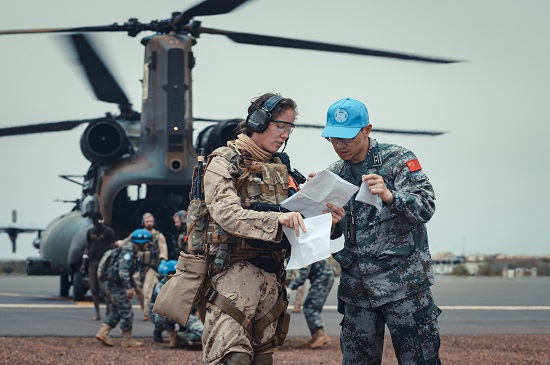
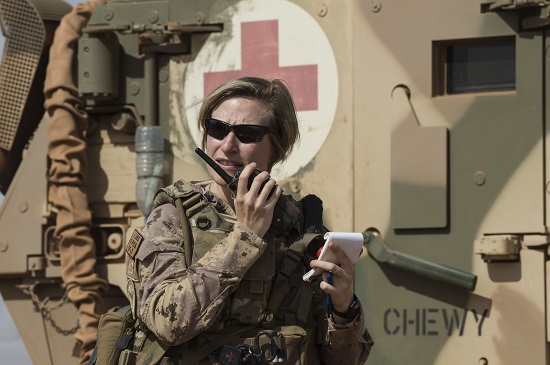
Une gardienne de la paix canadienne coordonne une mission pour évacuer deux entrepreneurs civils de l’ONU blessés. Mali, août 2019. Photo : ministère de la Défense nationale TM03-2019-0007-002
9 images
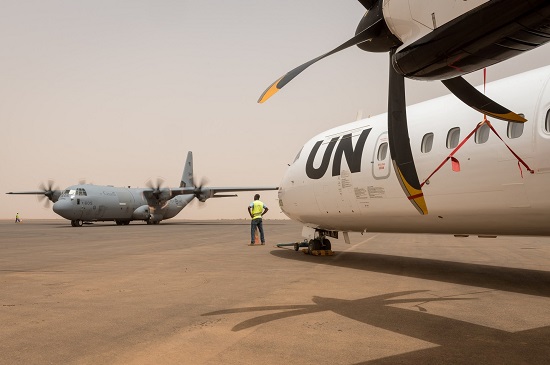
Un avion de transport CC-130 Hercules des Forces armées canadiennes transportant des gardiens de la paix canadiens arrive à Gao, au Mali. Juin 2018. Photo : ministère de la Défense nationale
9 images
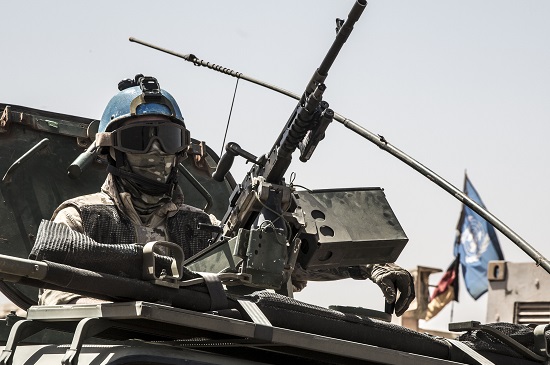
Un membre des Forces armées canadiennes assure la sécurité d’un convoi vers une base militaire. Mali, février 2019. Photo : ministère de la Défense nationale
9 images
Un mécanicien de bord opère la mitrailleuse de porte d’un hélicoptère CH-146 Griffon des Forces armées canadiennes lors d’une mission d’escorte aérienne. Mali, février 2019. Photo : ministère de la Défense nationale TM02-2019-0018-0025
9 images
Des gardiens de la paix canadiens endurent une épaisse poussière lors d’un exercice d’évacuation médicale avec des troupes néerlandaises. Mali, février 2019. Photo : ministère de la Défense nationale TM02-2019-0018-0048
9 images
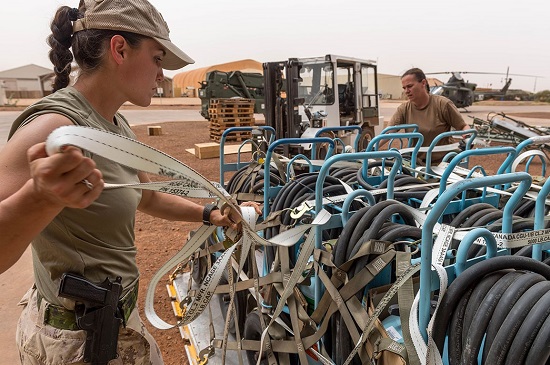
Deux gardiennes de la paix canadiennes déchargent du matériel livré par un avion Hercules CC-130 à la base de l’ONU à Gao, au Mali. Juillet 2018. Photo : ministère de la Défense nationale (Cplc Jennifer Kusche).
9 images
Une gardienne de la paix canadienne participe à un exercice d’hélicoptères multinational. Mali, mars 2019. Photo : ministère de la Défense nationale TM02-2019-0021-0001
9 images
Un hélicoptère CH-146 Griffon et un hélicoptère CH-147F Chinook des Forces armées canadiennes survolent la campagne aride du Mali. Juin 2019. Photo : ministère de la Défense nationale TM02-2019-0074-0007
9 images
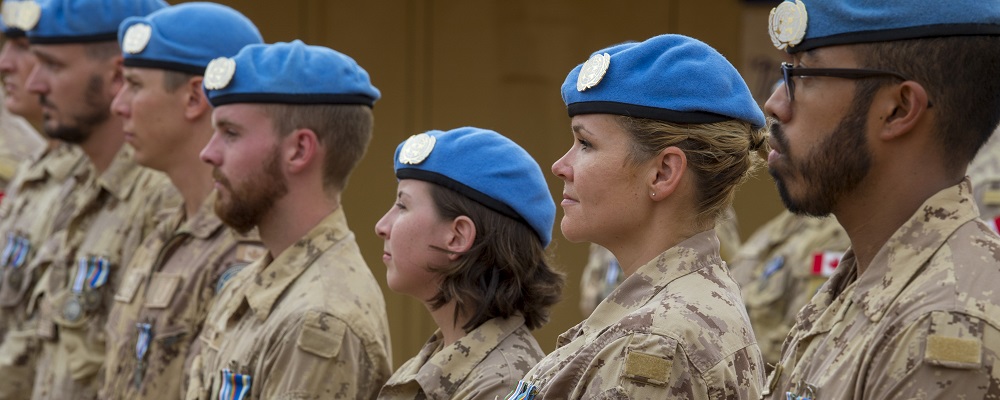
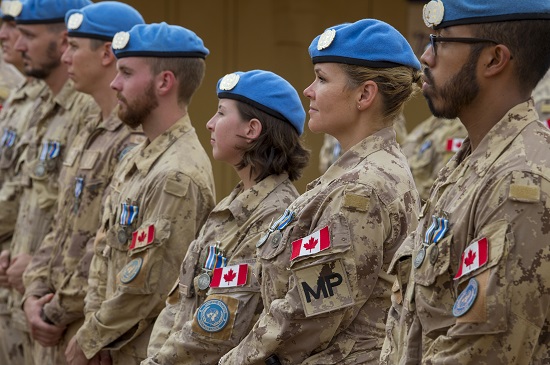
Des gardiens de la paix canadiens dans leur base au Mali. Ils venaient de recevoir des médailles pour leur participation à la mission des Nations Unies dans ce pays. Juin 2019. Photo : ministère de la Défense nationale TM02-2019-0076-0010