
Monument du champ de bataille

Stoney Creek, Ontario
Type
Autre

En 1888, la Wentworth Historical Society a été créée dans le but de commémorer la bataille de Stoney Creek. Un organisme issu de ce groupe, connu sous le nom de Women’s Wentworth Historical Society, a ouvert le Battlefield House Museum (Gage House) en 1899 et, en 1900, a commandé des plans pour la conception d’un monument impressionnant. La Women’s Wentworth Historical Society, qui est en grande partie responsable de l’achèvement du monument en 1913, est devenue l’une des premières sociétés culturelles entièrement féminines au Canada.

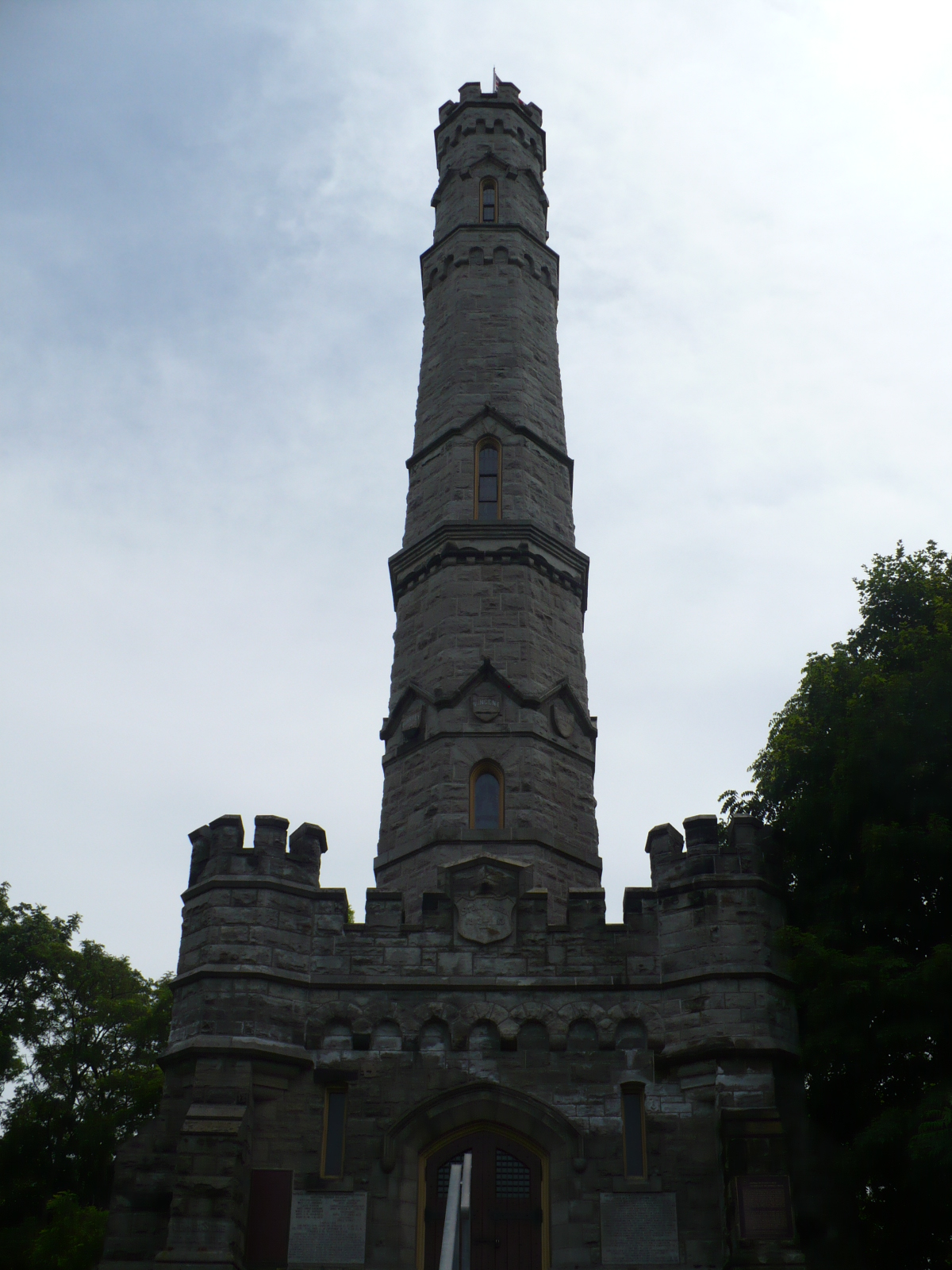
Le monument commémorant la bataille a été construit à la mémoire de ceux qui ont combattu lors de la bataille de Stoney Creek pendant la guerre de 1812. Le cabinet d’architectes de Hamilton, F.J. Rastrick and Sons, a préparé les plans du monument en 1900, Edward L. Rastrick supervisant la conception. Le premier coup de pioche a été donné par la comtesse Grey le 28 mai 1909, et la première pierre a été posée par le général French lors d’une cérémonie le 26 mai 1910, F.H. Dickenson étant chargé de la construction. Les problèmes d’obtention de fonds gouvernementaux ont entraîné des retards tout au long de l’année 1911. Les travaux ont repris en 1912 lorsque le ministère de la Milice et de la Défense a garanti des fonds supplémentaires. Le 6 juin 1913, le monument est inauguré par la reine Mary par télégraphe depuis le palais de Buckingham.

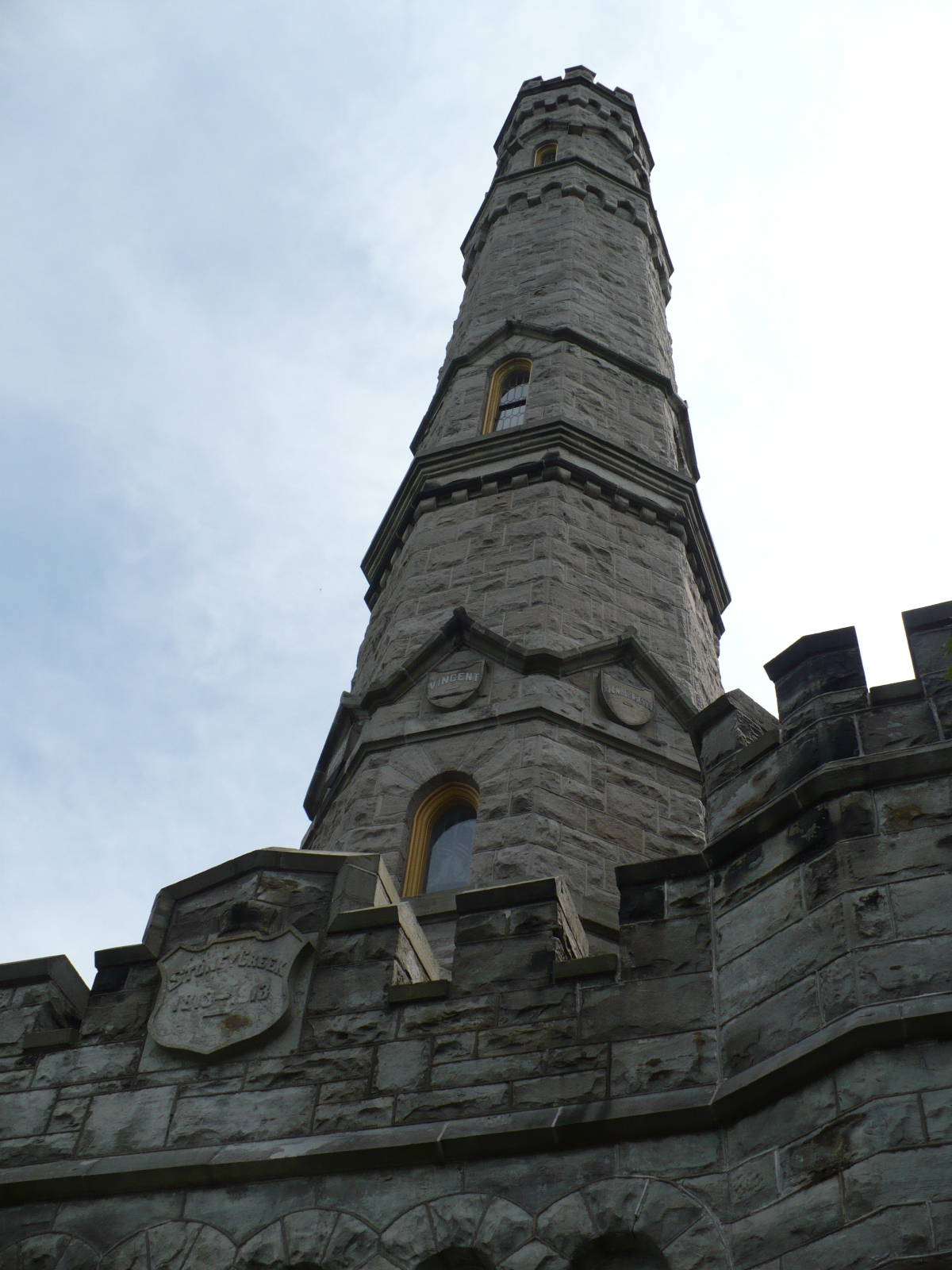
Il est construit en pierre et mesure 100 pieds de haut, symbolisant le centième anniversaire de la bataille à la date où il a été inauguré. Cette hauteur reconnaît également les cent ans de paix entre les États-Unis et le Canada qui ont suivi la guerre de 1812 – un pied de pierre pour chaque année de paix. Le concept a été choisi pour ressembler au monument Nelson du début du XIXe siècle à Édimbourg, en Écosse. Sa base carrée est surmontée d’une tour octogonale fuselée à motifs néogothiques d’inspiration Tudor (crénelure, couronnement, corbeaux, motifs de bouclier, porte en chêne massif, tourelles, contreforts). Les plateformes d’observation situées au sommet de la base et au sommet de la tour offrent des vues sur l’ensemble du champ de bataille. L’escalier intérieur en colimaçon comporte de larges paliers.

Les calcaires canadiens provenant de Georgetown, d’Hamilton et de Queenstown ont été utilisés pour le monument et le noyau est en béton armé. Huit boucliers de pierre encerclent le monument, chacun portant un nom commémorant des individus britanniques et canadiens importants de la bataille, tels que le major Ogilvie et le lieutenant Fitzgibbon. On retrouve des allées bordées d’arbres, des massifs de fleurs et des escaliers menant de la maison Gage au monument.

William Murray, extrait d’un poème, Hamilton Spectator, vendredi 6 juin 1913 :

At Stirring Stoney Creek
The Centenary Of The Battle
Unveiling Of The Monument
Memory Of Its Heroes

The Queen has "touched the button" o'er
Three thousand miles of sea.
And, lo! The veil is seen no more
Where it was wont to be.
The monument in all its glory,
Stands up to tell its stirring story.

Nor should we overlook to-day
The feats of Countess Calder
And her companions, bright and gay-
Who'll never be noted aulder-
Without whose lustrous labours here
No monument could now appear.

Il a été restauré en 1993 et inauguré par le lieutenant-gouverneur Hal Jackman le 4 juin 1994. Il est maintenant administré et entretenu par la Municipalité de Stoney Creek.

Inscription

[plaque]

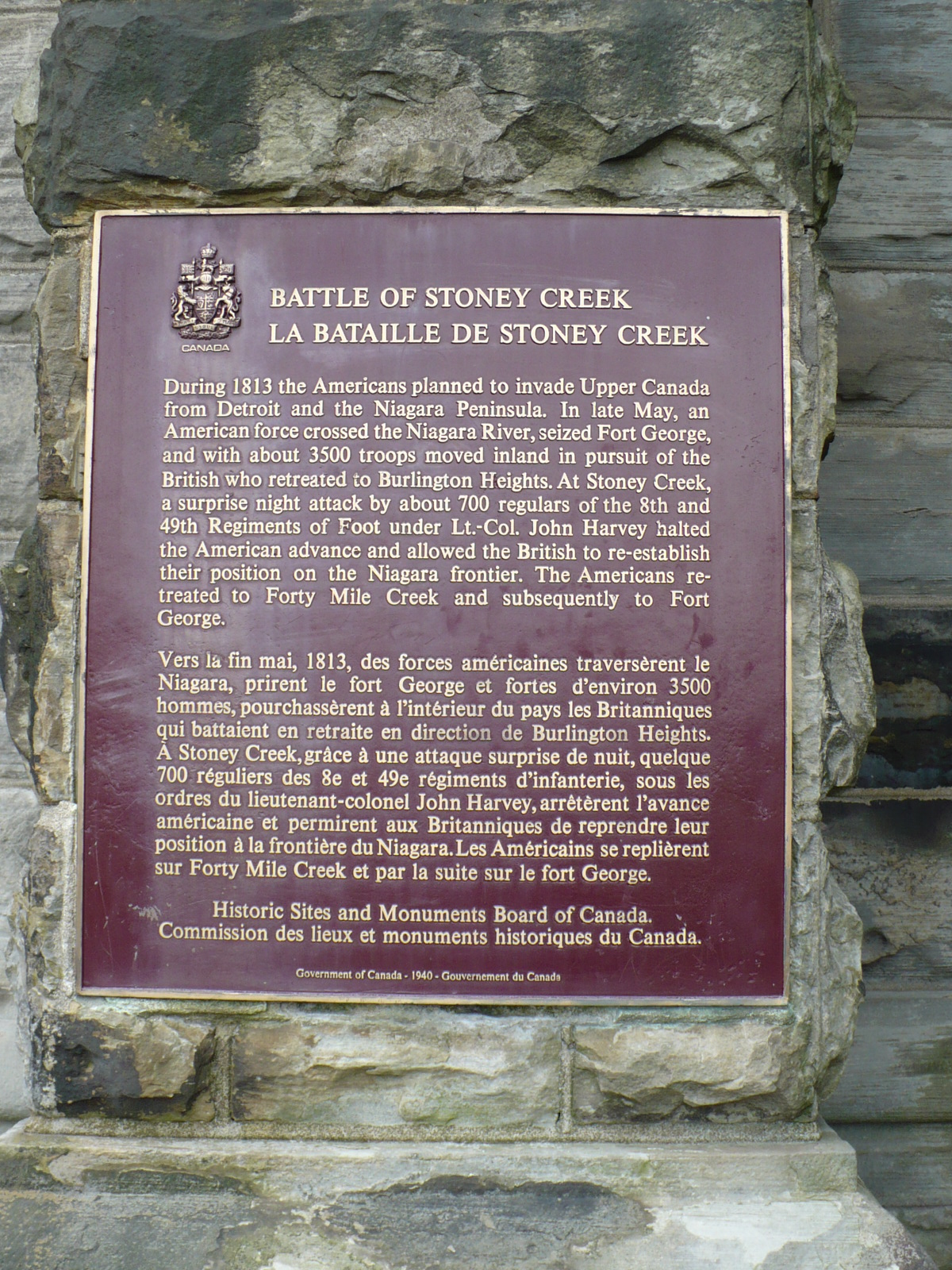
Battle of Stoney Creek
La Bataille de Stoney Creek

During 1813 the Americans planned to invade Upper Canada from Detroit and the Niagara Peninsula.  In late May, an American force crossed the Niagara River, seized Fort George, and with about 3500 troops moved inland in pursuit of the British who retreated to Burlington Heights.  At Stoney Creek, a surprise night attack by about 700 regulars of the 8th and 49th Regiments of Foot under Lt.-Col. John Harvey halted the American advance and allowed the British to re-establish their position on the Niagara frontier.  The Americans retreated to Forty Mile Creek and subsequently to Fort George.

Vers la fin mai, 1813, des forces américaines traversèrent le Niagara, prirent le fort George et fortes d’environ 3500 hommes, pourchassèrent  à l'intérieur du pays les Britanniques qui battaient en retraite en direction de Burlington Heights. À Stoney Creek, grâce à une attaque surprise de nuit, quelque 700 réguliers des 8e et 49e régiments d’infanterie, sous les ordres du lieutenant-colonel John Harvey, arrêtérent l'avance américaine et permirent aux Britanniques de reprendre leur position à la frontière du Niagara. Les Américains se replièrent sur Forty Mile Creek et par la suite sur le Fort George.

Historic Sites and Monuments Board of Canada.
Commission de lieux et monuments historiques du Canada.

Government of Canada - 1940  -  Gouvernement du Canada

[plaque]

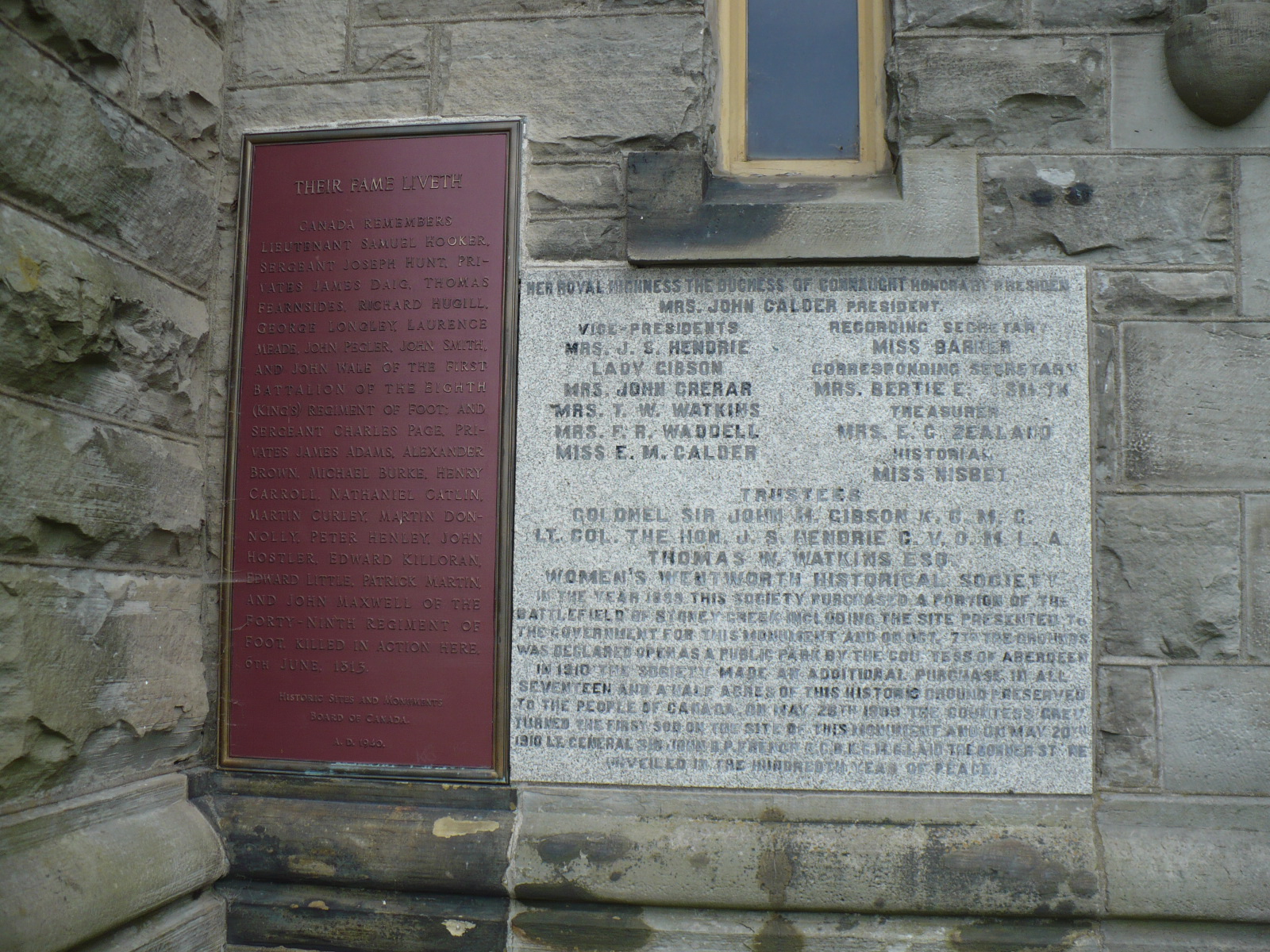
Their Fame Liveth
Canada Remembers

Lieutenant Samuel Hooker
Sergeant Joseph Hunt
Privates         James Daig
                        Thomas Fernsides
                        Richard Hugill
                        George Longley
                        Laurence Meade
                        John Pegler
                        John Smith
                        John Wale

First Battalion of the Eighth Regiment of Foot
Sergeant Charles Page
Privates         James Adams
                        Alexander Brown
                        Michael Burke
                        Henry Carroll
                        Nathaniel Catlin
                        Martin Curley
                        Martin Donnolly
                        Peter Henley
                        John Hostller
                        Edward Killoran
                        Edward Little
                        Patrick Martin
                        John Maxell

Of the 49th Regiment of Foot
Killed in action

[plaque]

Her Royal Highness the Duchess of Connaught, Honorary President
Mrs. John Calder, President
Vice Presidents     Mrs. J. S. Hendrie
                                 Lady Gibson
                                 Mrs. John Crerar
                                 Mrs. T. W. Watkins
                                 Mrs. F. R. Waddell
                                 Miss E. M. Calder
Recording Secretary Miss Barker
Corresponding Secretary Mrs. Bertie E. Smith
Treasurer Mrs. E. G. Zealand
Historian Miss Nisbet
Trustees
Colonel Sir John M. Gibson K.C.M.C.
Lt. Col, the Hon. J. S. Hendrie C.V.O.M.L.A.
Thomas W. Watkins Esq.

Women’s Wentworth Historical Society

In the year 1899 this society purchased a portion of the Battlefield of Stoney Creek including the site presented to the Government for this Monument and on October 7th the grounds was declared open as a public park by the Countess of Aberdeen.  In 1810 the Society made an additional purchase in all seventeen and a half acres of this historic ground preserved to the people of Canada.  On May 28th 1909 the Countess Grey turned the first sod on the site of this Monument and on May 20th 1920 Lt. General Sir John B. P. French C.B.K.C.H.C. laid the corner stone.  Unveiled in the hundredth year of peace.

[dedication stone]

UNVEILED BY ELECTRICITY JUNE 6TH 1913 BY

HER MAJESTY QUEEN MARY

THIS MONUMENT WAS ERECTED BY THE PEOPLE OF CANADA, COLONEL THE HONOURABLE SAM HUGHES BEING MINISTER OF MILITIA AND DEFENCE, TO COMMEMORATE THE BATTLE OF STONEY CREEK JUNE 6TH 1813.

THE BRITISH TROOPS UNDER COMMAND OF GENERAL VINCENT AND LIEUT. COLONEL HARVEY CONSISTED OF THE 49TH REG'T IN COMMAND OF MAJOR PLENDERLEATH AND FIVE COMPANIES OF THE 8TH OF KING'S IN COMMAND OF MAJOR OGILVIE, TO WHICH WAS ADDED THE VOLUNTEER ASSISTANCE OF THE SETTLERS HEREABOUTS LED BY CAPT. W.H.MERRITT OF THE CANADIAN MILITIA, THE TOTAL NUMBER BEING ABOUT SEVEN HUNDRED. THE AMERICAN FORCE NUMBERED UPWARDS OF THREE THOUSAND UNDER COMMAND OF GENERALS CHANDLER AND WINDER.

THEY WERE ENCAMPED IN THIS IMMEDIATE VICINITY WITH STAFF HEADQUARTERS IN THE GAGE FARM HOUSE, NOW MAINTAINED BY THE WOMENS WENTWORTH HISTORICAL SOCIETY THROUGH WHOSE REPRESENTATIONS AND UNDER WHOSE DIRECTION THIS MEMORIAL WAS BUILT.

IN THE DEAD OF NIGHT THE BRITISH ADVANCED FROM BURLINGTON HEIGHTS AND SURPRISING THE ENEMY, PUT HIM TO CONFUSION. THIS IS HELD TO HAVE BEEN THE DECISIVE ENGAGEMENT IN THE WAR OF 1812-13.

HERE THE TIDE OF INVASION WAS MET AND TURNED BY THE PIONEER PATRIOTS AND SOLDIERS OF THE KING OF ONE HUNDRED YEARS AGO.

MORE DEADLY THAN THEIR LIVES THEY HELD THOSE PRINCIPLES AND TRADITIONS OF BRITISH LIBERTY OF WHICH CANADA IS THE INHERITOR.

[eight shield plaques on Monument tower]

Scout-Green
James Gage
Ogilvie
Merritt
Plenderleath
Harvey
Vincent
Fitzgibbon

Location
Monument du champ de bataille

77, rue King ouest
Stoney Creek
Ontario
Coordonnées GPS
Lat. 43.2165545
Long. -79.7661938

Battlefield Monument

1 sur 5 images

surroundings

1 sur 5 images

plaque

1 sur 5 images

plaque

1 sur 5 images

Battlefield Monument

1 sur 5 images
Table des matières