[plaque]
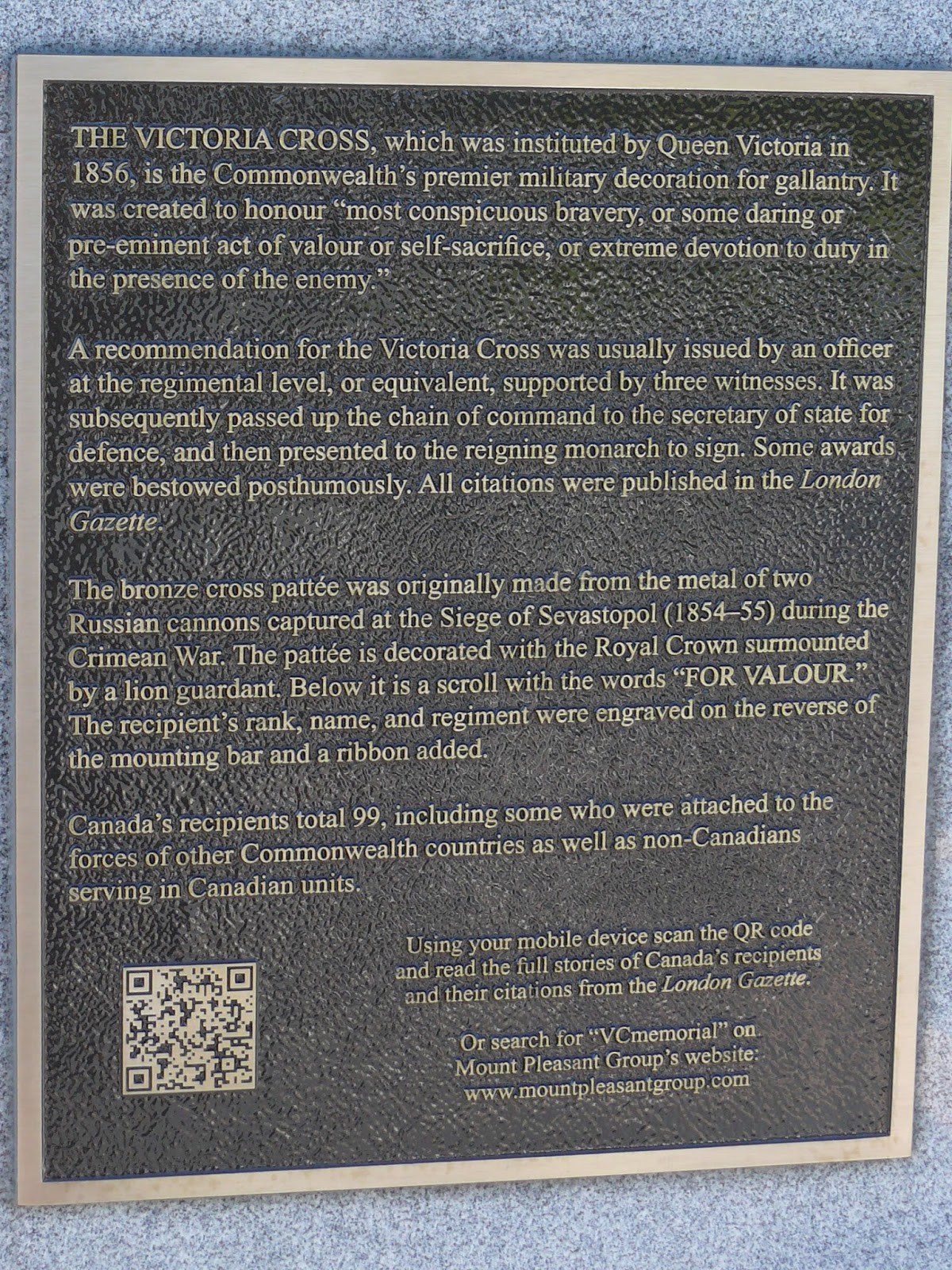
THE VICTORIA CROSS, which was instituted by Queen Victoria in
1856, is the Commonwealth's premier military decoration for gallantry. It
was created to honour "most conspicuous bravery, or some daring or
pre-eminent act of valour or self-sacrifice, or extreme devotion to duty in
the presence of the enemy."
A recommendation for the Victoria Cross was usually issued by an officer
at the regimental level, or equivalent, supported by three witnesses. It was
subsequently passed up the chain of command to the secretary of state for
defence, and then presented to the reigning monarch to sign. some awards
were bestowed posthumously. All citations were published in the London
Gazette.
The bronze cross pattee was originally made from the metal of two
Russian cannons captured at the Siege of Sevastopol (1854-55) during the
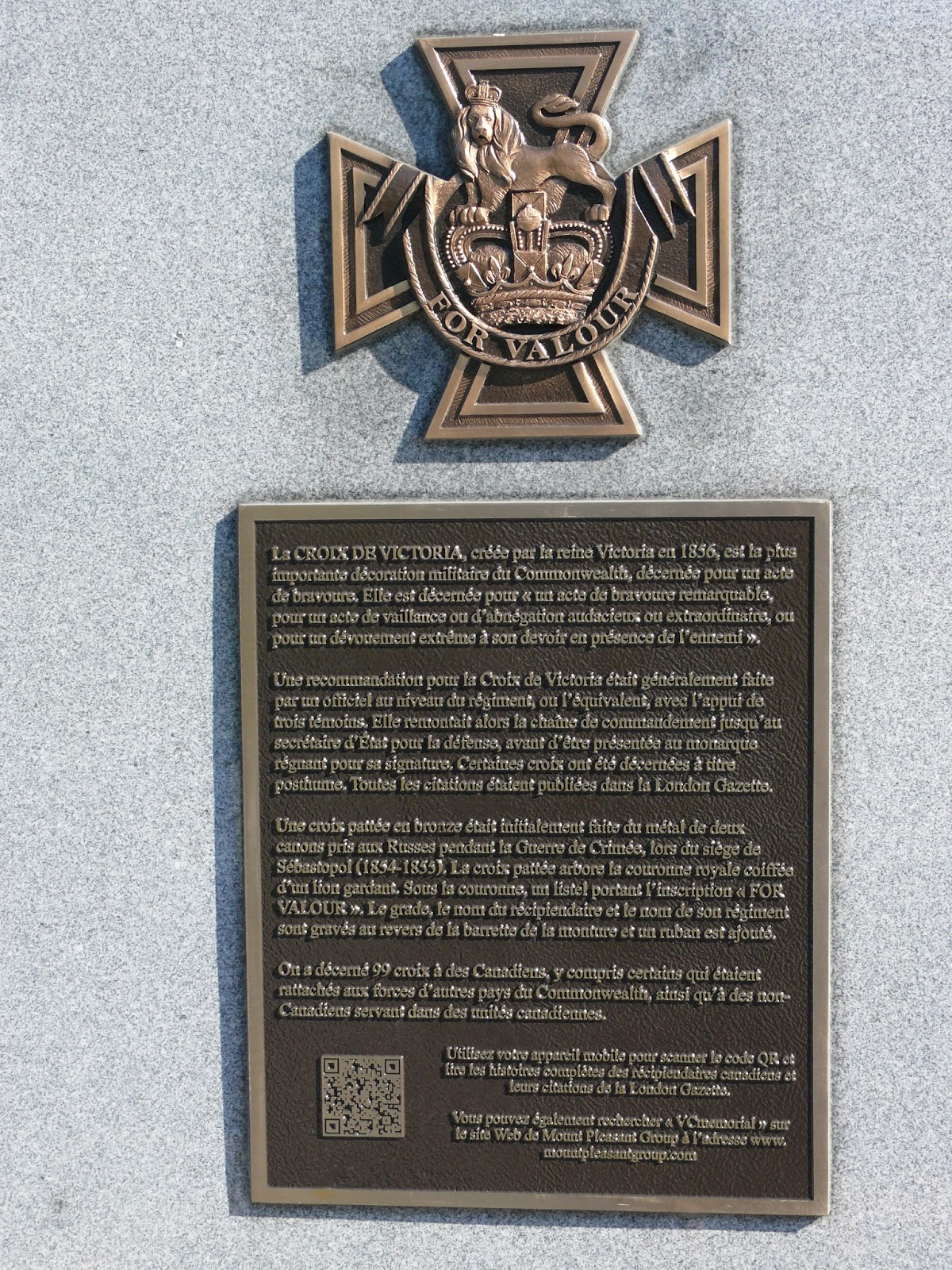
Crimean War. The pattee is decorated with the Royal Crown surmounted
by a lion guardant. Below it is a scroll with the words "FOR VALOUR."
The recipient's rank, name and regiment were engraved on the reverse of
the mounting bar and a ribbon added.
Canada's recipients total 99, including some who were attached to the
forces of other Commonwealth countries as well as non-Canadians
serving in Canadian units.
[plaque]
LA CROIX DE VICTORIA, créée par la reine Victoria en 1856, est la plus
imortante décoration militaire du Commonwealth, décernée pour un acte
de bravoure. Elle est décernée pour « un acte de bravoure remarquable,
pour un acte de vaillance ou d'abnégation audacieux ou extraordinaire, ou
pour un dévouement extrême à son devoir en présence de l'ennemi ».
Une recommandation pour la Croix de Victoria était généralement faite
par un officiel au niveau du régiment, ou l'équivalent, avec l'appui de
trois témoins. Elle remontait alors la chaîne de commandement jusqu'au
secrétaire d'État pour la défense, avant d'étre présentée au monarque
régnant pour sa signature. Certaines croix ont été décernées à titre
posthume. Toutes les citations étaient publiées dans le London Gazette.
Une croix pattée en bronze était initialement faite du métal de deux
canons prix aux Russes pendant la Guerre de Crimée, lors du siege de
Sébastopol (1854-1855). Le croix pattée arbore la couronne royale coiffée
d'un lion gardant. Sous la couronne, un listel portant l'inscription « FOR
VALOR ». Le grade, le nom du récipiendaire et le nom de son regiment
sont gravés au revers dela barrette de monture et un ruban est ajouté.
On a décerné 99 croix à des Canadiens, y compris certains qui étaient
rattachés aux forces d'autres pays du Commonwealth, ainsi qu'à des non-
Canadiens servant dans des unités canadiennes.
[wall/mur]
needs further research/recherche incomplète