[plaque]
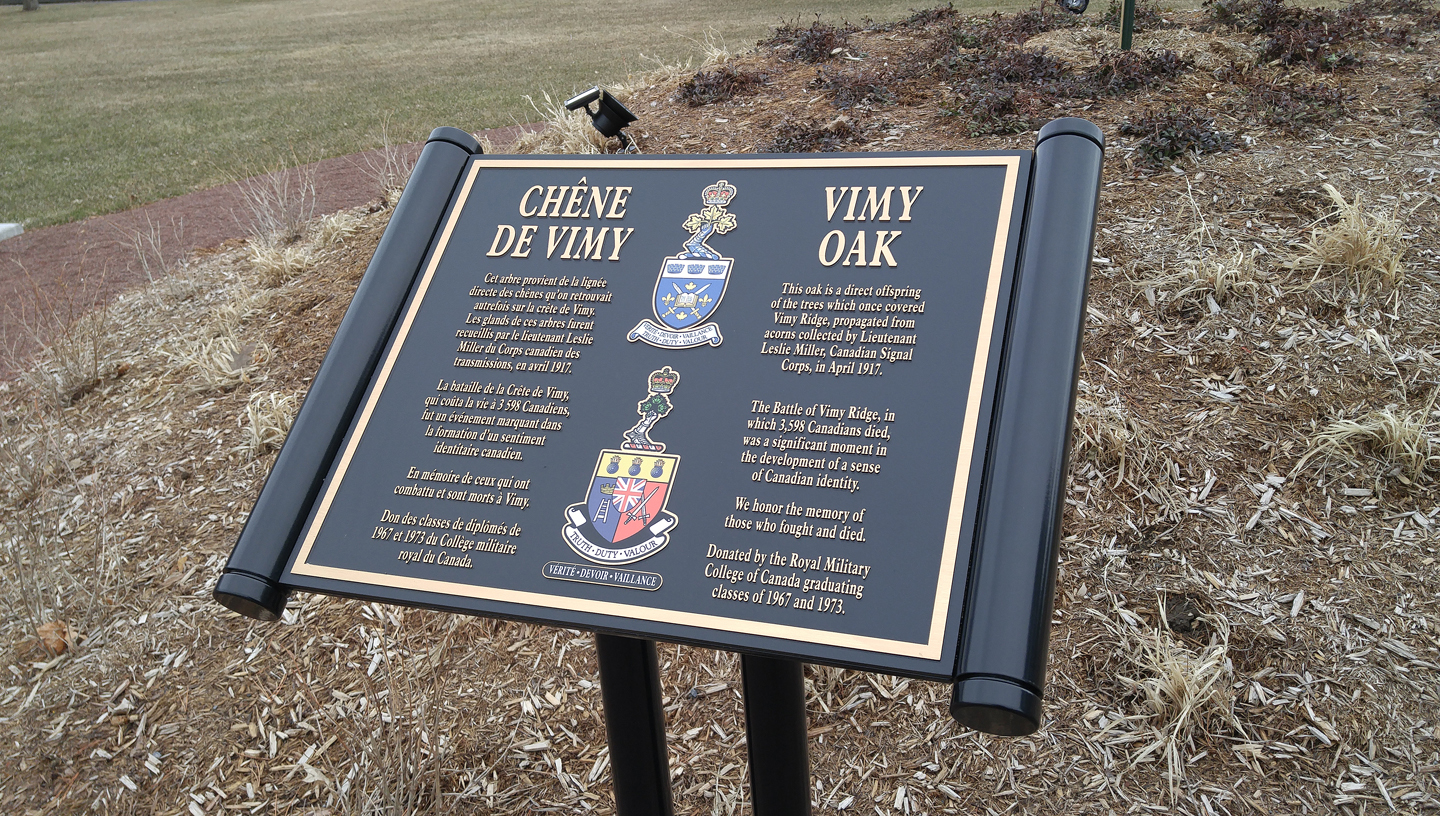
- CHÊNE
DE VIMY
- Cet arbre provient de la lingée
directe des chênes qu'on retrouvait
autrefois su la crête de Vimy.
Les glands de ces arbres furent
recueillis par le lieutenant Leslie
Miller du Corps canadien des
transmission, en avril 1917.
- La bataille de la Crête de Vimy,
qui coûta la vie à 3 598 Canadiens
fut un événement marquant dans
la formation d'un sentiment
identitaire canadien.
- En mémoire de ceux qui ont
combattu et sont morts à Vimy.
- Don des classes de diplômés de
1967 et 1973 du Collège militairs
royal du Canada.
- VIMY
OAK
- This oak is a direct offspring
of the trees which once covered
Vimy Ridge, propagated from
acorns collected by Lieutenant
Leslie Miller, Canadian Signal
Corps, in April 1917.
- The Battle of Vimy Ridge, in
which 3,598 Canadian died,
was a significan moment in
the devlopment of a sense
of Canadian identity.
- We honor the memory of
those who fought and died.
- Donated by the Royal Military
College of Canada graduating
classes of 1967 and 1973.
TRUTH DUTY VALOUR
VÉRITÉ DEVOIR VALEUR
[storyboard/scénarimage]
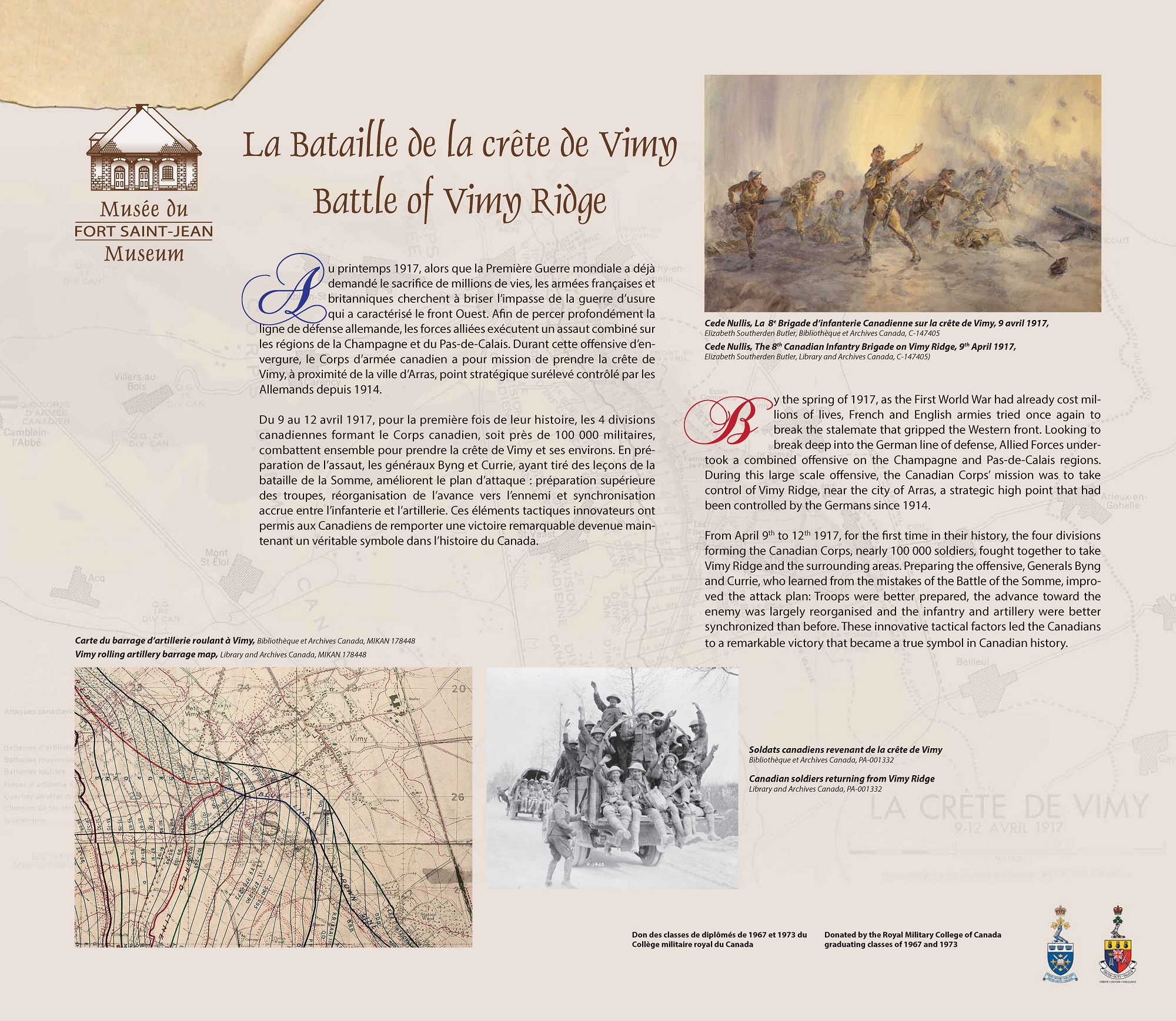
La Bataille de la crête de Vimy
Battle of Vimy Ridge
Au printemps 1917, alors que la Première Guerre mondiale a déjà
demandé le sacrifice de millions de vies, les armées françaises et
britanniques cherchent à briser l’impasse de la guerre d’usure
qui a caractérisé le front Ouest. Afin de percer profondément la
ligne de défense allemande, les forces alliées exécutent un assaut combiné sur
les régions de la Champagne et du Pas-de-Calais. Durant cette offensive d’envergure,
le Corps d’armée canadien a pour mission de prendre la crête de
Vimy, à proximité de la ville d’Arras, point stratégique surélevé contrôlé par les
Allemands depuis 1914.
Du 9 au 12 avril 1917, pour la première fois de leur histoire, les 4 divisions
canadiennes formant le Corps canadien, soit près de 100 000 militaires,
combattent ensemble pour prendre la crête de Vimy et ses environs. En préparation
de l’assaut, les généraux Byng et Currie, ayant tiré des leçons de la
bataille de la Somme, améliorent le plan d’attaque : préparation supérieure
des troupes, réorganisation de l’avance vers l’ennemi et synchronisation
accrue entre l’infanterie et l’artillerie. Ces éléments tactiques innovateurs ont
permis aux Canadiens de remporter une victoire remarquable devenue maintenant
un véritable symbole dans l’histoire du Canada.
By the spring of 1917, as the First World War had already cost millions
of lives, French and English armies tried once again to
break the stalemate that gripped the Western front. Looking to
break deep into the German line of defense, Allied Forces undertook
a combined offensive on the Champagne and Pas-de-Calais regions.
During this large scale offensive, the Canadian Corps’ mission was to take
control of Vimy Ridge, near the city of Arras, a strategic high point that had
been controlled by the Germans since 1914.
From April 9th to 12th 1917, for the first time in their history, the four divisions
forming the Canadian Corps, nearly 100 000 soldiers, fought together to take
Vimy Ridge and the surrounding areas. Preparing the offensive, Generals Byng
and Currie, who learned from the mistakes of the Battle of the Somme, improved
the attack plan: Troops were better prepared, the advance toward the
enemy was largely reorganised and the infantry and artillery were better
synchronized than before. These innovative tactical factors led the Canadians
to a remarkable victory that became a true symbol in Canadian history.