
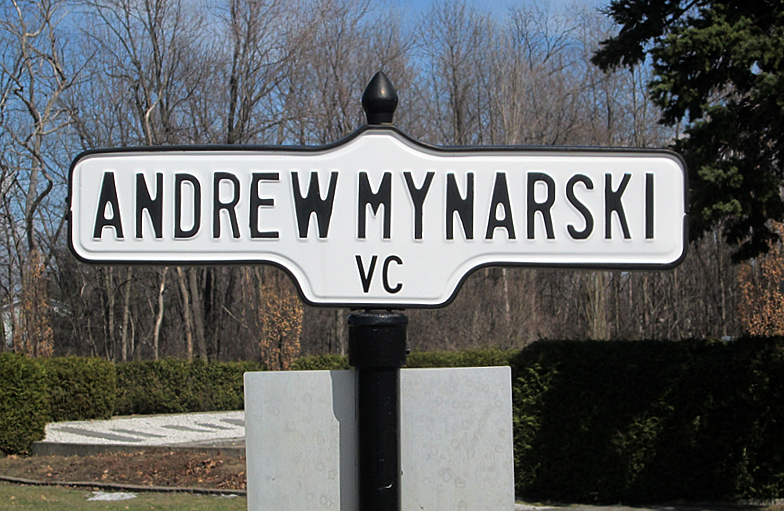
Andrew Mynarski, rue VC

Pointe-Claire,
Type
Autre

Ce chemin est nommé en l’honneur du sous-lieutenant d’aviation Andrew Charles Mynarski, VC.

Andrew Charles Mynarski naît à Winnipeg, au Manitoba, le 14 octobre 1916. Il s'enrôle dans l’Aviation royale du Canada (ARC) en 1941.

Dans la nuit du 12 au 13 juin 1944, le Sous-lieutenant d’aviation Mynarski est mitrailleur dorsal à bord d’un bombardier Avro Lancaster du 419eEscadron de l’ARC durant une attaque contre la gare ferroviaire de marchandises à Cambrai, en France. L’avion est attaqué par un chasseur de nuit allemand, les deux moteurs gauches tombent en panne, et un incendie éclate entre les tourelles dorsales et arrière ainsi que dans le réservoir d’essence de l’aile gauche. L’incendie prend bientôt une telle ampleur que le pilote ordonne d’abandonner l’appareil. Alors que Mynarski quitte sa tourelle et se déplace vers la trappe d’évacuation, il s’aperçoit que le mitrailleur arrière, le Lieutenant d’aviation G. P. Brophy, est incapable de sortir de sa tourelle, qui ne peut être déplacée en raison d’une panne des circuits hydraulique et manuel. Le Sous-lieutenant d'aviation Mynarski se dirige immédiatement vers l’arrière, au milieu des flammes, afin de libérer Brophy. Son parachute et ses pantalons maintenant en feu, Mynarski s’efforce sans succès de déplacer la tourelle et de libérer Brophy. À ce moment-là, le Lieutenant d'aviation Brophy indique clairement qu’il n’y a plus rien à faire et que Mynarski doit tenter de se sauver. À regret, le Sous-lieutenant d'aviation Mynarski retourne à la trappe d’évacuation au milieu des flammes et saute, son parachute et ses vêtements en feu. Après avoir touché terre, il est finalement trouvé par les Français, mais il meurt en raison de la gravité de ses brûlures.

La Croix de Victoria est décernée à titre posthume au Sous-lieutenant d’aviation Mynarski pour sa tentative courageuse et désintéressée en vue de sauver son camarade. De façon miraculeuse, le Lieutenant d’aviation Brophy survit à l’écrasement du Lancaster en détresse et, grâce à la Résistance française, il est de retour en Angleterre en septembre.

Inscription

[front/devant]

Citation from London Gazette, no.37754, 11 October 1946.

"Pilot Officer Mynarski was the mid-upper gunner of a Lancaster aircraft, detailed to attack a target at Cambrai in France, on the night of 12th June, 1944. The aircraft was attacked from below and astern by an enemy fighter and ultimately came down in flames.

As an immediate result of the attack, both port engines failed. Fire broke out between the mid-upper turret and the rear turret, as well as in the port wing. The flames soon became fierce and the captain ordered the crew to abandon the aircraft.

Pilot Officer Mynarski left his turret and went towards the escape hatch. He then saw that the rear gunner was still in his turret and apparently unable to leave it. The turret was, in fact, immovable, since the hydraulic gear had been put out of action when the port engines failed, and the manual gear had been broken by the gunner in his attempts to escape.

Without hesitation, Pilot Officer Mynarski made his way through the flames in an endeavour to reach the rear turret and release the gunner. Whilst so doing, his parachute and his clothing, up to the waist, were set on fire. All his efforts to move the turret and free the gunner were in vain. Eventually the rear gunner clearly indicated to him that there was nothing more he could do and that he should try to save his own life. Pilot Officer Mynarski reluctantly went back through the flames to the escape hatch. There, as a last gesture to the trapper gunner, he turned towards him, stood to attention in his flaming clothing and saluted, before he jumped out of the aircraft. Pilot Officer Mynarski’s descent was seen by French people on the ground. Both his parachute and clothing were on fire. He was found eventually by the French, but was so severely burnt that he died from his injuries.

The rear gunner had a miraculous escape when the aircraft crashed. He subsequently testified that, had Pilot Officer Mynarski not attempted to save his comrade’s life, he could have left the aircraft in safety and would, doubtless, have escaped death.

Pilot Officer Mynarski must have been fully aware that in trying to free the rear gunner he was almost certain to lose his own life. Despite this, with outstanding courage and complete disregard for his own safety, he went to the rescue. Willingly accepting the danger, Pilot Officer Mynarski lost his life by a most conspicuous act of heroism which called for valour of the highest order."

Location
Andrew Mynarski, rue VC

703 Avenue Donegani
Pointe-Claire
Coordonnées GPS
Lat. 45.4386443
Long. -73.8365496

Table des matières