
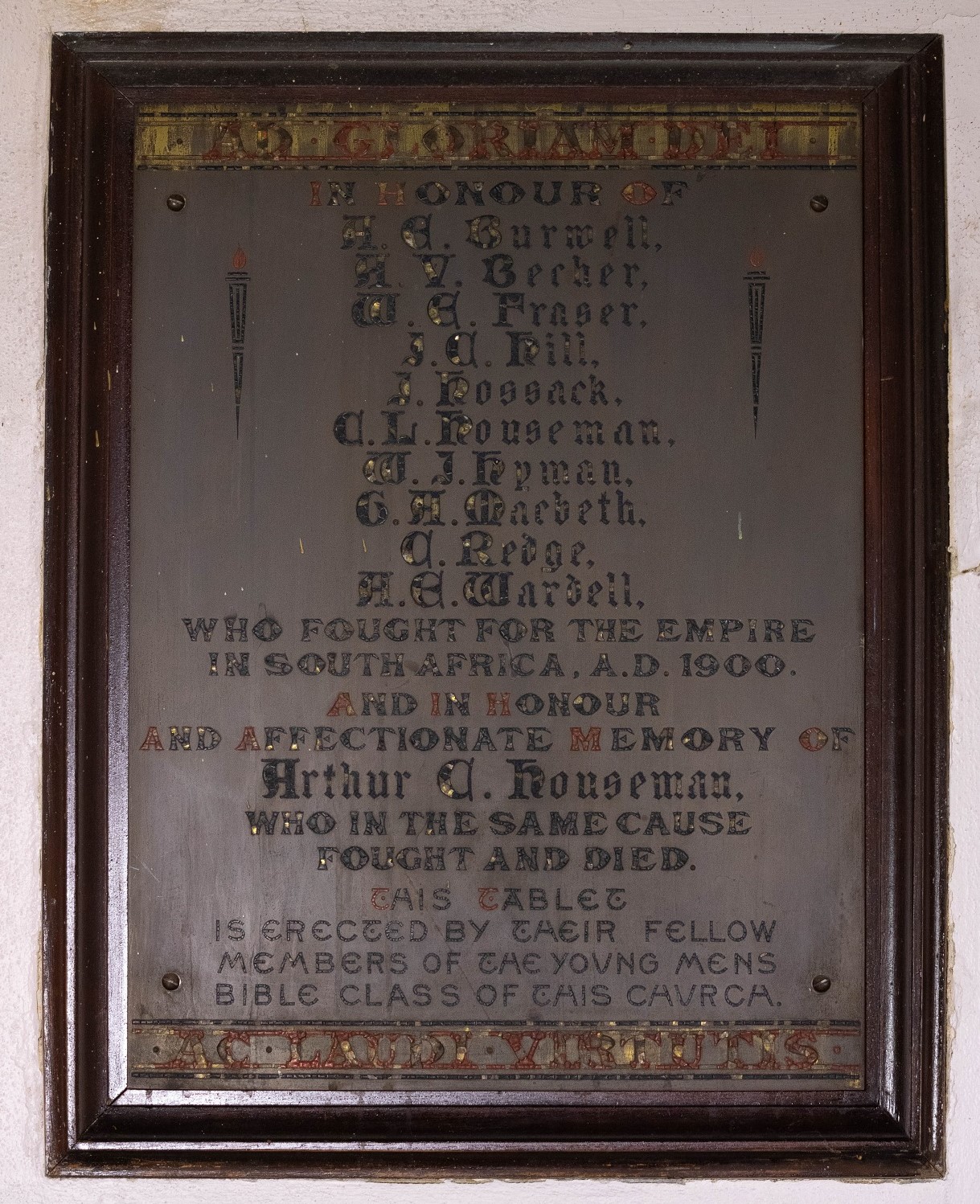
The South African War Plaque was unveiled in 1901, 2nd anniversary of the October 25, 1899 departure to South Africa.
Eleven men from the St. John’s Bible Class and St. John’s Athletic Club volunteered for the South African War. Six joined B Company of the First Canadian Contingent to South Africa: Sergeant Macbeth, Privates Burwell, Hill, Hyman, Redge, and Wardell. Private Becher was a member of the reinforcement group contingent. Private Frasher joined A squadron of the First Battalion of the Canadian Mounted Rifles of the second Canadian Contingent. Arthur C. Houseman was a civil surgeon for South African Light Horse Cavalry unit. He was cited for bravery by British Commander-in-Chief, General Sir Redevers Buller (London England, Gazette of Feb 1901). He was killed in the war and buried in South Africa. The assignments for C.L. Houseman and J. Hossack are not known.
The eleven men left left London on October 25, 1899 as part of a grand parade. At 1:00 PM they left Wolseley Baracks and marched to Victoria Park. Upon entering the park the crowd and school children began to sing, “The Soldiers of the Queen.” After a short ceremony they marched down Richmond Avenue to the old Grand Trunk Railway station and were addressed by Prime Minister Sir Wilfred Laurier. Upon boarding the train, a band played: “God Save the Queen” and “Auld Lang Syne” (London Free Press 26 October 1899 and London Advertiser 26 October 1899).
In South Africa, they took part in the Zand River fight, Battle of Paardeberg and the surrender of Piet Cronje’s Boer Army on February 27, 1900, along with Lord Roberts’ march on Pretoria.