[front/devant]
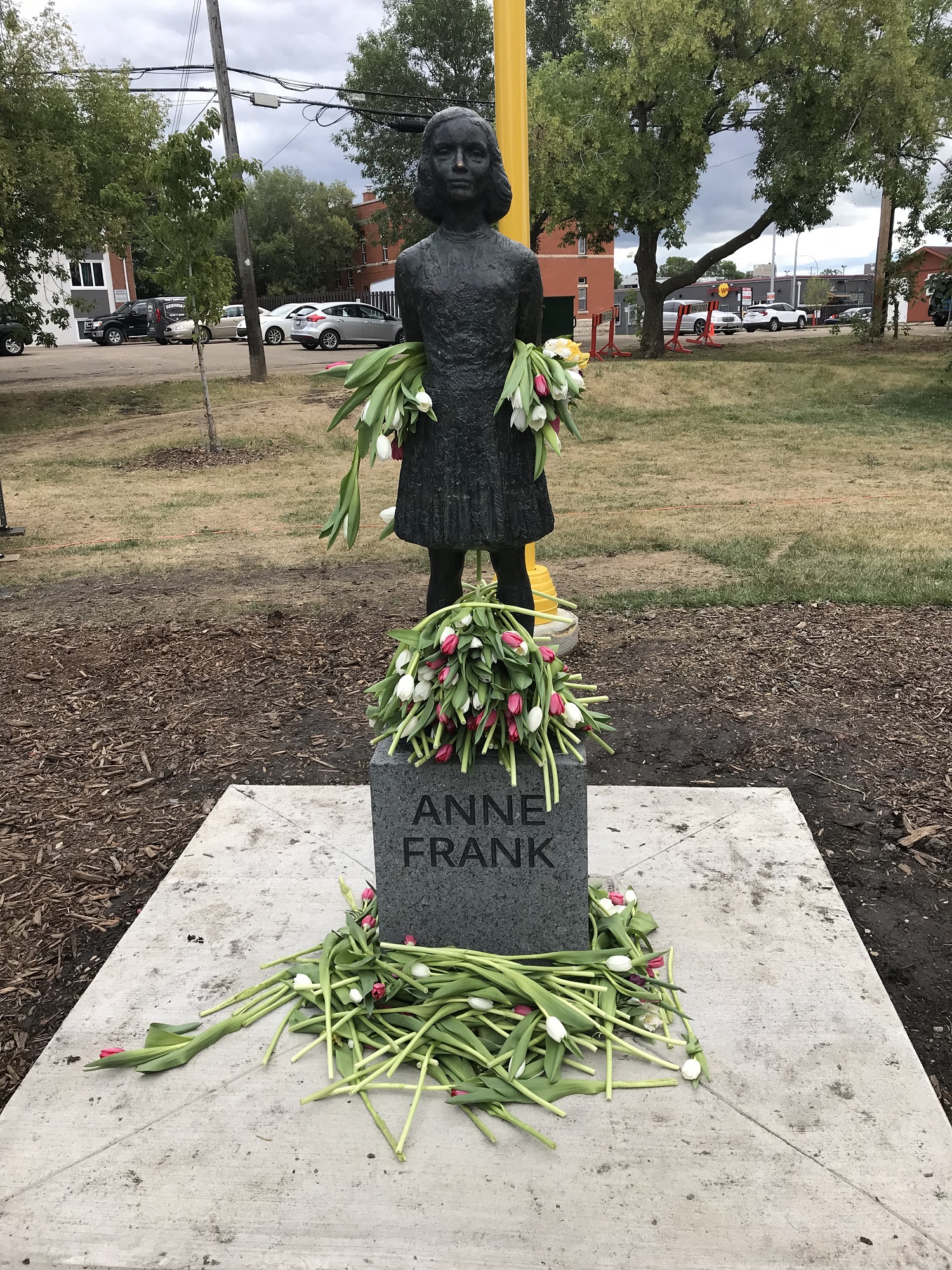
ANNE
FRANK
[back/arrière]
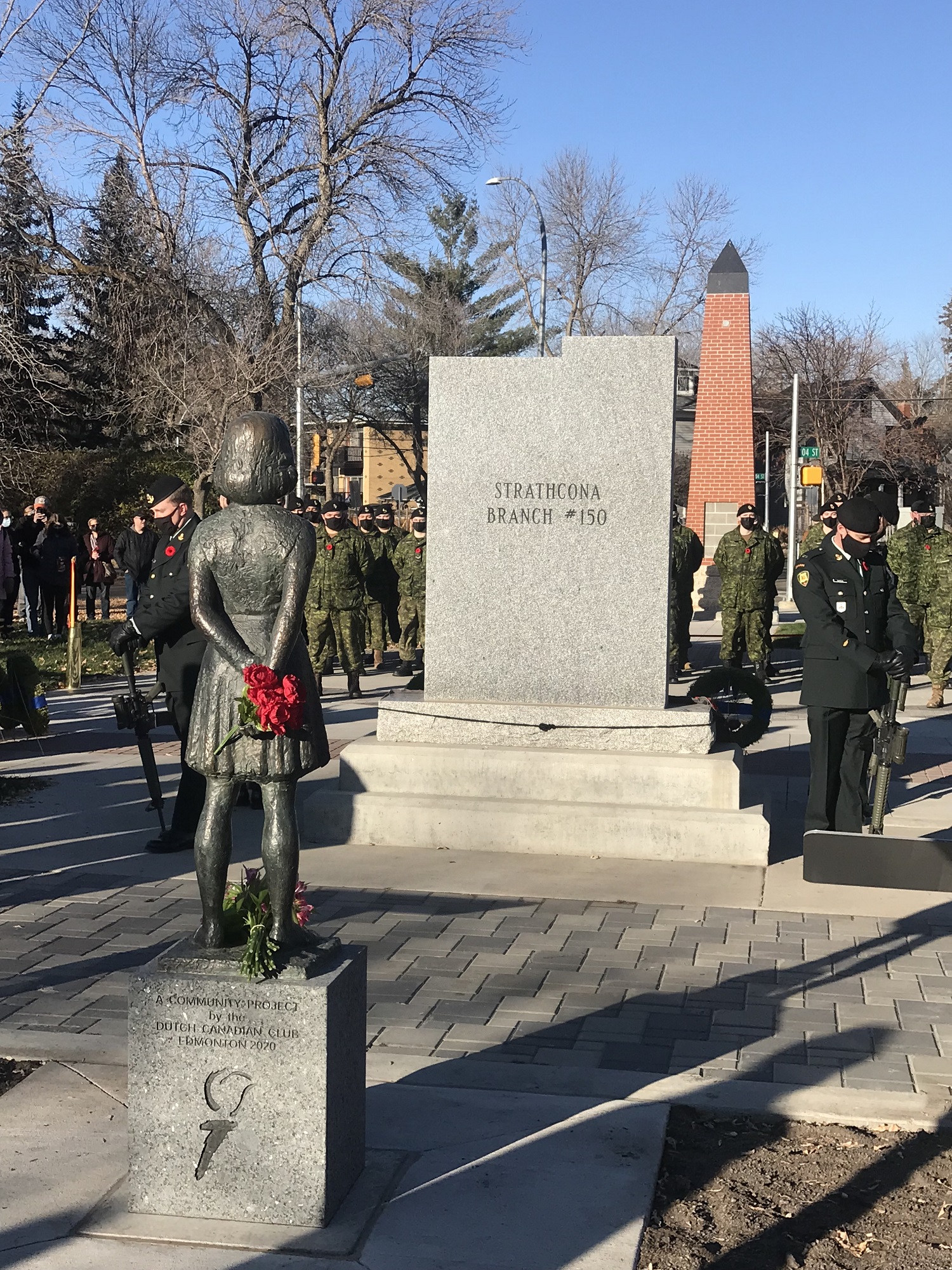
A COMMUNITY PROJECT
by the
DUTCH CANADIAN CLUB
EDMONTON 2020
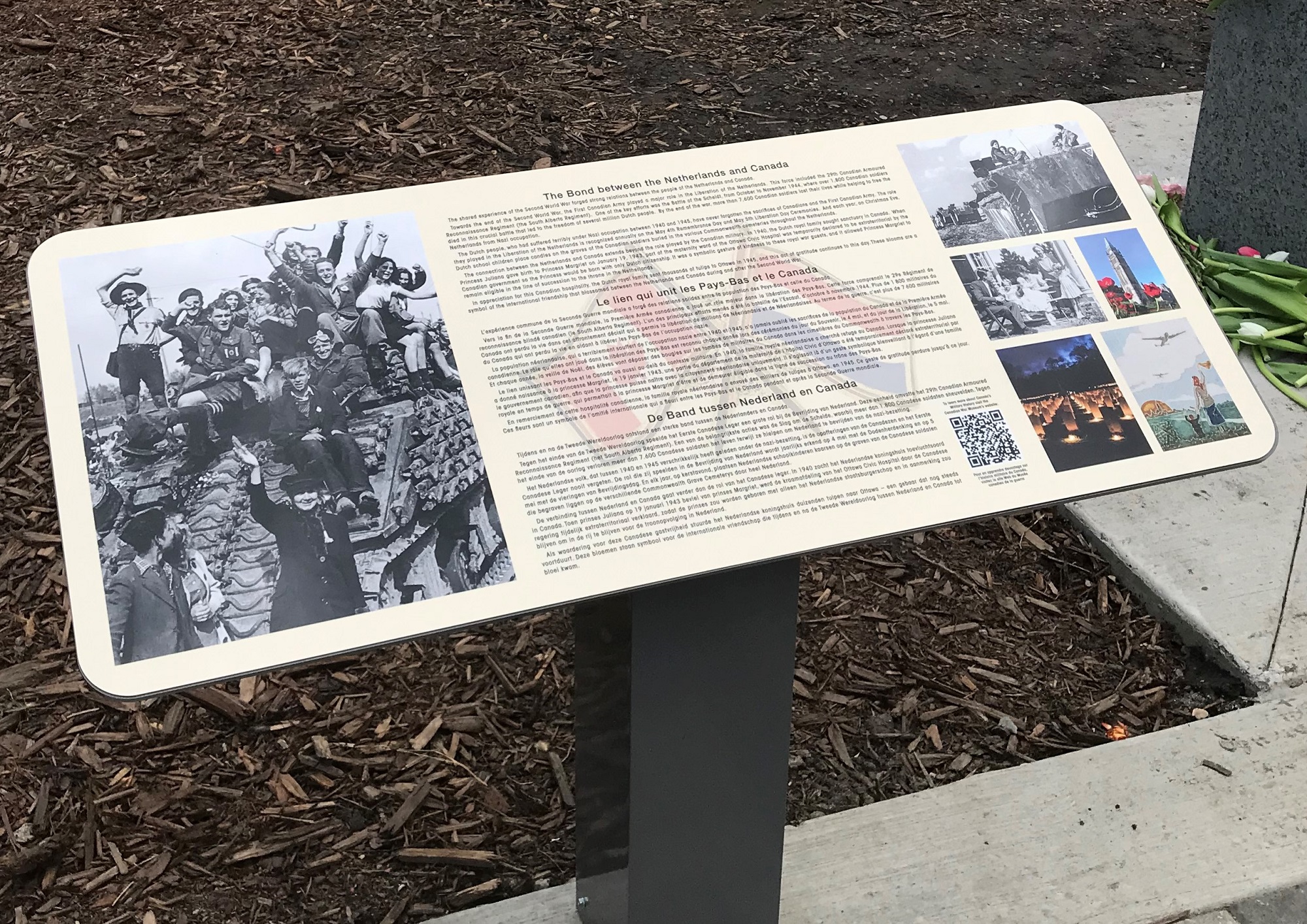
[educational plaque/plaque éducative]
The Bond between the Netherlands and Canada
The shared experience of the Second World War forged strong relations between the people of the Netherlands and Canada.
Towards the end of the Second World War, the First Canadian Army played a major role in the Liberation of the Netherlands. This force included the 29th Canadian Armoured Reconnaissance Regiment (the South Alberta Regiment). One of the key efforts was the Battle of the Scheldt, from October to November 1944, where over 1,800 Canadian soldiers died in this crucial battle that led to the freedom of several million Dutch people. By the end of the war, more than 7,600 Canadian soldiers lost their lives while helping to free the Netherlands from Nazi occupation.
The Dutch people, who had suffered terribly under Nazi occupation between 1940 and 1945, have never forgotten the sacrifices of Canadians and the First Canadian Army. The role they played in the Liberation of the Netherlands is recognized annually on the May 4th Remembrance Day and May 5th Liberation Day Ceremonies. And each year, on Christmas Eve, Dutch school children place candles on the graves of the Canadian soldiers buried in the various Commonwealth cemeteries throughout the Netherlands.
The connection between the Netherlands and Canada extends beyond the role played by the Canadian military. In 1940, the Dutch royal family sought sanctuary in Canada. When Princess Juliana gave birth to Princess Margriet on January 19, 1943, part of the maternity ward of the Ottawa Civic Hospital was temporarily declared to be extraterritorial by the Canadian government so the Princess would be born with only Dutch citizenship. It was a symbolic gesture of kindness to these royal war guests, and it allowed Princess Margriet to remain eligible in the line of succession to the throne in the Netherlands.
In appreciation for this Canadian hospitality, the Dutch royal family sent thousands of tulips to Ottawa in 1945, and this act of gratitude continues to this day. These blooms are a symbol of the international friendship that blossomed between the Netherlands and Canada during and after the Second World War.
Le lien qui unit les Pays-Bas et le Canada
L’expérience commune de la Seconde Guerre mondiale a forgé des relations solides entre la population des Pays-Bas et celle du Canada.
Vers la fin de la Seconde Guerre mondiale, la Première Armée canadienne a joué un rôle majeur dans la libération des Pays-Bas. Cette force comprenait le 29e Régiment de reconnaissance blindé canadien (le South Alberta Regiment). L’un des principaux efforts menés a été la bataille de l’Escaut, d’octobre à novembre 1944. Plus de 1 800 militaires du Canada ont perdu la vie dans cet affrontement décisif qui a permis la libération de millions de Néerlandais et de Néerlandaises. Au terme de la guerre, c’est plus de 7 600 militaires du Canada qui ont perdu la vie en aidant à libérer les Pays-Bas de l’occupation nazie.
La population néerlandaise, qui a terriblement souffert de l’occupation nazie entre 1940 et 1945, n’a jamais oublié les sacrifices de la population du Canada et de la Première Armée canadienne. Le rôle qu’elles ont joué dans la libération des Pays-Bas est reconnu chaque année lors des cérémonies du jour du Souvenir, le 4 mai, et du jour de la Libération, le 5 mai. Et chaque année, la veille de Noël, des élèves vont déposer des bougies sur les tombes de militaires du Canada dans les cimetières du Commonwealth à travers les Pays-Bas.
Le lien unissant les Pays-Bas et le Canada va aussi au-delà du contexte militaire. En 1940, la famille royale néerlandaise a cherché refuge au Canada. Lorsque la princesse Juliana a donné naissance à la princesse Margriet, le 19 janvier 1943, une partie du département de la maternité de l’hôpital Civic d’Ottawa a été temporairement déclaré extraterritorial par le gouvernement canadien, afin que la princesse puisse naître avec la citoyenneté néerlandaise uniquement. Il s’agissait là d’un geste symbolique bienveillant à l’égard d’une famille royale en temps de guerre, qui permettait à la princesse Margriet d’être et de demeurer éligible dans la ligne de succession au trône des Pays-Bas.
En remerciement de cette hospitalité canadienne, la famille royale néerlandaise a envoyé des milliers de tulipes à Ottawa, en 1945. Ce geste de gratitude perdure jusqu’à ce jour. Ces fleurs sont un symbole de l’amitié internationale qui a fleuri entre les Pays-Bas et le Canada pendant et après la Seconde Guerre mondiale.
De Band tussen Nederland en Canada
Tijdens en na de Tweede Wereldoorlog ontstond een sterke band tussen de Nederlanders en Canada.
Tegen het einde van de Tweede Wereldoorlog speelde het Eerste Canadese Leger een grote rol bij de Bevrijding van Nederland. Deze eenheid omvatte het 29th Canadian Armoured Reconnaissance Regiment (het South Alberta Regiment). Een van de belangrijkste acties was de Slag om de Schelde, waarbij meer dan 1.800 Canadese soldaten sneuvelden. Tegenhet einde van de oorlog verloren meer dan 7.600 Canadese soldaten het leven terwijl ze hielpen om Nederland te bevrijden van de nazi-bezetting.
Het Nederlandse volk, dat tussen 1940 en 1945 verschrikkelijk heeft geleden onder de nazi-bezetting, is de opofferingen van de Canadezen en het Eerste Canadese Leger nooit vergeten. De rol die zij speelden in de Bevrijding van Nederland wordt jaarlijks erkend op 4 mei met de Dodenherdenking en op 5 mei met de vieringen van Bevrijdingsdag. En elk jaar, op kerstavond, plaatsen Nederlandse schoolkinderen kaarsen op de graven van de Canadese soldaten die begraven liggen op de verschillende Commonwealth Grave Cemeterys door heel Nederland.
De verbinding tussen Nederland en Canada gaat verder dan de rol van het Canadese leger. In 1940 zocht het Nederlandse koningshuis toevluchtsoord in Canada. Toen prinses Juliana op 19 januari 1943 beviel van prinses Margriet, werd de kraamafdeling van het Ottawa Civic Hospital door de Canadese regering tijdelijk extraterritoriaal verklaard, zodat de prinses zou worden geboren met alleen het Nederlandse staatsburgerschap en in aanmerking zou blijven om in de rij te blijven voor de troonopvolging in Nederland.
Als waardering voor deze Canadese gastvrijheid stuurde het Nederlandse koningshuis duizenden tulpen naar Ottawa – een gebaar dat nog steeds voortduurt. Deze bloemen staan symbool voor de internationale vriendschap die tijdens en na de Tweede Wereldoorlog tussen Nederland en Canada tot bloei kwam.
[educational plaque/plaque éducative]
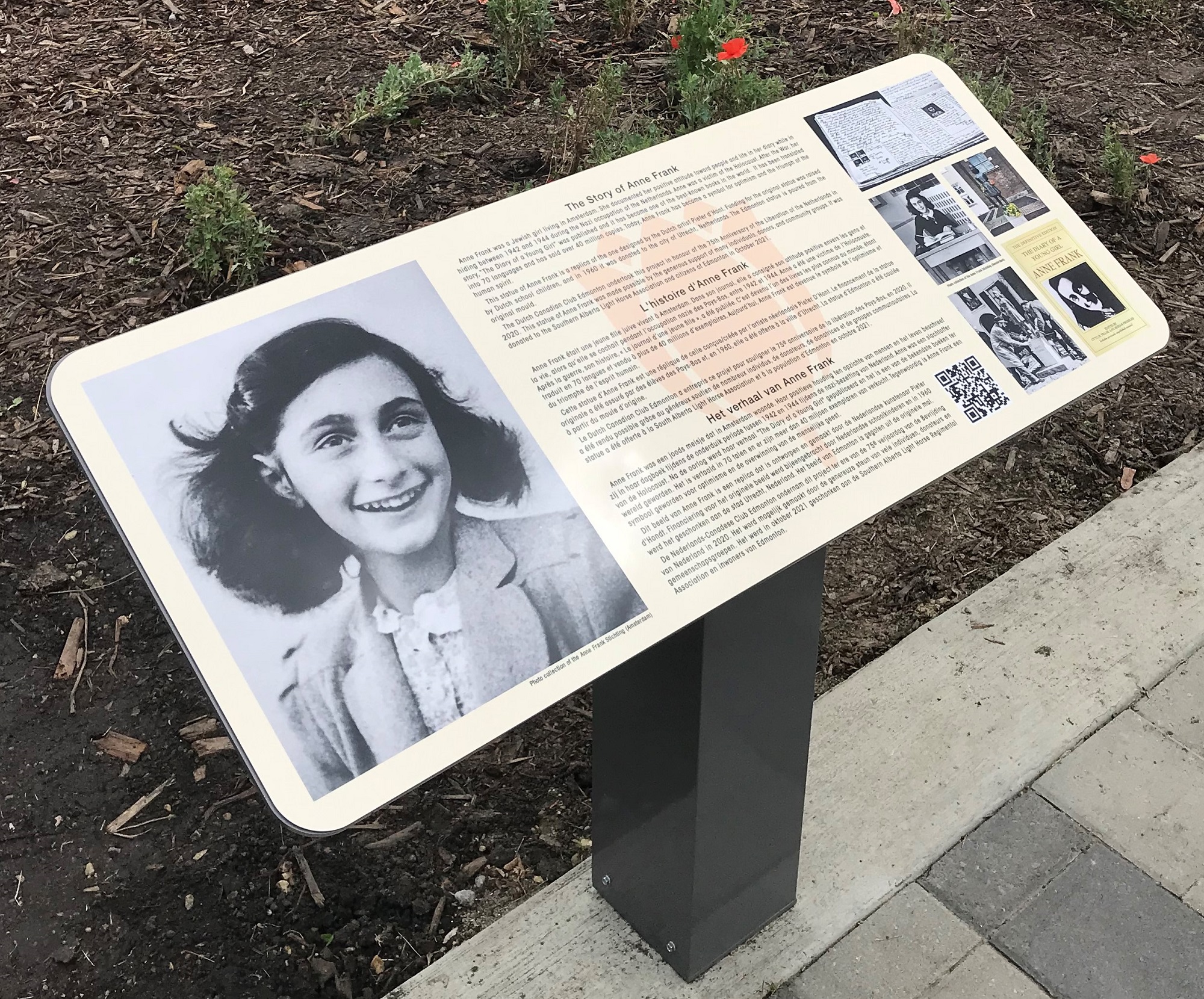
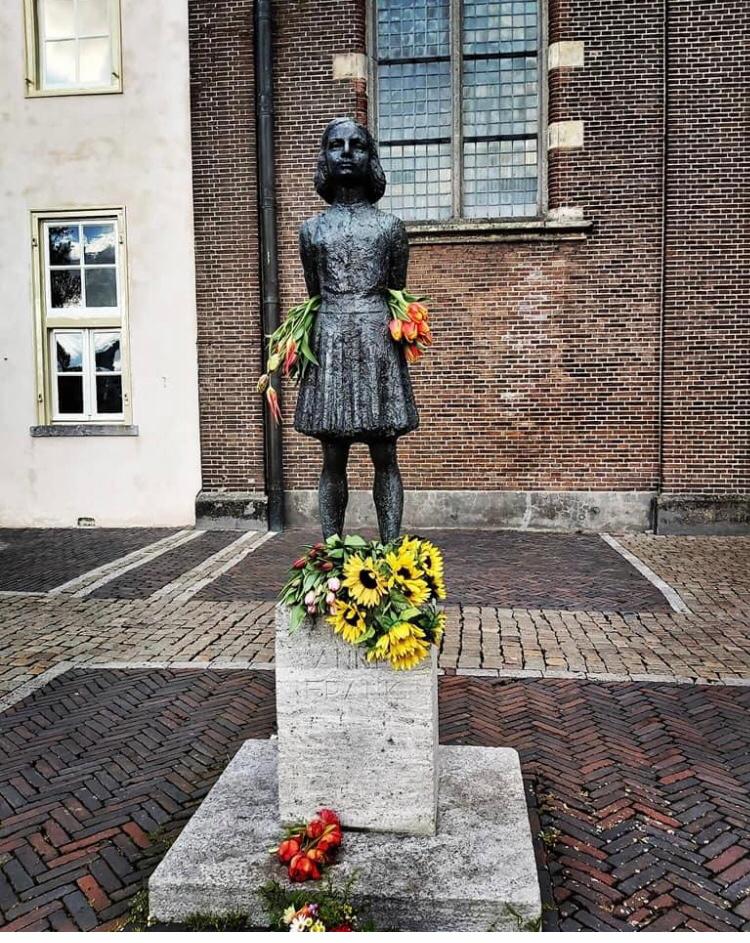
The Story of Anne Frank
Anne Frank was a Jewish girl living in Amsterdam. She documented her positive attitude toward people and life in her diary while in hiding between 1942 and 1944 during the Nazi occupation of the Netherlands. Anne was a victim of the Holocaust. After the Second World War, her story, “The Diary of a Young Girl” was published and it has become one of the best-known books in the world. It has been translated into 70 languages and has sold over 30 million copies. Today, Anne Frank has become a symbol for optimism and the triumph of the human spirit.
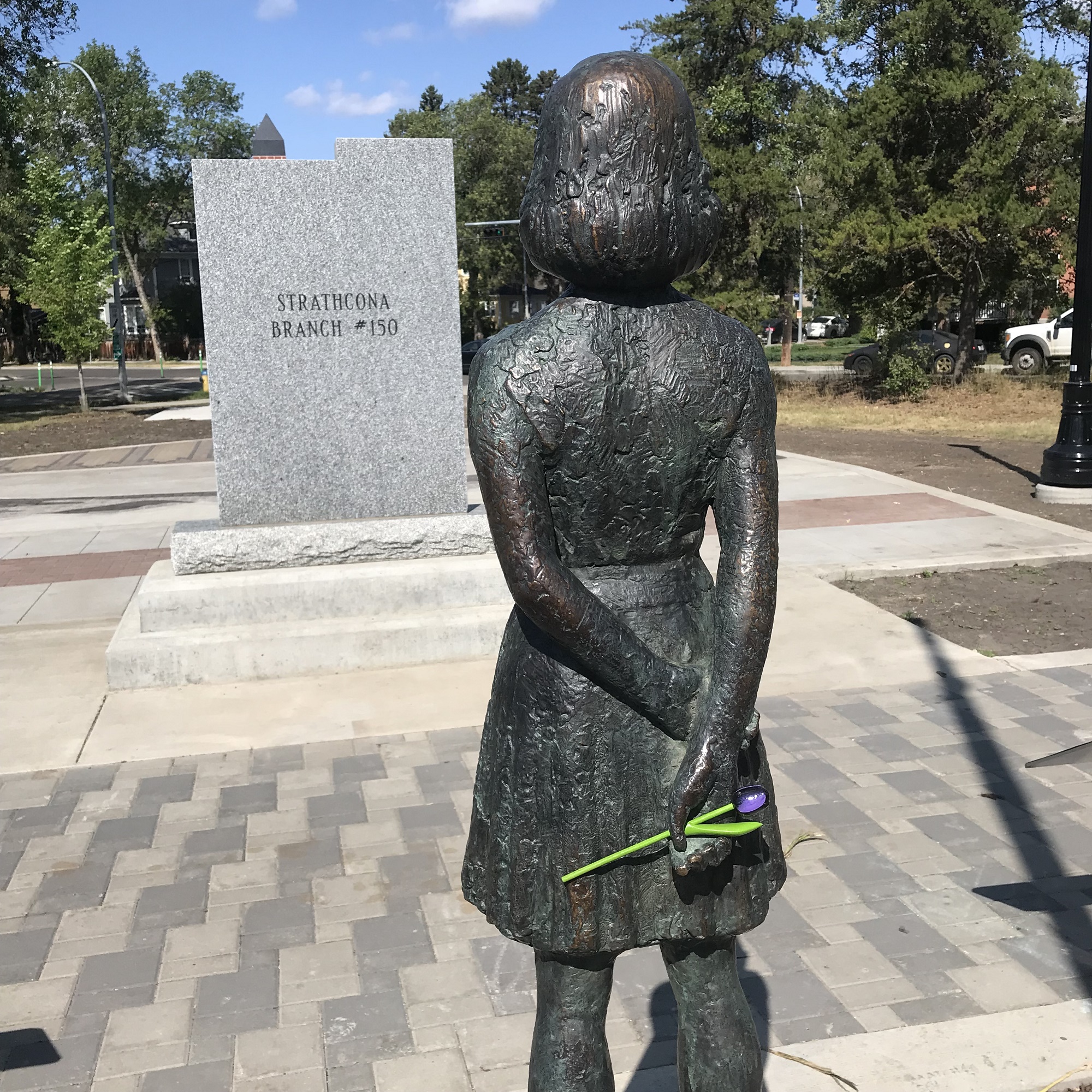
This statue of Anne Frank is a replica of the original, designed and created by the Dutch artist Pieter D’Hont. Funding for the first statue was raised by Dutch school children, and in 1960 it was donated to the city of Utrecht, The Netherlands. The Edmonton statue is cast from the original mould.
The Dutch Canadian Club Edmonton undertook this project in honour of the 75th Anniversary of the Liberation of the Netherlands in 2020. It was made possible by the generous support of many individuals, donors, and community groups. The statue was donated to the South Alberta Light Horse Regimental Association and citizens of Edmonton in October 2021.
L'histoire d'Anne Frank
Anne Frank était une jeune fille juive vivant à Amsterdam. Dans son journal, elle a consigné son attitude positive envers les gens et la vie, alors qu’elle se cachait pendant l’occupation nazie des Pays-Bas, entre 1942 et 1944. Anne a été une victime de l’Holocauste. Après la Seconde Guerre mondiale, son histoire, « Le journal d’une jeune fille », a été publiée. C’est devenu l’un des livres les plus connus au monde, étant traduit en 70 langues et vendu à plus de 30 millions d’exemplaires. Aujourd’hui, Anne Frank est devenue le symbole de l’optimisme et du triomphe de l’esprit humain.
Cette statue d’Anne Frank est une réplique de celle conçue et créée par l’artiste néerlandais Pieter D’Hont. Le financement de la statue originale a été assuré par des élèves des Pays-Bas et, en 1960, elle a été offerte à la ville d’Utrecht. La statue d’Edmonton a été coulée à partir du moule d’origine.
Le Dutch Canadian Club Edmonton a entrepris ce projet pour souligner le 75e anniversaire de la libération des Pays-Bas, en 2020. Il a été rendu possible grâce au généreux soutien de nombreux individus, de donateurs, de donatrices et de groupes communautaires. La statue a été offerte à la South Alberta Light Horse Regimental Association et à la population d’Edmonton en octobre 2021.
Het verhaal van Anne Frank
Anne Frank was een joods meisje dat in Amsterdam woonde. Haar positieve houding ten opzichte van mensen en het leven beschreef zij in haar dagboek tijdens de onderduik periode tussen 1942 en 1944 tijdens de nazi-bezetting van Nederland. Anne was een slachtoffer van de Holocaust. Na de Tweede Wereldoorlog haar verhaal "The Diary of a Young Girl" gepubliceerd en het is een van de bekendste boeken ter wereld geworden. Het is vertaald in 70 talen en er zijn meer dan 30 miljoen exemplaren van verkocht. Tegenwoordig is Anne Frank een symbool geworden voor optimisme en de overwinning van de menselijke geest.
Dit beeld van Anne Frank is een replica dat is ontworpen en gemaakt door de Nederlandse kunstenaar Pieter d'Hondt. Financiering voor het originele beeld werd bijeengebracht door Nederlandse schoolkinderen en in 1960 werd het geschonken aan de stad Utrecht, Nederland. Het beeld van Edmonton is gegoten uit de originele mal.
De Nederlands-Canadese Club Edmonton ondernam dit project ter ere van de 75e verjaardag van de Bevrijding van Nederland in 2020. Het werd mogelijk gemaakt door de genereuze steun van vele individuen, donateurs en gemeenschapsgroepen. Het werd in oktober 2021 geschonken aan de Southern Alberta Light Horse Regimental ssociation en inwoners van Edmonton.