Service militaire
Lieu de l’enterrement/commemoration
Fils de Robert et Christina Hoey; époux de Louisa Hoey, de 92, Belmont Avenue, Hamilton, Ontario.
Galerie numérique de Soldat John Edward Hoey
Galerie numérique de
Soldat John Edward Hoey
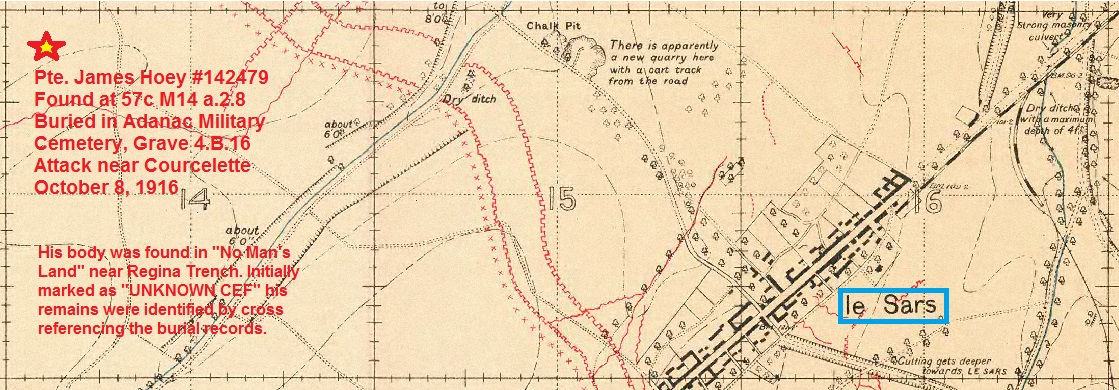
This trench map, taken as an extract of the original 1916 map "Le Sars", has been cropped and marked to show the exact location of Pte. Hoey's remains were found by the Imperial War Graves Commission (now CWGC) circa 1920. Comparison of this map to the Graves Registration Form (GRRF) and the Concentration of Graves Burial Return (COG-BR) demonstrates the process used to mark, register, exhume and rebury the remains in a cemetery post war. The map also allows a family member to go to the exact area where Pte, Hoey fell in battle.
Galerie numérique de
Soldat John Edward Hoey
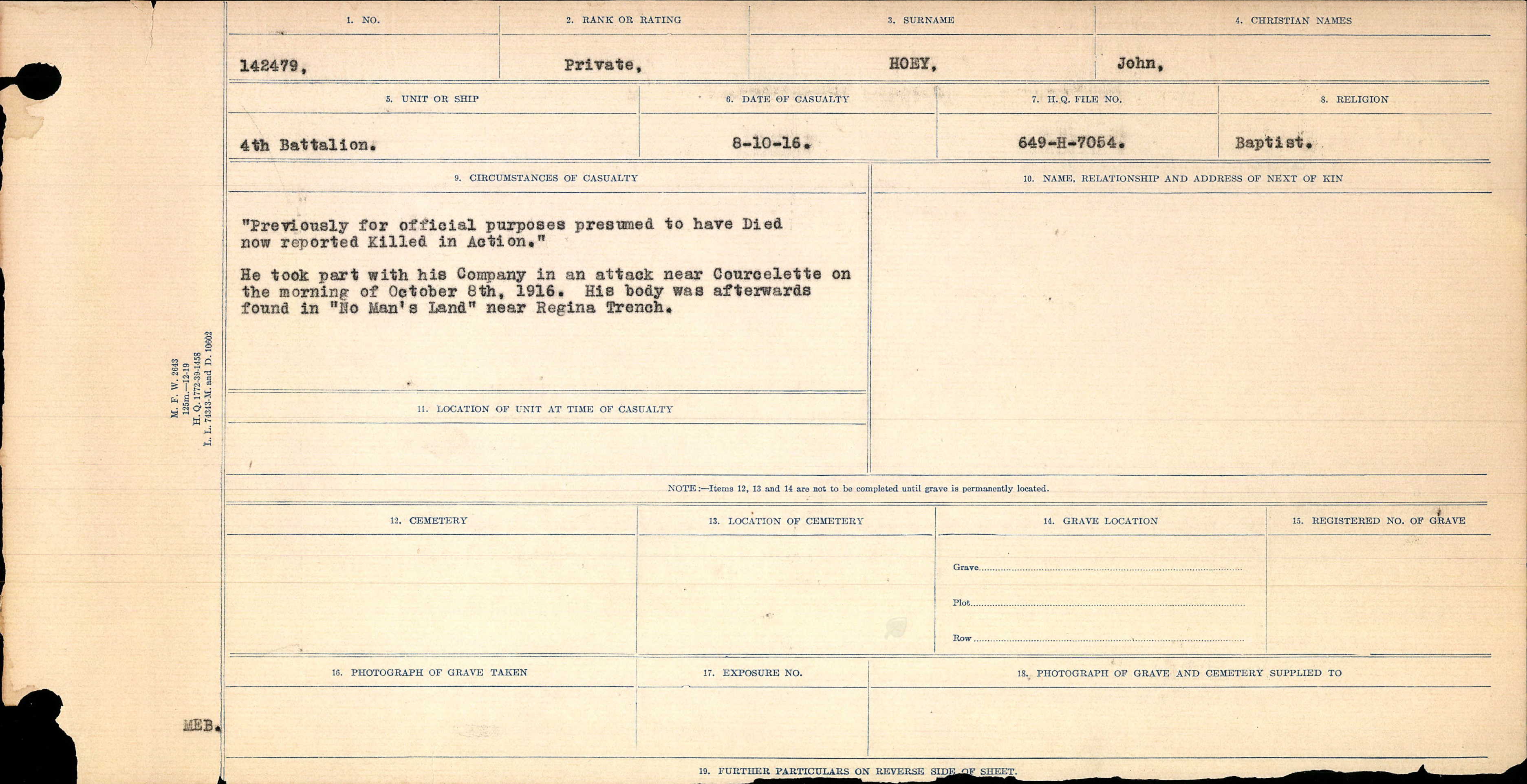
The "Circumstance of Death" from the collection of Library and Archives Canada provides the details of the death of Private John Hoey. It tells us that he took part with his Company in an attack near Courcelette on the morning of October 8, 1916. His body was afterwards found in "No Man's Land" near Regina Trench. An image of the location of his remains shows that he was just north of Regina Trench (the red line) when his body was recovered.
Galerie numérique de
Soldat John Edward Hoey
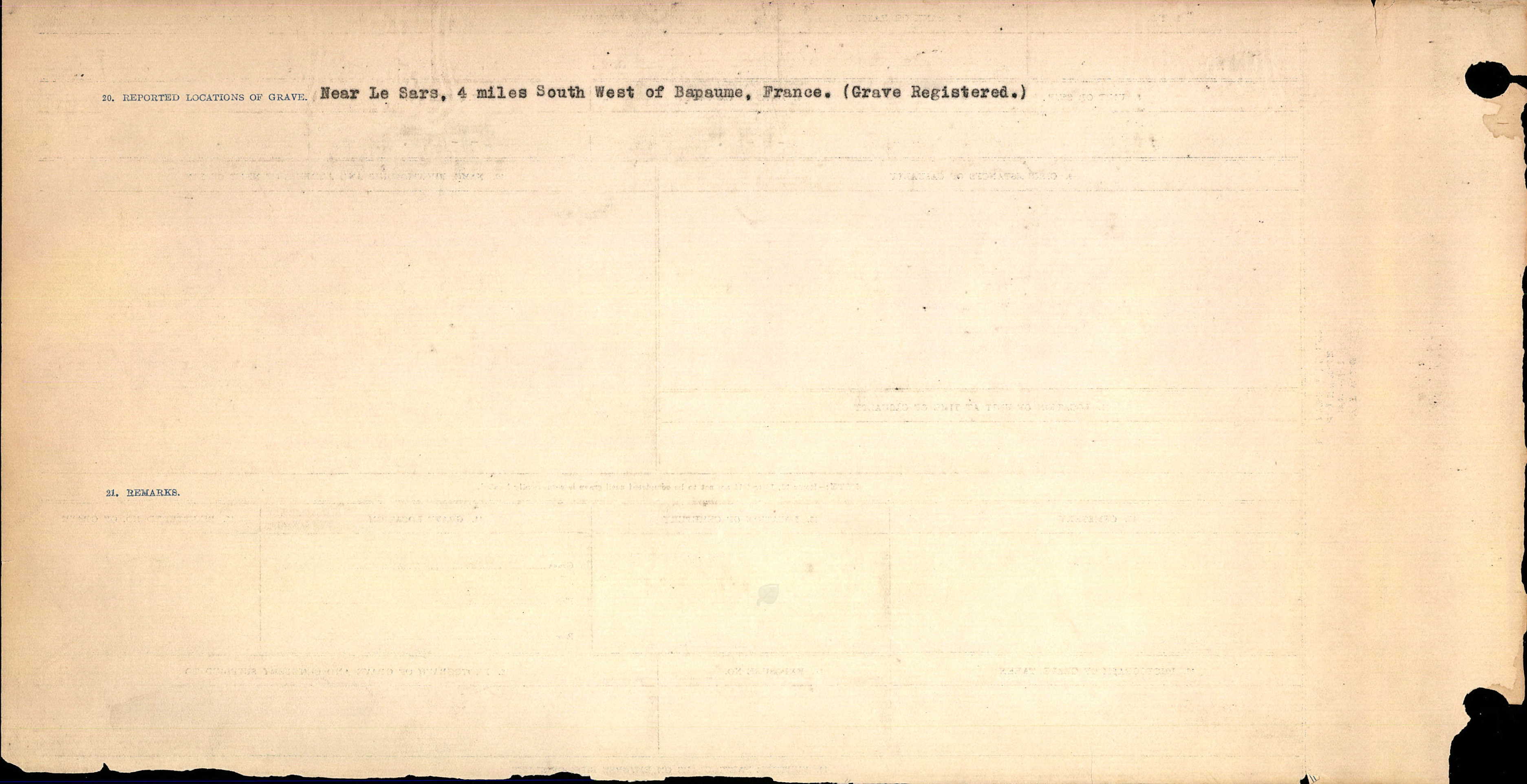
The reverse side of the "Circumstance of Death" file from the collection of Library and Archives Canada provides the details of the reported burial location or grave. In this case, detailed map coordinates are not provided, they merely report that it was near Le Sars, 4 miles south west of Bapaume, France and that the grave was registered. Pte. Hoey's grave was not initially matched to his name during the post war exhumation and concentration of the battlefield casualties. It was through the matching of records by the War Graves Commission that they were able to place a name to the remains marked with the cross.
Galerie numérique de
Soldat John Edward Hoey
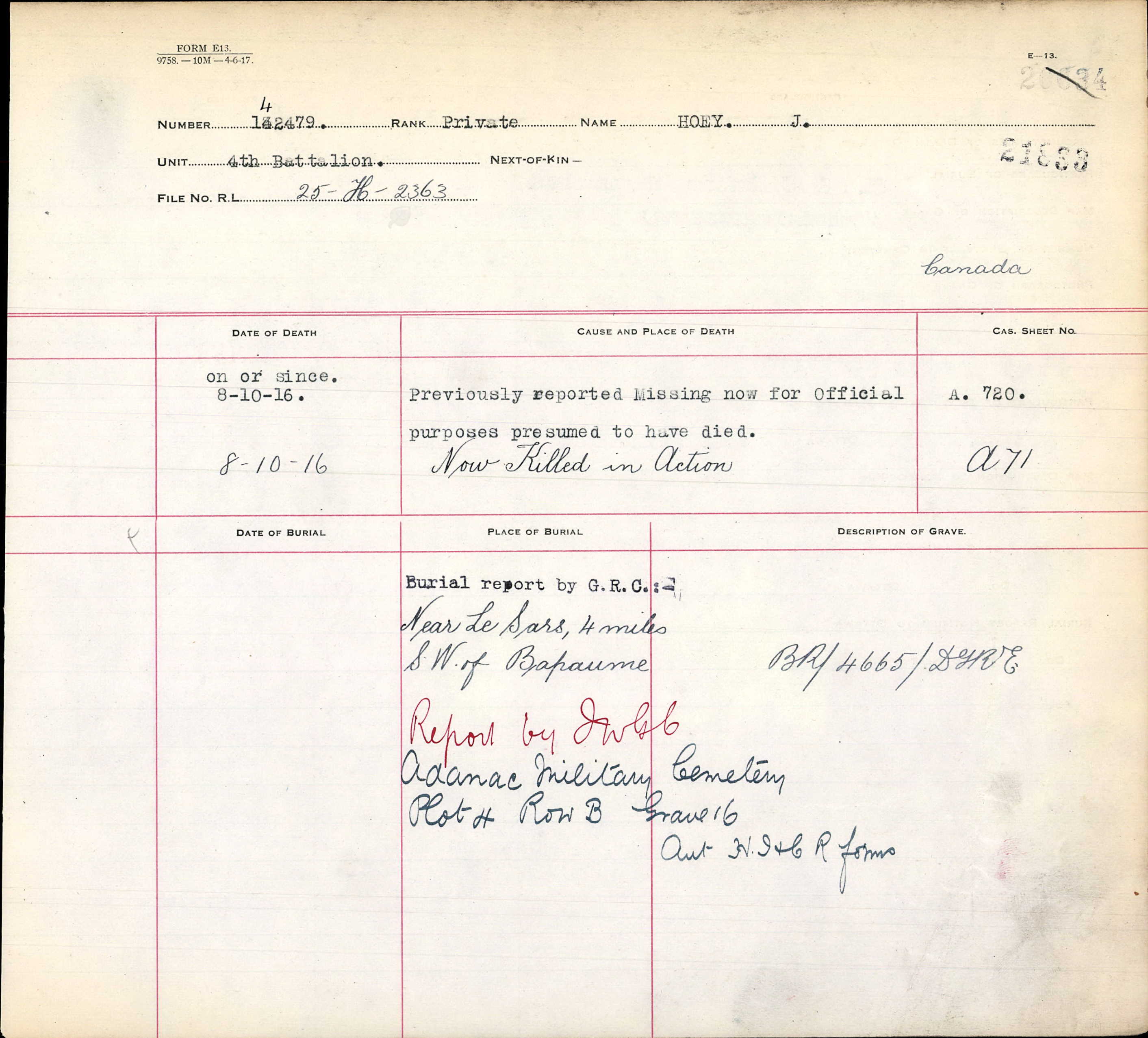
A separate file was prepared from the casualty information called the "Canada, CEF Commonwealth War Graves Registers, 1914-1919". These records are also in the collection of Library and Archives Canada. These records were prepared by the Department of Militia and Defense. They record the final resting place of the soldier and the notification of the next of kin. If the body was never recovered, these records contain the official memorial on which the individual’s name would be found. In the case of Private Hoey it notes that he was initially reported missing and was presumed to have died on or since October 8, 1916. When his body was recovered, a notation was made "Now Killed in Action". Note the same burial reference provided by the War Graves Commission and then the record that he is buried in Plot H Row B Grave 16 at the Adanac Military Cemetery, France.
Galerie numérique de
Soldat John Edward Hoey
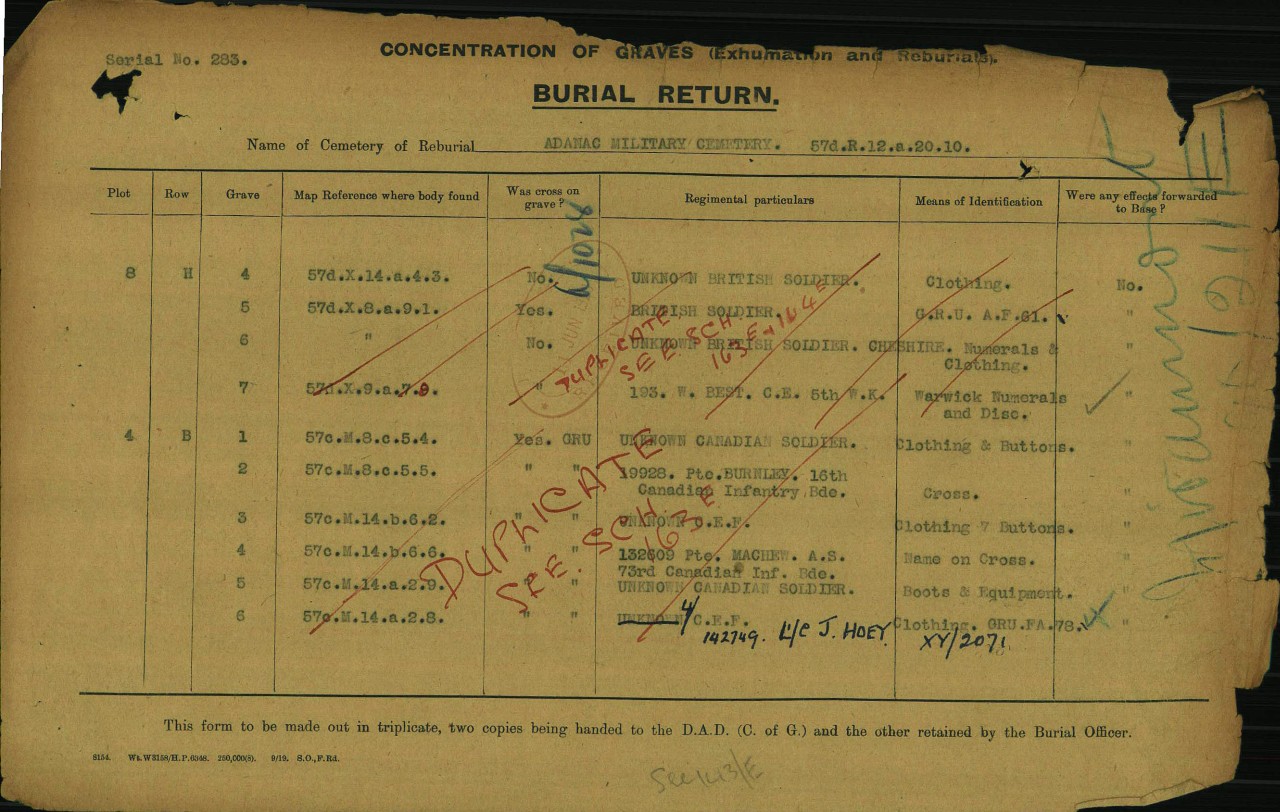
After the Armistice, the Imperial War Graves Commission (now CWGC) undertook major projects to recover the remains of those that had fallen in battle. Some were buried in small "battlefield cemeteries" and others were buried where they fell, often in a trench or a shell hole. In many cases the battle was so severe that time could not be taken, or lives could not be risked, to properly mark all the battlefield graves. Someone took the time and risk to mark his grave with a cross, which was later used to identify his remains. The "Concentration of Graves - Burial Return " (COG-BR) tells us that the Graves Registration Unit had recorded the grave (GRU.FA.78) probably from the cross. With that they changed the listing from "UNKNOWN CEF" to his name. They have his number wrong on this form (142749 instead of 142479) and they have him listed as a Lance Corporal, suggesting he may have had an unrecorded battlefield promotion. He was buried in Grave 4.B.16 not 4.B.6 as shown on the COG-BR.
Galerie numérique de
Soldat John Edward Hoey
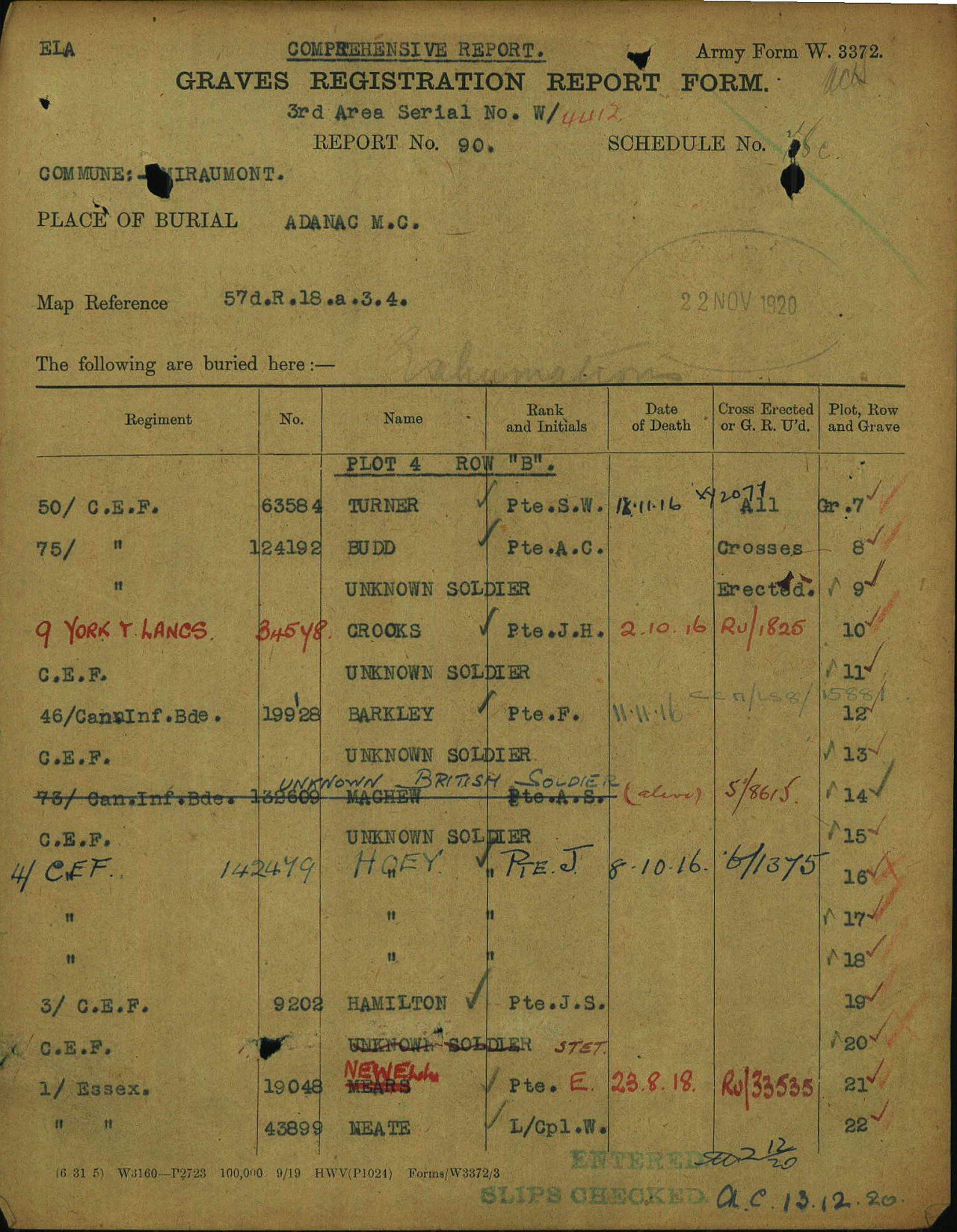
The "Graves Registration Form" (GRRF) takes all of the available information and records where Private Hoey was buried. You will note in this image that they have corrected the details to show his correct Service Number is #142479 and that he is buried in Adanac Military Cemetery in Plot 4 Row B Grave 16. It also notes that he served with the 4th Infantry Battalion of the Canadian Expeditionary Force and that he died on October 8, 1916. The manual entry on this GRRF shows that Pte. Hoey was to have been recorded as an "UNKNOWN SOLDIER C.E.F." until the Graves Registration Unit matched the information from his battlefield cross to the remains that had been exhumed.
Galerie d'images
-
This trench map, taken as an extract of the original 1916 map "Le Sars", has been cropped and marked to show the exact location of Pte. Hoey's remains were found by the Imperial War Graves Commission (now CWGC) circa 1920. Comparison of this map to the Graves Registration Form (GRRF) and the Concentration of Graves Burial Return (COG-BR) demonstrates the process used to mark, register, exhume and rebury the remains in a cemetery post war. The map also allows a family member to go to the exact area where Pte, Hoey fell in battle.
-
The "Circumstance of Death" from the collection of Library and Archives Canada provides the details of the death of Private John Hoey. It tells us that he took part with his Company in an attack near Courcelette on the morning of October 8, 1916. His body was afterwards found in "No Man's Land" near Regina Trench. An image of the location of his remains shows that he was just north of Regina Trench (the red line) when his body was recovered.
-
The reverse side of the "Circumstance of Death" file from the collection of Library and Archives Canada provides the details of the reported burial location or grave. In this case, detailed map coordinates are not provided, they merely report that it was near Le Sars, 4 miles south west of Bapaume, France and that the grave was registered. Pte. Hoey's grave was not initially matched to his name during the post war exhumation and concentration of the battlefield casualties. It was through the matching of records by the War Graves Commission that they were able to place a name to the remains marked with the cross.
-
A separate file was prepared from the casualty information called the "Canada, CEF Commonwealth War Graves Registers, 1914-1919". These records are also in the collection of Library and Archives Canada. These records were prepared by the Department of Militia and Defense. They record the final resting place of the soldier and the notification of the next of kin. If the body was never recovered, these records contain the official memorial on which the individual’s name would be found. In the case of Private Hoey it notes that he was initially reported missing and was presumed to have died on or since October 8, 1916. When his body was recovered, a notation was made "Now Killed in Action". Note the same burial reference provided by the War Graves Commission and then the record that he is buried in Plot H Row B Grave 16 at the Adanac Military Cemetery, France.
-
After the Armistice, the Imperial War Graves Commission (now CWGC) undertook major projects to recover the remains of those that had fallen in battle. Some were buried in small "battlefield cemeteries" and others were buried where they fell, often in a trench or a shell hole. In many cases the battle was so severe that time could not be taken, or lives could not be risked, to properly mark all the battlefield graves. Someone took the time and risk to mark his grave with a cross, which was later used to identify his remains. The "Concentration of Graves - Burial Return " (COG-BR) tells us that the Graves Registration Unit had recorded the grave (GRU.FA.78) probably from the cross. With that they changed the listing from "UNKNOWN CEF" to his name. They have his number wrong on this form (142749 instead of 142479) and they have him listed as a Lance Corporal, suggesting he may have had an unrecorded battlefield promotion. He was buried in Grave 4.B.16 not 4.B.6 as shown on the COG-BR.
-
The "Graves Registration Form" (GRRF) takes all of the available information and records where Private Hoey was buried. You will note in this image that they have corrected the details to show his correct Service Number is #142479 and that he is buried in Adanac Military Cemetery in Plot 4 Row B Grave 16. It also notes that he served with the 4th Infantry Battalion of the Canadian Expeditionary Force and that he died on October 8, 1916. The manual entry on this GRRF shows that Pte. Hoey was to have been recorded as an "UNKNOWN SOLDIER C.E.F." until the Graves Registration Unit matched the information from his battlefield cross to the remains that had been exhumed.
Dans les livres du souvenir
Inscription commémorative sur la :
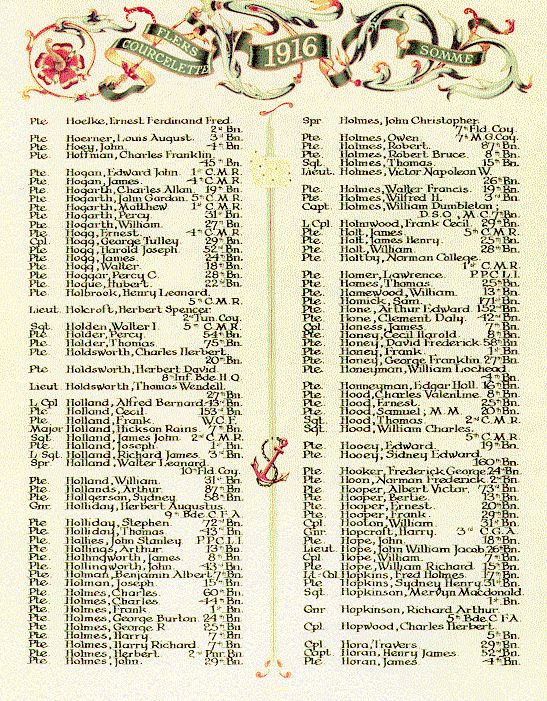
Page 104 du Livre du Souvenir de la Première Guerre mondiale.
Commander cette page
Télécharger cette page
CIMETIÈRE MILITAIRE ADANAC Somme, France
Miraumont est un village situé à quelque 14,5 kilomètres au nord-nord-est d'Albert. Le cimetière se trouve à 3 kilomètres environ au sud du village, du côté est de la route menant à Courcelette (D107). Il y a des panneaux annonçant la direction du cimetière dans le centre de Miraumont.
Pour plus d’informations, visitez la Commission des sépultures de guerre du Commonwealth (site disponible en anglais seulement).
L’image du coquelicot est une marque déposée de la Légion royale canadienne (Direction nationale) et est utilisée avec sa permission. Cliquez ici pour en savoir plus sur le coquelicot.
Avons-nous oublié quelque chose ?
Contribuer à cette page commémorative
Avez-vous des photos, des informations ou une correction concernant la page commémorative de cet individu? Apprenez-en plus sur le MVGC et les informations que nous collectons.