Service militaire
Lieu de l’enterrement/commemoration
Fils de feu John Hamman, et de Sophia Hamman, de Campbellville, Ontario.
Galerie numérique de Soldat Edward Charles Hamman
Galerie numérique de
Soldat Edward Charles Hamman
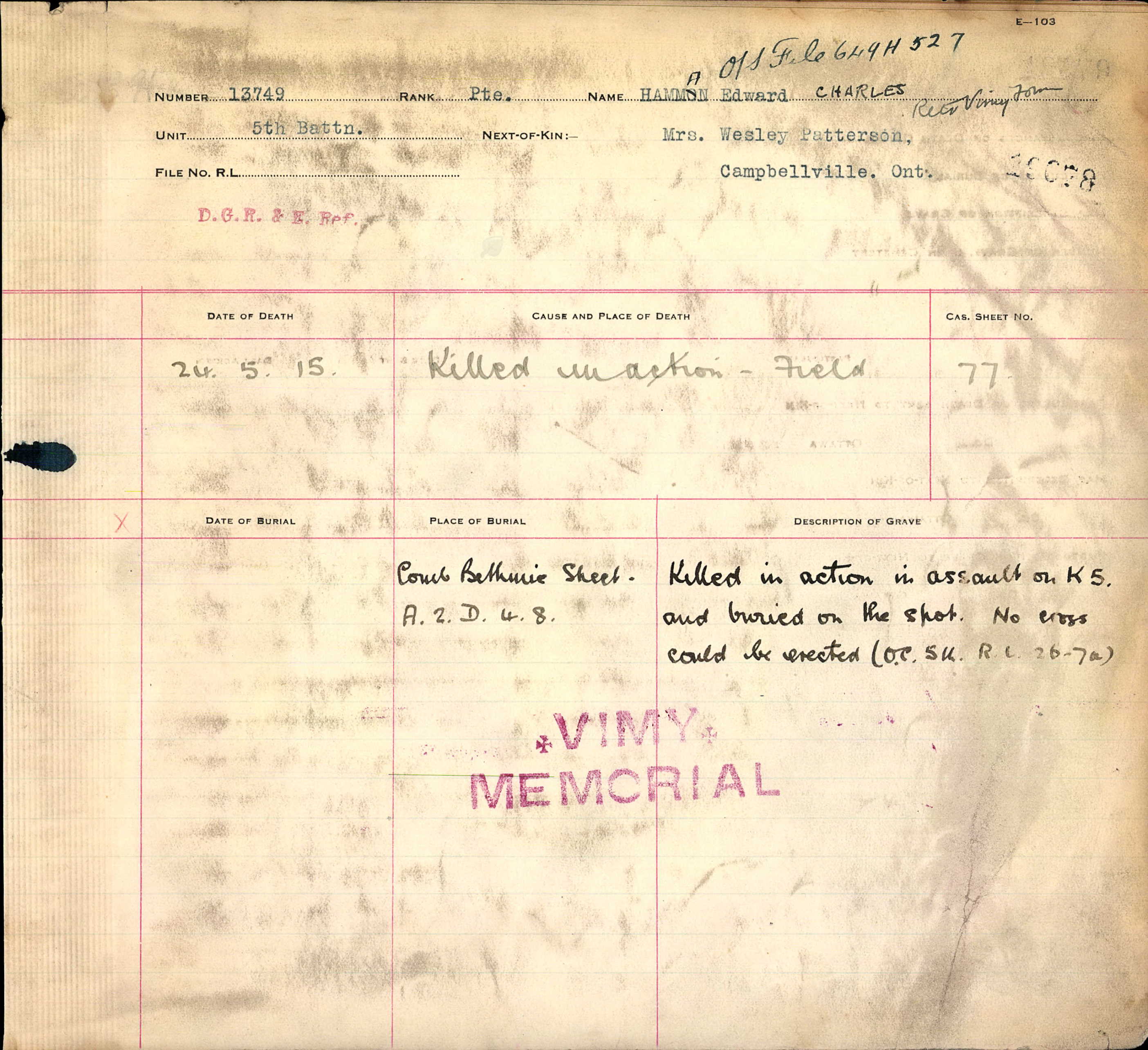
The War Graves Register for Private Hamman says that he was killed in action in the assault on K5 and was buried on the spot. It was further stated that "no cross could be erected". In May 1915 the CEF was involved in the Battle of Festubert, only a few short weeks after near devastation at the 2nd Battle of Ypres. The war diary for May 24, 1915 shows that 4 Officers, 11 NCOs and 30 Other Ranks were killed that day (Bethune, Festubert) - south of Ypres, north of the Artois Plateau (Arras). A further 8 Officers, 30 NCOs and 174 men were wounded. Appendix A to the September war diary details the horrors of that attack. The reference to the attack at K5 by the 5th Battalion is detailed on page 102 of Nicholson, Chapter IV.
Galerie numérique de
Soldat Edward Charles Hamman
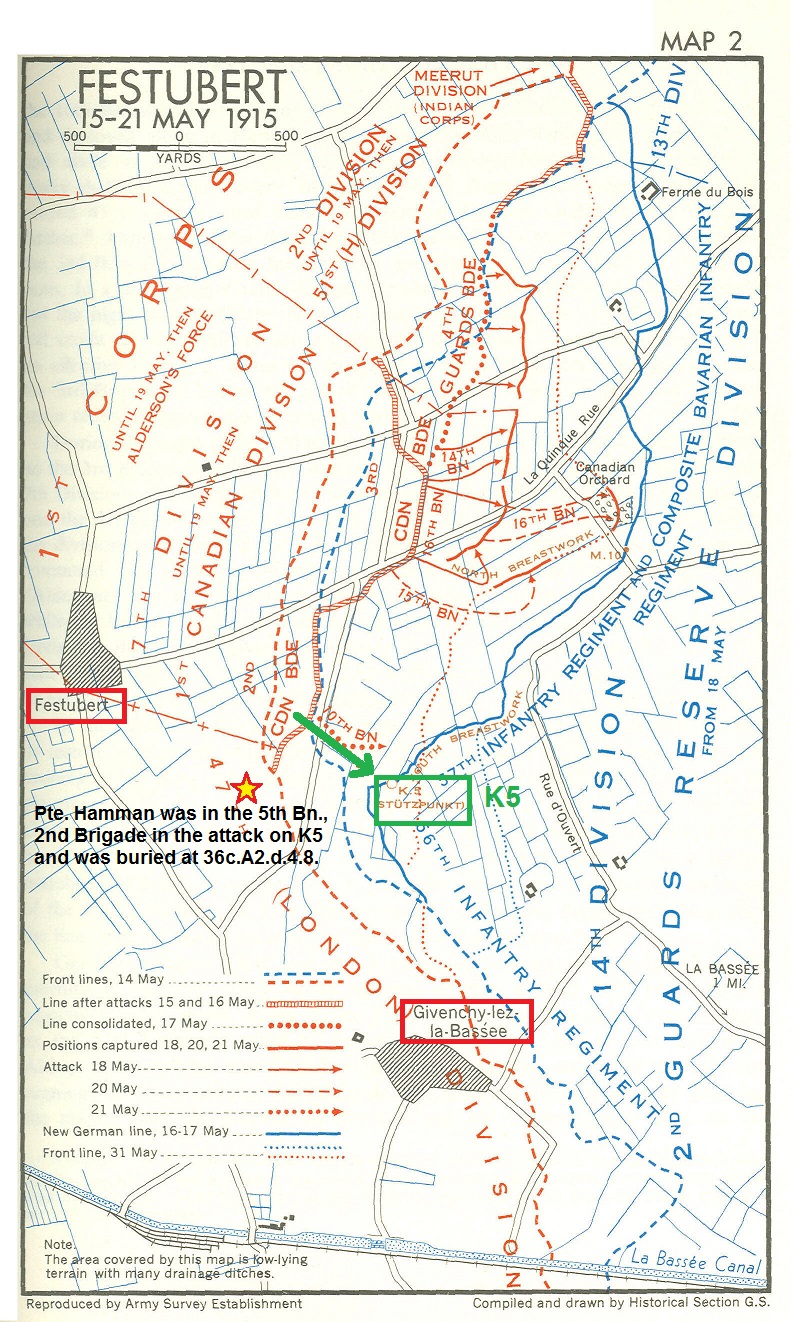
The spot noted as K5 is depicted on Map 6 from Nicholson's "Official History of the Canadian Army in the First World War". The approximate location where Private Hamman was buried during the battle is marked by the star. The green arrow shows the general movement of the 2nd Infantry Brigade, which included the 5th Infantry Battalion, towards K5.
Galerie numérique de
Soldat Edward Charles Hamman
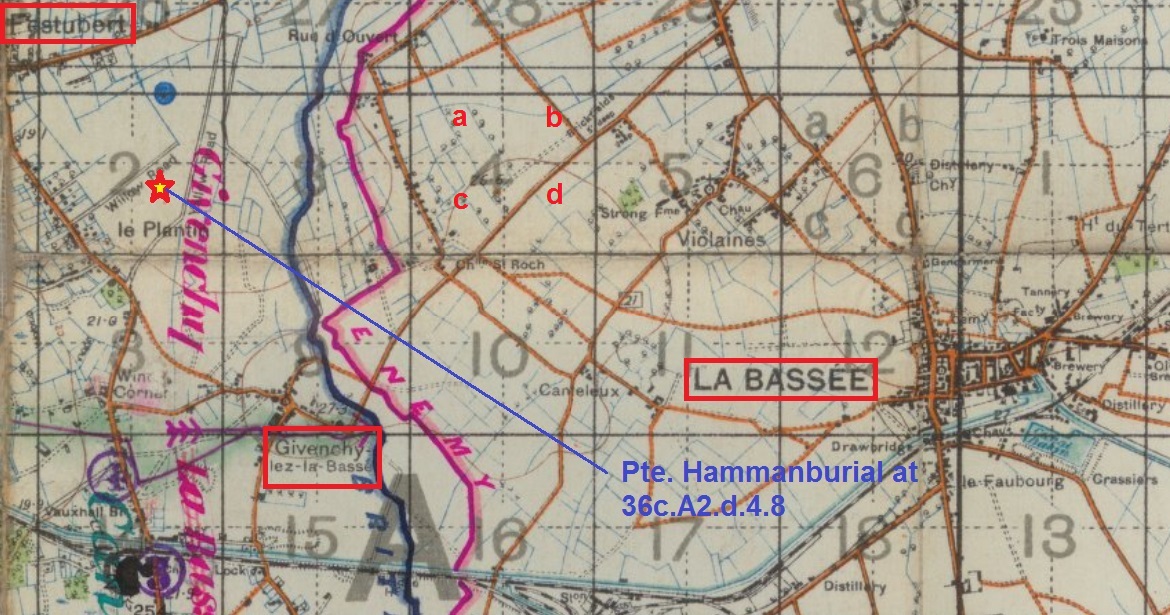
A 1915 trench map showing the details of the area and specifically where Pte. Hamman's body was reported to have been buried. This is Map 36c and the remains were in the large sector marked "A" and then in the sub-sector of "A" known as "2". Each sub-sector is divided further into "a, b, c, and d" (see example for sub-sector A4). In the square 36c.A2.d the remains are then at the crossing the grid lines 4 across the bottom and 8 up (= 36c.A2.d.4.8). The remains of Private Hamman may have been recovered after the Armistice and buried as an UNKNOWN Canadian Soldier in a nearby cemetery. There were thirty eight (38) Privates of the 5th Battalion killed at that location, on that day, that have no known grave.
Galerie d'images
-
The War Graves Register for Private Hamman says that he was killed in action in the assault on K5 and was buried on the spot. It was further stated that "no cross could be erected". In May 1915 the CEF was involved in the Battle of Festubert, only a few short weeks after near devastation at the 2nd Battle of Ypres. The war diary for May 24, 1915 shows that 4 Officers, 11 NCOs and 30 Other Ranks were killed that day (Bethune, Festubert) - south of Ypres, north of the Artois Plateau (Arras). A further 8 Officers, 30 NCOs and 174 men were wounded. Appendix A to the September war diary details the horrors of that attack. The reference to the attack at K5 by the 5th Battalion is detailed on page 102 of Nicholson, Chapter IV.
-
The spot noted as K5 is depicted on Map 6 from Nicholson's "Official History of the Canadian Army in the First World War". The approximate location where Private Hamman was buried during the battle is marked by the star. The green arrow shows the general movement of the 2nd Infantry Brigade, which included the 5th Infantry Battalion, towards K5.
-
A 1915 trench map showing the details of the area and specifically where Pte. Hamman's body was reported to have been buried. This is Map 36c and the remains were in the large sector marked "A" and then in the sub-sector of "A" known as "2". Each sub-sector is divided further into "a, b, c, and d" (see example for sub-sector A4). In the square 36c.A2.d the remains are then at the crossing the grid lines 4 across the bottom and 8 up (= 36c.A2.d.4.8). The remains of Private Hamman may have been recovered after the Armistice and buried as an UNKNOWN Canadian Soldier in a nearby cemetery. There were thirty eight (38) Privates of the 5th Battalion killed at that location, on that day, that have no known grave.
-
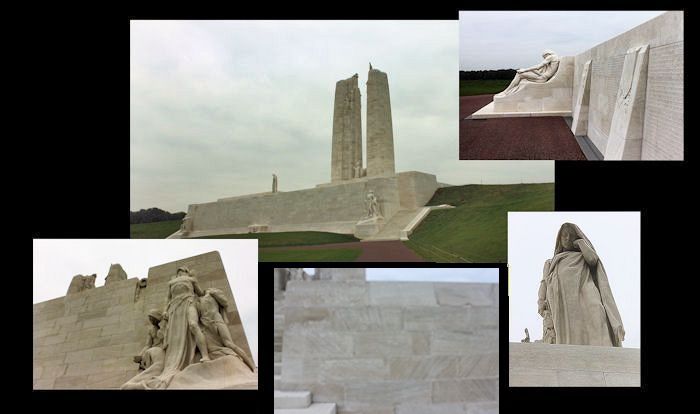
His name as it is inscribed on the Vimy Memorial. Over 11,000 fallen Canadians having no known place of burial in France, are honoured on this Memorial. May they never be forgotten. (J. Stephens)
-
Canada's Vimy Memorial, located approximately 8 kilometres to the north-east of Arras, France. May the sacrifice of so many never be forgotten. (J. Stephens)
Dans les livres du souvenir
Inscription commémorative sur la :
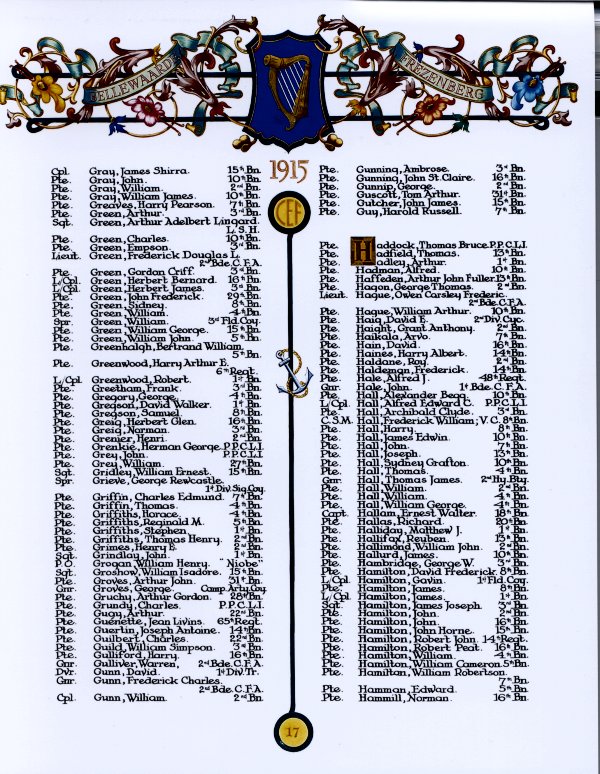
Page 17 du Livre du Souvenir de la Première Guerre mondiale.
Commander cette page
Télécharger cette page
MÉMORIAL DE VIMY Pas de Calais, France
L'hommage le plus impressionnant que le Canada a rendu à ceux de ses citoyens qui ont combattu et donné leur vie au cours de la Première Guerre mondiale, a trouvé son expression concrète dans le Monument Commémoratif du Canada à Vimy, qui surplombe majestueusement la plaine de Douai du sommet de la crête de Vimy, à environ huit kilomètres au nord-est d'Arras. Le Monument représente un hommage à tous ceux qui ont combattu pour leur pays durant ces quatre années de guerre et, en particulier, à ceux qui ont donné leur vie. Sur le socle du Monument, sont gravés dans la pierre, en français et en anglais, les mots suivants :
Sur les parois du Mémorial sont inscrits les noms de plus de 11 000 soldats canadiens «manquant à l'appel et présumés morts» en France.
Le terrain du parc de ce champ de bataille, d'une superficie de 91,18 hectares, «est un don de la nation française au peuple canadien», comme l'indique une plaque à l'entrée du Mémorial. La construction de cet ouvrage gigantesque commença en 1925; onze ans plus tard, le 26 juillet 1936, le roi Édouard VIII dévoilait le Mémorial de Vimy.
Le parc qui entoure le Mémorial est l'oeuvre d'experts en horticulture. Une multitude d'arbres et d'arbustes du Canada y ont été plantés pour rappeler les forêts et les bois canadiens. Autour du Mémorial, au-delà des coteaux verdoyants qui y mènent, s'étendent des parcs boisés. À la vue des tranchées et des tunnels parfaitement restaurés, le visiteur peut imaginer l'énorme tâche que le Corps canadien dut accomplir ce matin historique, il y a bien des années.
Le 3 avril 2003, le gouvernement du Canada a désigné le 9 avril de chaque année comme étant la journée nationale du souvenir de la bataille de la crête de Vimy.
Pour plus d’informations, visitez la Commission des sépultures de guerre du Commonwealth (site disponible en anglais seulement).
L’image du coquelicot est une marque déposée de la Légion royale canadienne (Direction nationale) et est utilisée avec sa permission. Cliquez ici pour en savoir plus sur le coquelicot.
Avons-nous oublié quelque chose ?
Contribuer à cette page commémorative
Avez-vous des photos, des informations ou une correction concernant la page commémorative de cet individu? Apprenez-en plus sur le MVGC et les informations que nous collectons.