Service militaire
Lieu de l’enterrement/commemoration
Galerie numérique de Chef d'escadron Alfred Johnstone Hughes
- Onglets 1
- Onglets 2
- Onglets 3
- Onglets 4
- Onglets 5
- Onglets 6
- Onglets 7
- Onglets 8
- Onglets 9
- Onglets 10
- Onglets 11
- Onglets 12
- Onglets 13
- Onglets 14
- Onglets 15
- Onglets 16
- Onglets 17
- Onglets 18
- Onglets 19
- Onglets 20
- Onglets 21
- Onglets 22
Galerie numérique de
Chef d'escadron Alfred Johnstone Hughes
Galerie numérique de
Chef d'escadron Alfred Johnstone Hughes
This report by No. 4 Missing Search and Enquiry Unit of the RAF describes the end of Hughes' Lancaster as viewed b y German witnesses. The bodies were so badly disfured that no identification could occur. This was the only Lancaster lost in the area on that night. Still they are still listed as missing because no positive ID was established.
Source: Li9brary & Archives Canada RG 24 Vol
Via R. Whitehouse
Galerie numérique de
Chef d'escadron Alfred Johnstone Hughes
The original Exhumation Report (p1) done by F/L Thorogood on 8 Sept 1948.
This is the report referred to in the HQ report. The bodies were so badly burned that there was no possibility of ID. The ID tags were made of compressed fiber and would burn in a really bad crash.
This (Riechswald Forest Military Cemetery) is the most probable grave site for Hughes and his crew.
Source: Library & Archives Canada RG 24 Vol
Via R. Whitehouse
Galerie numérique de
Chef d'escadron Alfred Johnstone Hughes
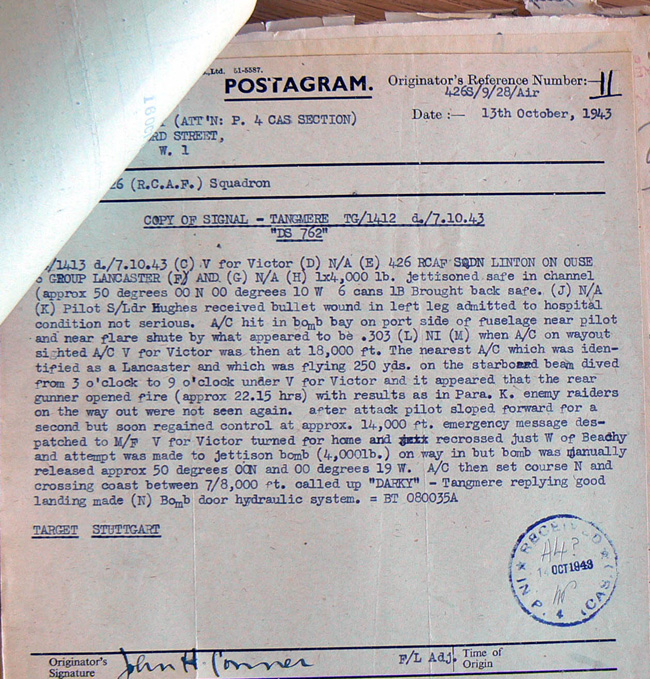
Mission Aborted 7 Nov 43<P>
On 7 Nov 43 Hughes and his crew were on an outward trip to Stuttgard when another Lancaster mistook them for a German nightfighter intruder and opened fire on them. Only Hughes was hit but the mission had to be aborted. He was hit by a .303 round in the left thigh. The wound was not serious, so Hughes quickly return to operations. He was killed 40 days later, just after the death of his father on the 15th of November, 1943.<P>
Source: Library & Archives Canada RG 24 Vol
Via R. Whitehouse
Galerie numérique de
Chef d'escadron Alfred Johnstone Hughes
Scholfield Letter 3 Jan 47<P>
This short letter to the Air Ministry was prompted a the author's reading of the German Death Cards for a crash in the area of Neiderlangen, District of Axchendorf, Germany for the night of 27 Nov 43. As he states, the area was on the bombing route of Lancaster DS 679 of426 Sqdn RCAF. This was the only crash that was located in the Germany records that fulfilled the time and route criteria for the Hughes crew. It brought about all the other investigations.
The German document is named at the top (EV 4635/44)<P>
Source:Library & Archives Canada RG24 via R. Whitehouse
Galerie numérique de
Chef d'escadron Alfred Johnstone Hughes
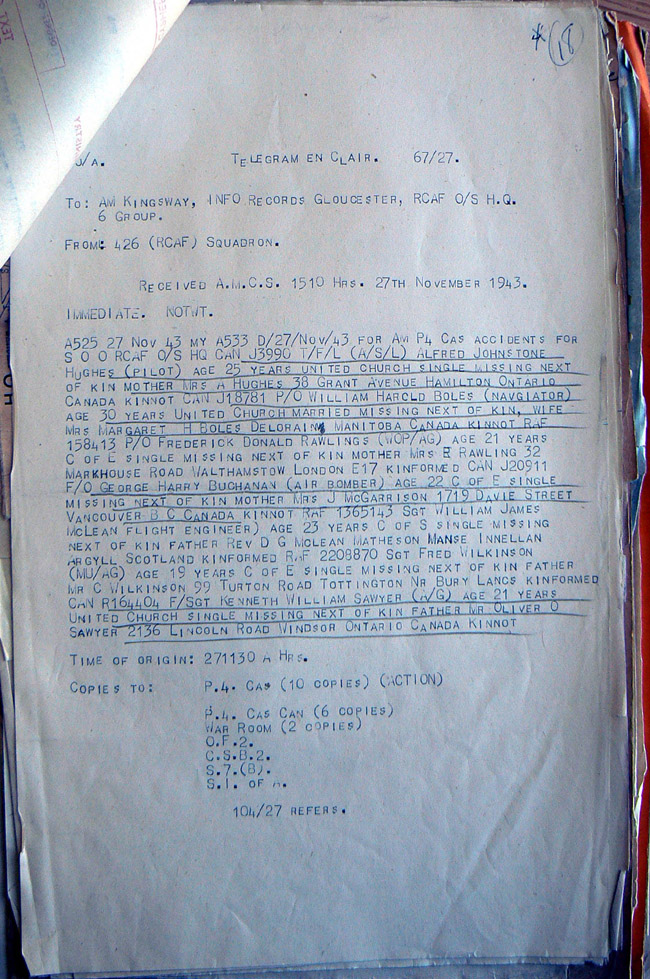
Message Enclaire NOK 27 Nov 43<P>
This message was sent to the Air Ministry as a standard missing aircraft alert. It states the answers to preset questions. If you read it carefully, you can guess what the questions were. This was done for every single missing aircraft for the entire period of the war.<P>
Source:Library & Archives Canada RG24 via R. Whitehouse
Galerie numérique de
Chef d'escadron Alfred Johnstone Hughes
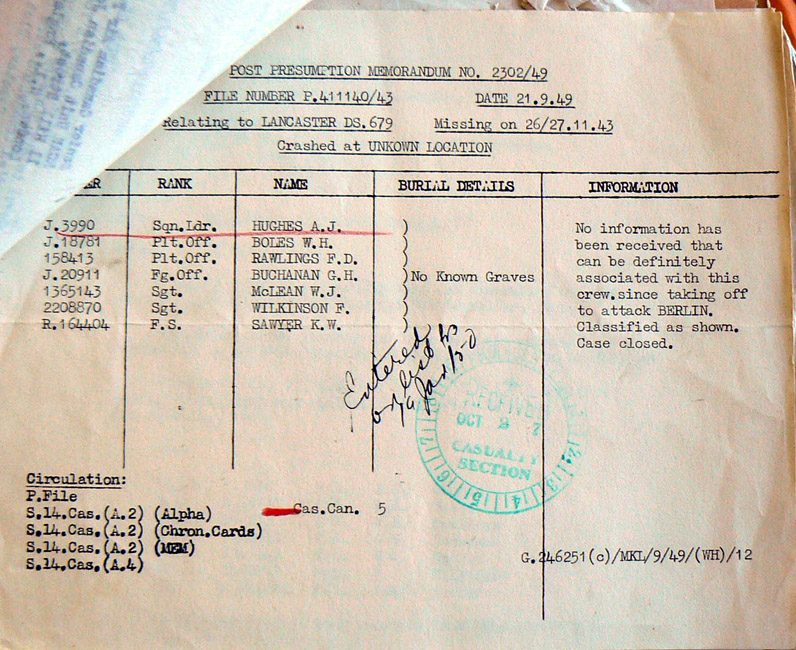
Post Presumption Memo 2302/49<P>
On 21 Sept 1949 the RCAF closed the file on Hughes and his crew with this memo. They knew at the time that there was a crew of a possible Lancaster buried in the Reichswald Forest Cemetery. They had the German documents on the case. However, the bodies, when exhumed for reburial, were so totally burned and broken that no identification was possible with the technology of that day. We know that Hughes was very tall for a pilot (6'2"). Today, a study of the bones would tell us "if" one of those bodies could have been Hughes. If that were the case, then there is a strong possibility that the others could be given a "collective grave".<P>
Source:Library & Archives Canada RG24 via R. Whitehouse
Galerie d'images
-
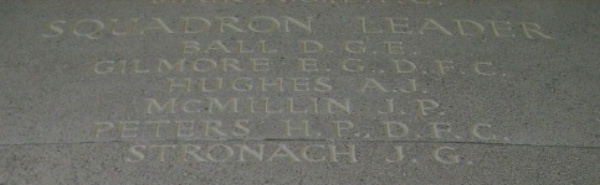
Inscription - Runnymede Memorial - September 2010 … photo courtesy of Marg Liessens
-
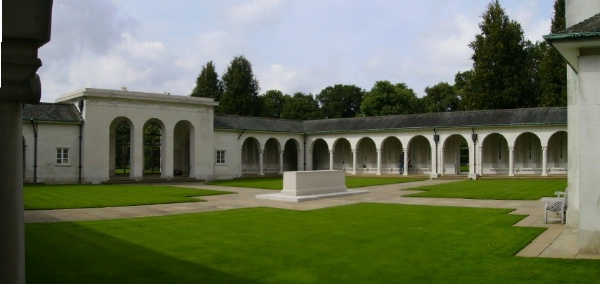
Stone of Remembrance - Runnymede Memorial - September 2010 … photo courtesy of Marg Liessens
-
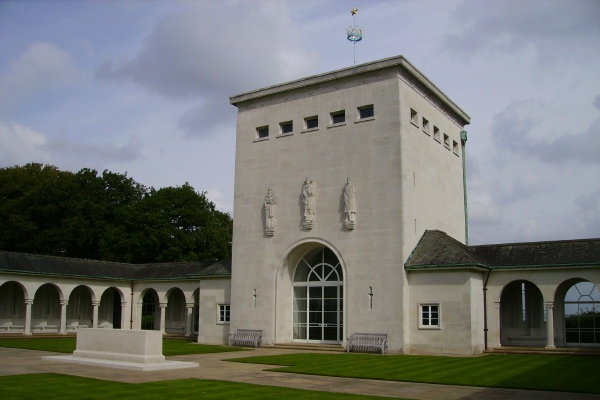
Runnymede Memorial - September 2010 … photo courtesy of Marg Liessens
-
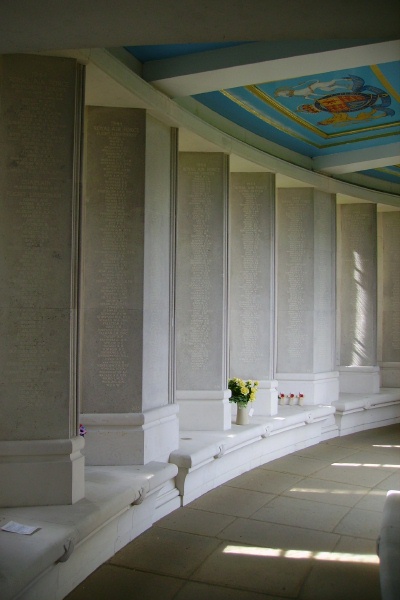
Panels - Runnymede Memorial - September 2010 … photo courtesy of Marg Liessens
-
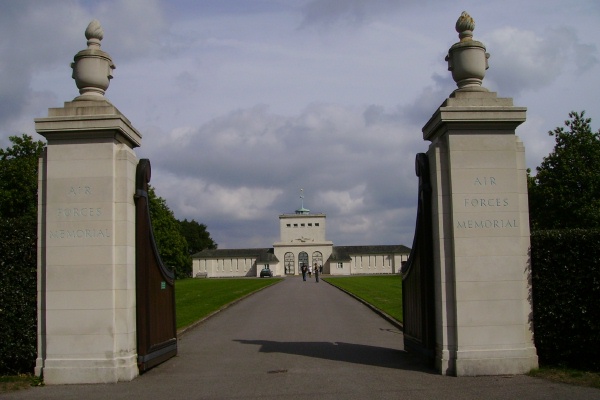
Entrance - Runnymede Memorial - September 2010 … photo courtesy of Marg Liessens
-
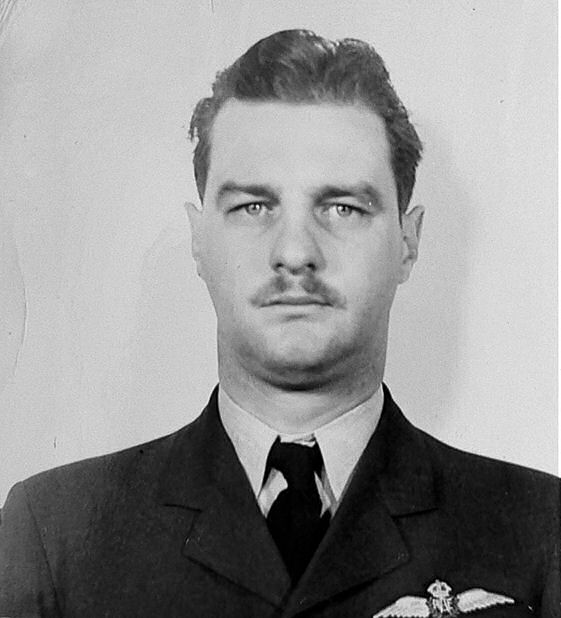
This photograph of S/L A J Hughes is taken from his pers file in the Canadian Archives. It was probably taken at the time he was awarded his wings since he shows no ribbons underneath the wings. Source: Li9brary & Archives Canada RG 24 Vol Via R. Whitehouse
-
This report by No. 4 Missing Search and Enquiry Unit of the RAF describes the end of Hughes' Lancaster as viewed b y German witnesses. The bodies were so badly disfured that no identification could occur. This was the only Lancaster lost in the area on that night. Still they are still listed as missing because no positive ID was established. Source: Li9brary & Archives Canada RG 24 Vol Via R. Whitehouse
-
The original Exhumation Report (p1) done by F/L Thorogood on 8 Sept 1948. This is the report referred to in the HQ report. The bodies were so badly burned that there was no possibility of ID. The ID tags were made of compressed fiber and would burn in a really bad crash. This (Riechswald Forest Military Cemetery) is the most probable grave site for Hughes and his crew. Source: Library & Archives Canada RG 24 Vol Via R. Whitehouse
-
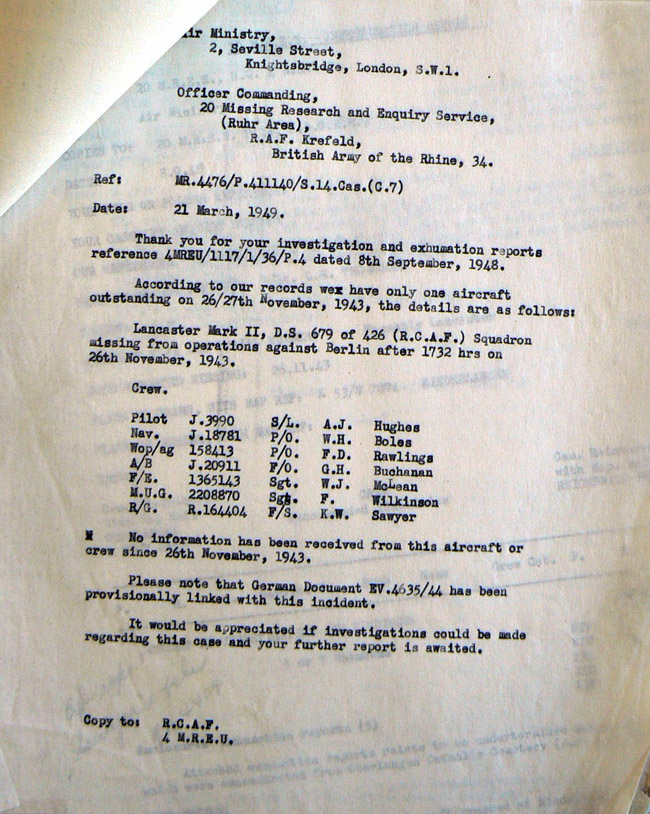
Air Ministry Letter 21 March 1949<P> This letter acknowledges that only one aircraft was missing in the crash area on that night. (Lancaster II DS 679) <P> Source: Library & Archives Canada RG 24 Vol Via R. Whitehouse
-
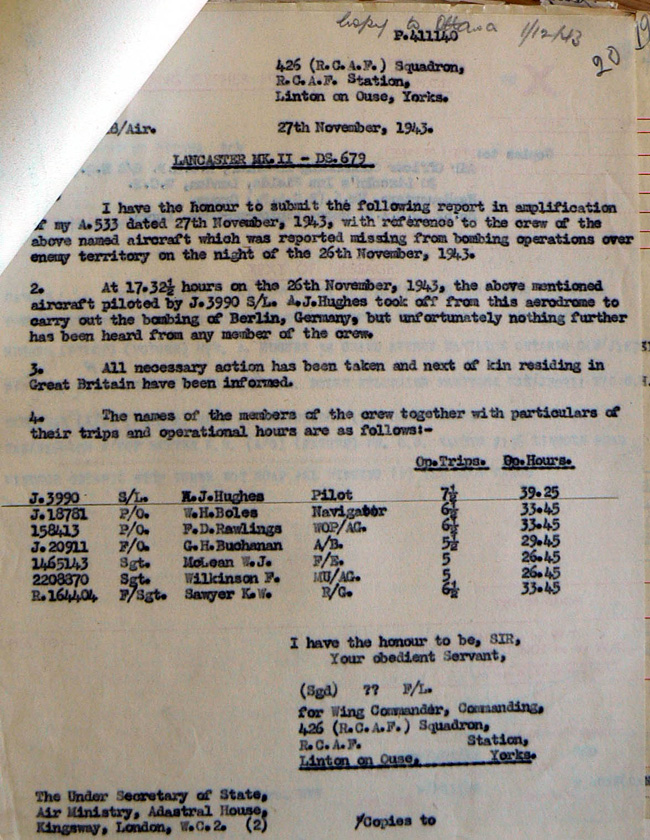
426 Sqdn Letter 27 Nov 1943 The letter to the Air Ministry giving details of the crew's operational experience. This gives the names, numbers and crew positions as well. Source: Library & Archives Canada RG 24 Vol Via R. Whitehouse
-
Mission Aborted 7 Nov 43<P> On 7 Nov 43 Hughes and his crew were on an outward trip to Stuttgard when another Lancaster mistook them for a German nightfighter intruder and opened fire on them. Only Hughes was hit but the mission had to be aborted. He was hit by a .303 round in the left thigh. The wound was not serious, so Hughes quickly return to operations. He was killed 40 days later, just after the death of his father on the 15th of November, 1943.<P> Source: Library & Archives Canada RG 24 Vol Via R. Whitehouse
-
Scholfield Letter 3 Jan 47<P> This short letter to the Air Ministry was prompted a the author's reading of the German Death Cards for a crash in the area of Neiderlangen, District of Axchendorf, Germany for the night of 27 Nov 43. As he states, the area was on the bombing route of Lancaster DS 679 of426 Sqdn RCAF. This was the only crash that was located in the Germany records that fulfilled the time and route criteria for the Hughes crew. It brought about all the other investigations. The German document is named at the top (EV 4635/44)<P> Source:Library & Archives Canada RG24 via R. Whitehouse
-
Message Enclaire NOK 27 Nov 43<P> This message was sent to the Air Ministry on the day after the crash to notify them of the Next of Kin.<P> Source:Library & Archives Canada RG24 via R. Whitehouse
-
Message Enclaire NOK 27 Nov 43<P> This message was sent to the Air Ministry as a standard missing aircraft alert. It states the answers to preset questions. If you read it carefully, you can guess what the questions were. This was done for every single missing aircraft for the entire period of the war.<P> Source:Library & Archives Canada RG24 via R. Whitehouse
-
Post Presumption Memo 2302/49<P> On 21 Sept 1949 the RCAF closed the file on Hughes and his crew with this memo. They knew at the time that there was a crew of a possible Lancaster buried in the Reichswald Forest Cemetery. They had the German documents on the case. However, the bodies, when exhumed for reburial, were so totally burned and broken that no identification was possible with the technology of that day. We know that Hughes was very tall for a pilot (6'2"). Today, a study of the bones would tell us "if" one of those bodies could have been Hughes. If that were the case, then there is a strong possibility that the others could be given a "collective grave".<P> Source:Library & Archives Canada RG24 via R. Whitehouse
-
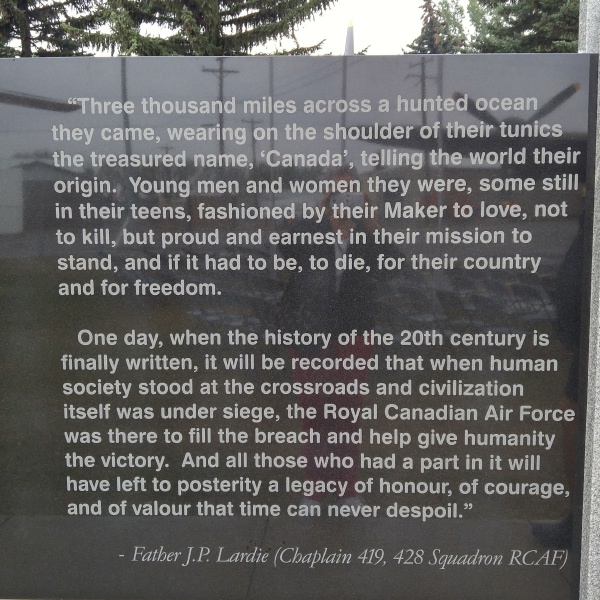
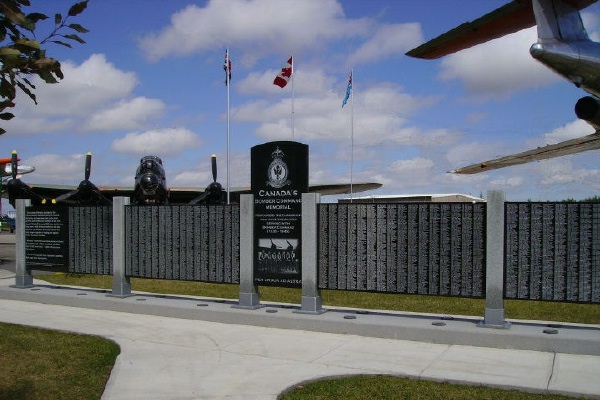
Father J P Lardie's comments as inscribed on the Bomber Command Memorial Wall in Nanton, AB … photo courtesy of Marg Liessens
-
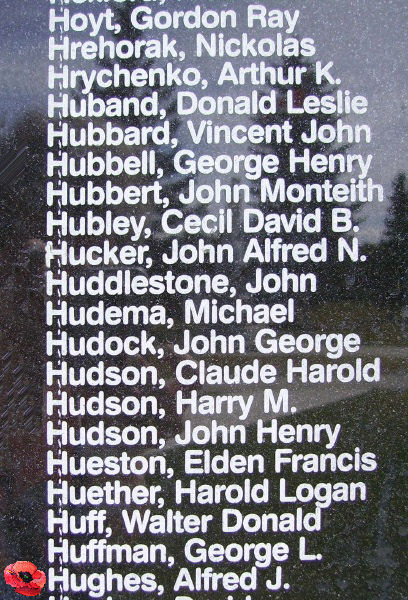
Squadron Leader Alfred Johnstone Hughes is also commemorated on the Bomber Command Memorial Wall in Nanton, AB … photo courtesy of Marg Liessens
-
Squadron Leader Alfred Johnstone Hughes is also commemorated on the Bomber Command Memorial Wall in Nanton, AB … photo courtesy of Marg Liessens
-
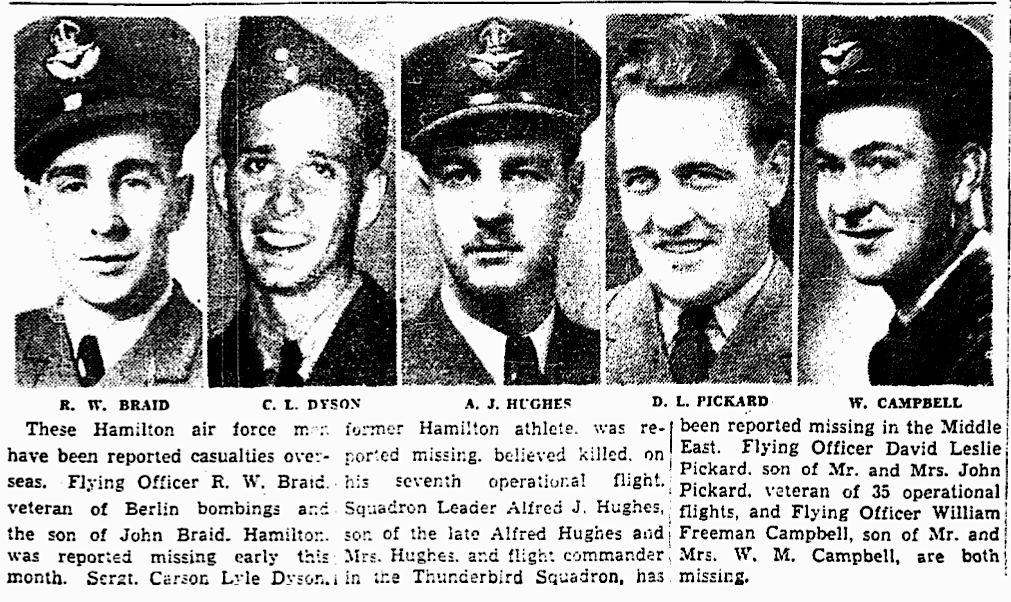
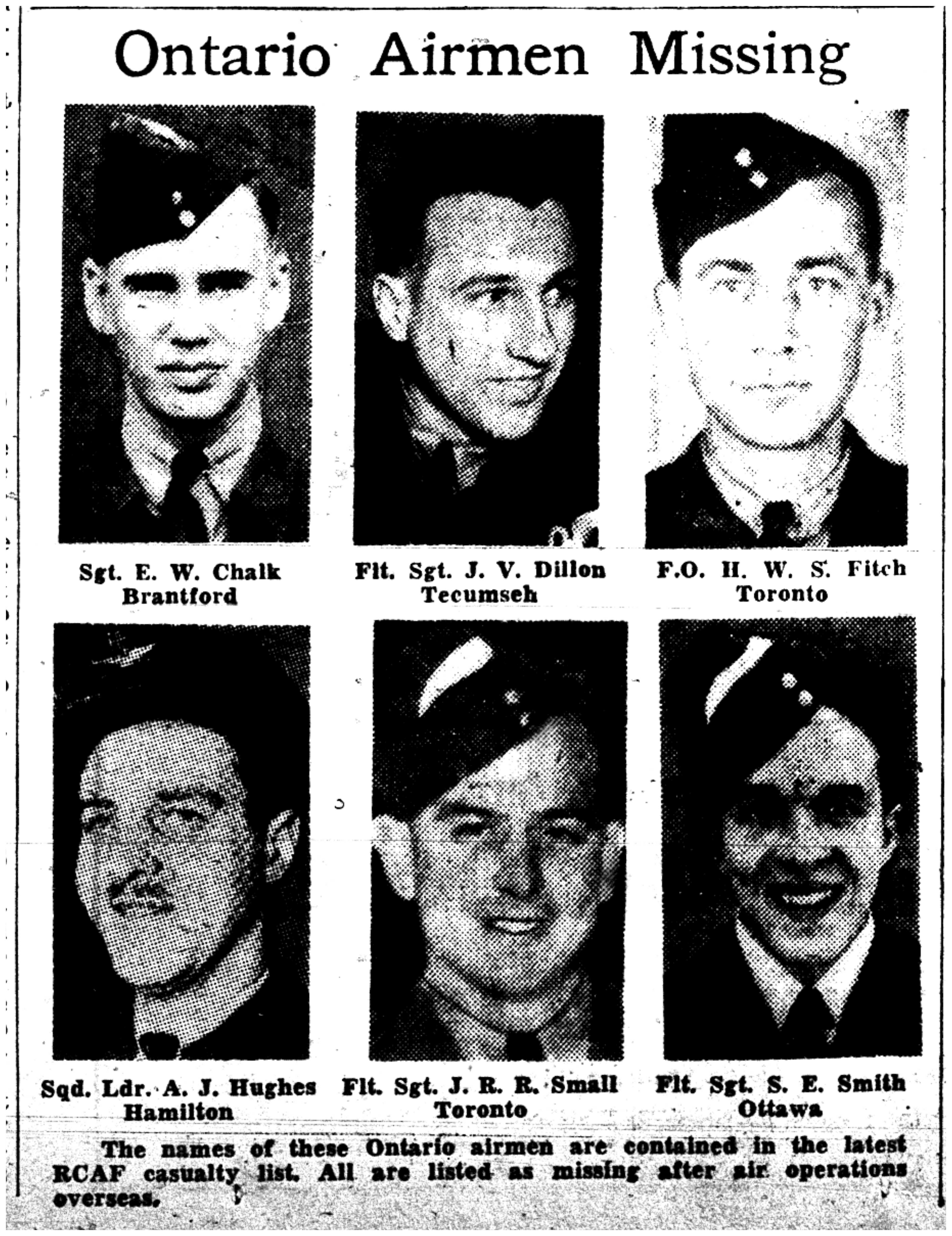
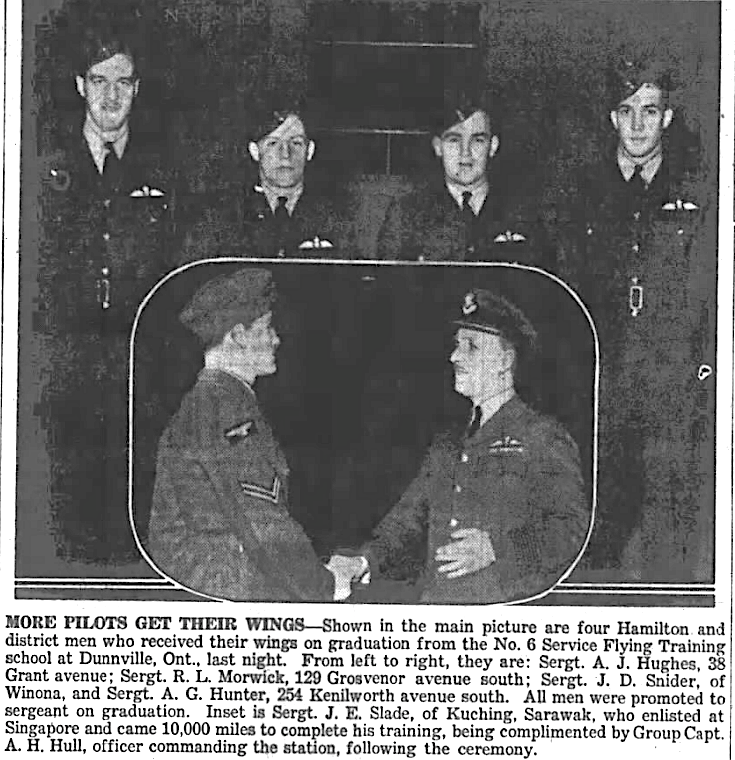
From the Toronto Star January 1944. Submitted for the project Operation Picture Me
-
From the Toronto Telegram January 1944. Submitted for the project Operation Picture Me
-
From the Hamilton Spectator c.1941. Submitted for the project Operation Picture Me
-
From the Hamilton Spectator c.1942. Submitted for the project Operation Picture Me
Dans les livres du souvenir
Inscription commémorative sur la :
Page 172 du Livre du Souvenir de la Seconde Guerre mondiale.
Commander cette page
Télécharger cette page
MÉMORIAL DE RUNNYMEDE Surrey, Royaume-Uni
Au cours de la Seconde Guerre mondiale, plus de cent seize mille hommes et femmes des forces aériennes du Commonwealth britannique sont morts au champ d'honneur. Plus de dix-sept mille d'entre eux étaient membres de l'Aviation royale canadienne ou des Canadiens qui servaient dans la Royal Air Force. Presque un tiers des morts n'ont pas de sépulture connue. De ce total, vingt mille quatre cent cinquante sont commémorés par nom au Mémorial de Runnymede situé à Englefield Green, près d'Egham, à trente-deux kilomètres à l'ouest de Londres.
L'architecture du Mémorial de Runnymede est originale et impressionnante. La pierre du Souvenir repose au centre d'un cloître qui domine une tour carrée perchée sur le sommet de la colline de Cooper qui surplombe la Tamise. Les allées du cloître aboutissent à deux observatoires, l'un donnant sur Windsor, l'autre sur l'aéroport de Londres à Heathrow. Les trois mille cinquante aviateurs canadiens tués au combat sont parmi ceux dont les noms sont gravés sur les revers de pierre des fenêtres étroites des allées cloîtrées et des observatoires.
Au-dessus de l'entrée à trois arches qui conduit au cloître, trône un aigle de pierre surmonté de la devise de la Royal Air Force «Per Ardua ad Astra». De chaque côté, figure une inscription en anglais dont voici la traduction :
« CE CLOÎTRE HONORE LES NOMS DE 20 000 AVIATEURS SANS SÉPULTURE CONNUE QUI SONT MORTS POUR LA LIBERTÉ LORS DES OPÉRATIONS AÉRIENNES AU-DESSUS DES ÎLES BRITANNIQUES, ET DES TERRES ET MERS DU NORD ET DE L'OUEST DE L'EUROPE. »
Dans la tour se trouve un sanctuaire voûté, paisible et propice à la méditation. On peut y lire, orné d'enluminures, un extrait d'un poème anglais de Paul H. Scott.
Pour plus d’informations, visitez la Commission des sépultures de guerre du Commonwealth (site disponible en anglais seulement).
L’image du coquelicot est une marque déposée de la Légion royale canadienne (Direction nationale) et est utilisée avec sa permission. Cliquez ici pour en savoir plus sur le coquelicot.
Avons-nous oublié quelque chose ?
Contribuer à cette page commémorative
Avez-vous des photos, des informations ou une correction concernant la page commémorative de cet individu? Apprenez-en plus sur le MVGC et les informations que nous collectons.