Attention!
Cette vidéo est disponible en anglais seulement.
Description
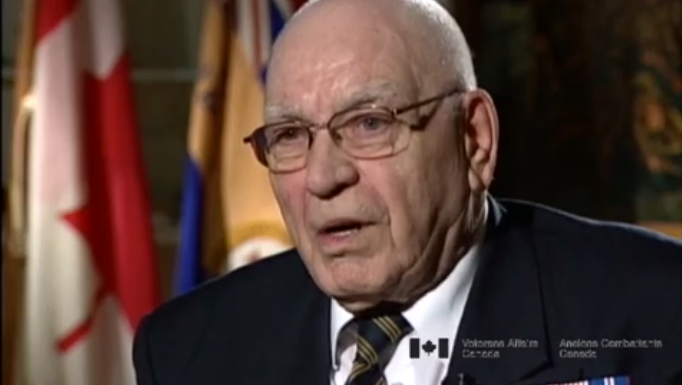
Mr. Duffley talks about training to drop supplies and troops to the 14th Army.
Louis Duffley
Louis Duffley est né à Quispamsis, Nouveau-Brunswick, le 14 février 1920. Ses amis et lui se sont joints à la Force aérienne et, en 1941, se sont rendus à Toronto pour recevoir leur équipement et être initié à la discipline élémentaire. De là, il s'est rendu à l'école technique de Belleville. Il y a terminé sa formation en 1942 et a été affecté à Moncton, Nouveau-Brunswick. Il y a passé un an et demi avant d'être envoyé à Dorval, Québec, pour suivre un autre cours. Deux mois plus tard, M. Duffley s'est joint au 165e Escadron, sur la côte Ouest. Finalement, il a été envoyé outre-mer en 1944, avec deux de ses copains de la Force aérienne.
Transcription
The aircrew were training to drop supplies, and/or troops, mostly Gurkhas and the, Akyab was the, sorry, Gujarat, was the base, and they did their training up at Rawalpindi up in the foothills of the Himalayas, both dropping troops and para supplies so that, and that took from, well we got there maybe sometime in October until January before we went to Burma.
When most people hear about Canadians being in Burma they think we were involved in the hump, flying the hump. That wasn't so, that was mostly Americans, flying from staging spots in upper northern Burma such as Ledo, into Kunming in China. They were helping the Chinese, not, nothing to do with the, with the war in Burma. 436 Squadron was one of fourteen squadrons that helped supply the 14th Army, it's just a coincidence that that's, the word fourteen is, is there. Of the fourteen, two were Canadians, four were British, and the rest were American. And they supplied the 14th Army entirely by air. I saw ammunition, barbwire, hay, rations, tobacco, beer, whatever, always dropped or landed at forward strips, but all taken in by these fourteen squadrons. So if Canada had two of fourteen, that's a significant contribution and nobody happens to know that.
When most people hear about Canadians being in Burma they think we were involved in the hump, flying the hump. That wasn't so, that was mostly Americans, flying from staging spots in upper northern Burma such as Ledo, into Kunming in China. They were helping the Chinese, not, nothing to do with the, with the war in Burma. 436 Squadron was one of fourteen squadrons that helped supply the 14th Army, it's just a coincidence that that's, the word fourteen is, is there. Of the fourteen, two were Canadians, four were British, and the rest were American. And they supplied the 14th Army entirely by air. I saw ammunition, barbwire, hay, rations, tobacco, beer, whatever, always dropped or landed at forward strips, but all taken in by these fourteen squadrons. So if Canada had two of fourteen, that's a significant contribution and nobody happens to know that.
Catégories
Canada's contribution in India
Médium
Video
Propriétaire
Veterans Affairs Canada
Guerre ou mission
Seconde Guerre mondiale
Emplacement géographique
Birmanie
Personne interviewée
Louis Duffley
Branche
Aviation
Unité ou navire
Escadron 436
Occupation
Aircraft Instrument Engineer
Durée
02:03