Attention!
Cette vidéo est disponible en anglais seulement.
Description
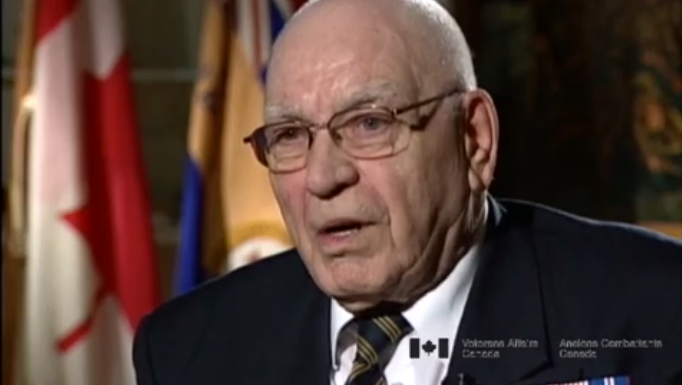
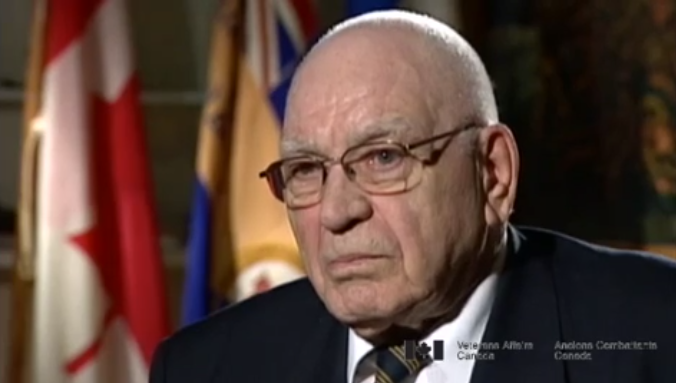
Mr. Belzile discusses developing a command structure in a unit and mutual respect between officers and NCO’s.
Transcription
You’re gonna get the job then that what you’ve been trained to do. You’re gonna be a platoon commander in my case in the infantry. I was given a sergeant as an assistant who was a sergeant from the PPCLI and myself, and we were literally given a block syllabus. A syllabus, a timetable to put about sixty people through basic training. You had twelve weeks to do that and during those twelve weeks of course, some of them fell off by the side, some of them went AWOL, some got sick, some got hurt in training. And by the end of the training, you got about 40, 42 people left out of the sixty some odd. Then as a group we selected, the sergeant and myself, rather not as, but amongst the group we selected three section commanders. It was up to us to have judged their leadership because we appointed them on the spot, with the sanction of the commanding officer, three corporals that were gonna become section commander. Because you know, the military is a very structured organization and, and necessarily so. So the people that run a section of eight to ten men are not like a commissioned officer that gets a platoon of about forty. But at the same time that young man you depended on to run that little group because in the field you don’t see more than three or four guys beside you. You take the lead in the dark or in dyer situations. You wear a rank on your shoulders but it doesn’t automatically get you respected. I mean getting yourself respected is something that you have to work at by showing that you can be compassionate to your troops but you can be concerned with their wherewithalls, and their ills, their problems and so on. And NCO’s over the years, the non-commissioned officers realize who’s on their side and who isn’t. If you’re wise at all in training and as a young officer too, that you realize the experience of these individuals that they, in fact, continue your training because in the school of infantry and in the school as well you are going through your own basic training they were the instructors. A lot in our case, of course, were also World War Two people because that was five, six years after the war. So we were the new generation. But most of our people that were, say, sergeants at the beginning of Korea and that sort of thing or in the case of officers or perhaps a captain that had done four or five years as a lieutenant. These guys almost invariably were World War Two. So, you know, and they carried a row of ribbons and medals and we tended to listen to them. So, and if you’re judicious enough to take their suggestions, you don’t have to because you’re the guy that’s the boss, but you would probably find, on analysis, that they’re usually right when they make a suggestion to you and so you learn to . . . Yeah, it’s like having a whole bunch of executive officers working with you but having a little board was only two or three people. Sound them out, always do that and if you have any doubts whatsoever about doing an attack from the right flank or the left flank you just look at the eyes in the sergeant, you know, and if he says . . . if you see him crinking probably he’s thought of something you may not have thought of, so you ask him then and make up your mind. To be able to be just as physical and as tough as they are is also important. They can’t see you as a wet noodle. If you’re asking them to be tough and to leap out of an air plane with you know, with sixty pounds of kit on your back, they expect to see you do it, too.
Catégories
They Salute the Commission
Médium
Video
Propriétaire
Veterans Affairs Canada
Guerre ou mission
Forces armées canadiennes
Personne interviewée
Charles Belzile
Branche
Armée
Unité ou navire
<em>Queen's Own Rifles of Canada</em>
Military Rank
Lieutenant général
Occupation
Commander
Durée
4:00