Attention!
Cette vidéo est disponible en anglais seulement.
Description
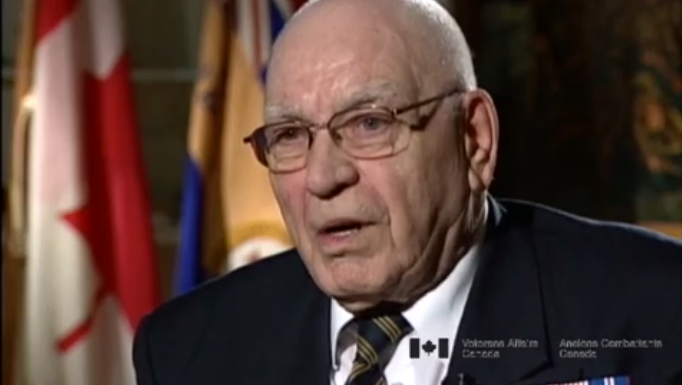
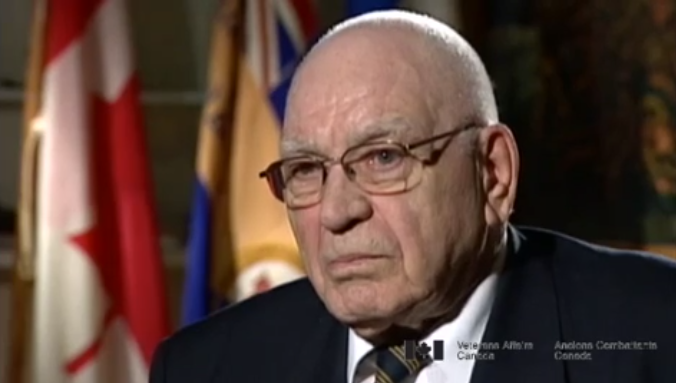
Dr. Theal describes the steps involved in moving the wounded back to the appropriate level of care.
Transcription
Each platoon had stretcher bearers. Stretcher bearers wore a white band with a red cross on their shoulder to indicate to the enemy that they were not armed and that they were protected by the Geneva Convention, which has long since, I think, gone out the window, but at that time was still effective. And the stretcher bearers had little syringe-like tubes, they could stick a needle into the patient and squeeze it and inject morphine, where necessary. So the first thing that patient saw was a stretcher bearer with his morphine, if necessary, and his bandages which he carried lots of. And two stretcher bearers would pick the casualty up on a stretcher and bring him back to the regimental aid post. The regimental aid post was central to the line. And that was, and the regimental aid, the medical doctor of the unit, was in the RAP, the regimental aid post. And the first thing I saw was the stretcher bearer bring in the casualty, and put him down on the ground or floor or wherever I was. I would check him over and they would explain what they had done, and I would do whatever was necessary further than that. But my important, the important thing I had to do was examine the patient fully and find out all the things that were the matter with him, put them on a tag and fasten it on his uniform and then get the patient transferred to a jeep and send the jeep back to the casualty clearing station which would be further back the line. Casualty clearing station then, that was this field ambulance around the casualty clearing station. They would examine and if they needed plasma or something like that or a cast they would apply the cast to the plasma, check the bandaging and so on, and then they would decide whether he should go by plane to an English hospital or stay there and just be treated locally or go to a small hospital further back or at a larger hospital, depending. Different hospitals had different functions, and there were surgical units that usually were in hospitals, but also there were advanced surgical units sometimes. They were sent up and they were attached to casualty clearing stations for a time. That’s the way the whole thing was, to get the patient back, back, and at the right point, get them treated and then back in the field when they could make it.
Catégories
Inject Morphine Where Necessary
Médium
Video
Propriétaire
Veterans Affairs Canada
Guerre ou mission
Seconde Guerre mondiale
Emplacement géographique
Normandie
Campagne
Jour-J
Personne interviewée
Dr. Gordon Irvine Theal
Branche
Armée
Unité ou navire
Corps médical militaire royal du Canada
Military Rank
Capitaine
Occupation
Doctor
Durée
3:35