Attention!
Cette vidéo est disponible en anglais seulement.
Description
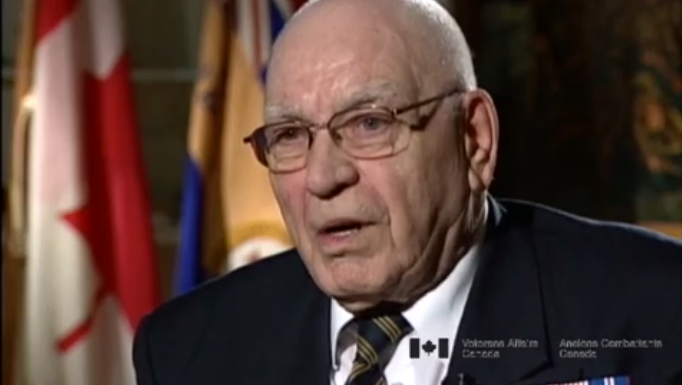
Mr. Niles describes the variety of patrols that were used against the North Korean positions.
Transcription
Well, there’s reconnaissance patrols. That means you just go out and you look, and you don’t do nothing. Because you don’t want them to know that you’re out there. So you look around, you take notice.And like, one night, me and my friend, we had a stupid corporal, you know. He would have fought in, like, two minutes. We seen a group patrol. We were going this way, but they were going that way. So he said to me, “Let them go,” so we let them go. When he asked us, “No, we didn’t see nothing.” What do we want to start a fight for? Somebody firing shots at me? So we never said nothing about it. And I don’t know how many times that might have happened. And you had others, they wanted to see how many hills or what hill that you could go, and how far you could get. Most of the time, they’d give us a beating on those hills. Fighting patrol is one that, like, when I said we went up the hill, that’s a fighting patrol. Because you’re going up there, and you know you’re gonna have to fight. An ambush patrol is one where you’re out on reconnaissance, looking around, and seeing these patrols. So if you’re ambushed by them, you’ll fight, you know what I mean? But most of the time, they just wanted to see where they were going and what they were doing out there. You see, if they started a fight, they wouldn’t be able to take much information back, because there would be half of them getting killed or something like that. And it would be a waste of time to send a patrol out there. So that’s what they’d do. They’d go out there. But a fighting patrol is when you went up there. But normally, when you went out there, it didn’t matter what kind of patrol you went on. It was a fighting patrol anyway, because you were equipped, because you had your grenades, you had, you had your rocket launchers, you had guys with Bren guns, you know and your Sten guns and your rifles. So you were pretty well equipped. Ah, a section is nine men, nine men to a section, and for a platoon, it’s around 27-28 men. And that’s what I was on that night, was a platoon patrol, which is a little bigger, a little easier to get noticed. Interviewer: If you stumbled into a Chinese or a North Korean patrol in no-man’s-land ...Oh. You’d have to fight. Oh yeah you’d have to fight. Interviewer: Can you describe what ...Well, I never really run into one. Only that time, going up the hill a couple of times there. I had buddies that had went out there. And they were almost back, and didn’t realize it that they were being followed back. And as he got close to our lines, that’s when they start firing at him, you see. You know, and then they went. But they were very clever. We went one time, to lay wire, barbed wire fence, between no-man’s-land and that, for the PPCLI. And we went out and we laid seventy or eighty feet of this barbed wire fence. And when we came back, sixty feet of what we had laid was gone. They were behind us, taking it down. They didn’t want to fight us. They just wanted to let us know they were there. And that gives you a scary feeling, knowing that they’re there, and they could have killed you. But they just want to let you know how close they are, and following right behind you. Quick as you put it up, they’re coming behind you and taking the bloody thing down.
Catégories
Reconnaissance Patrols
Médium
Video
Propriétaire
Veterans Affairs Canada
Guerre ou mission
Guerre de Corée
Emplacement géographique
Corée
Campagne
Corée
Personne interviewée
Joseph Allan Niles
Branche
Armée
Unité ou navire
<em>Royal Canadian Regiment</em>
Military Rank
Infantry
Durée
4:17