Attention!
Cette vidéo est disponible en anglais seulement.
Description
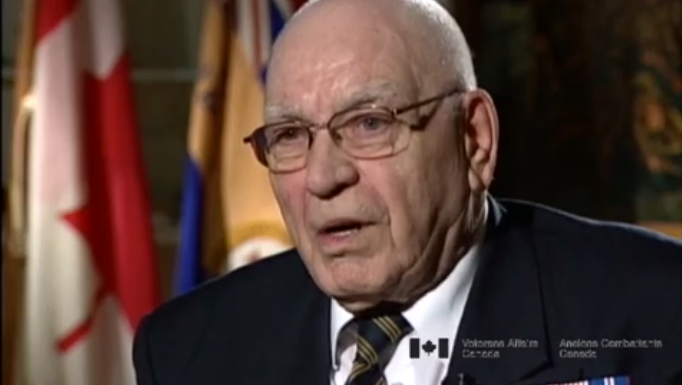
Mr. Welland discusses joining the Royal Navy as an officer in 1936 and learning his trade at sea. He gives a good description of celestial navigation.
Transcription
I knew I had to join as an officer, not as a sailor, if I was going to go anywhere in it. And I knew the difference between officers and sailors because my father had been an officer and I sort of understood the rank structure, if you like. And it was obviously to me, better to be an officer than a dogsbody. This is going back a long way and it’s pre-war. To get into the navy as a cadet, which is the lowest rank, I had to have senior matric and I had to have a foreign language. So I learned German and I took my correspondence course in spherical trigonometry, which wasn’t offered in the school. Then there was a competitive exam in the civil service and that year there were eight of us joined the navy. We were the total number of officers who joined the Canadian Navy that year. And that was in 1936. And at that time, there was no officer training in Canada for the navy or the army or the air force. We were all sent to England. At that time it was quite different from now. Britain ruled the waves, something like a fifth of the earth was painted pink. I spent a year in a British warship as a cadet and then I spent ... we were at sea the whole time. Well, most of the time. And I toured Norway and Denmark in this ship, and Scotland and the West Indies, bits of South America. So by the time I was 19, I had travelled quite extensively. And all the time studying, mainly studying, but doing the work in the ship as well. So we learned how ... all about the ship’s propulsion systems, concentrating on navigation, astro nav. At that time, the only way to find your position on the ocean was using a sextant and the heavenly bodies, stars and the sun and the moon. To find your position by stars, which was really the most accurate, you have to take the site when you can see the stars and also the horizon. So that’s about a ten minute gap in the evening and in the morning. So that’s when you measure the stars. And then to do the math on each star, you need about four or five of them, so they get cross fixes. To do the math on each one took about twenty minutes, so almost two hours. You could do it better than guessing and you got better at it. It would take around about two or three hours to actually figure out where you were at night and morning. And, you know, that system didn’t change until after World War Two. Well, in the Pacific Ocean in 1957, it was still the only way to find out where you were.
Catégories
There Was no Officer Training in Canada.
Médium
Video
Propriétaire
Veterans Affairs Canada
Guerre ou mission
Seconde Guerre mondiale
Personne interviewée
Robert Welland
Branche
Marine
Unité ou navire
HMS <em>Fame</em>
Military Rank
Sous-lieutenant
Occupation
Anti-submarine officer
Durée
4:18