Attention!
Cette vidéo est disponible en anglais seulement.
Description
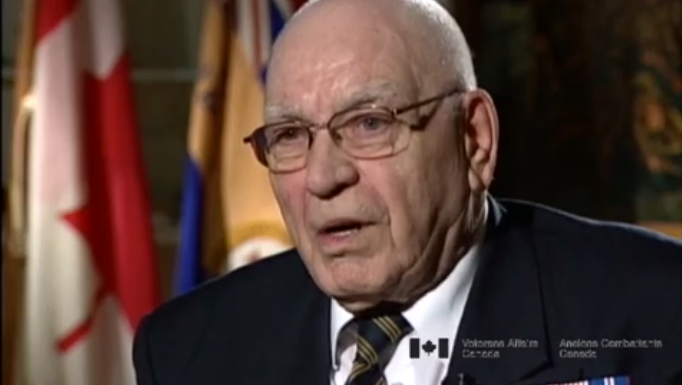
Mr. Welland gives an excellent description of convoy duty, and of the importance of convoys to Allied success in the war.
Transcription
Convoying was, you know, a dreary business. You know, sometimes you’d do a whole convoy and not be attacked at all. But you had to be on your toes the whole moment because ... basically, our side didn’t know where the German submarines were, so, you know. You could go for a week and not have one, and then suddenly 12, 15 submarines ascend on the convoy and that’s the way it worked. So, some trips complete no action at all. Other trips, just awful. I remember once there were ten ships sinking in sight of us, you know, they’d just been ... and then you’d have to go and rescue people from the water and chase down the submarines. But mainly, there wasn’t that much action in the convoy routes. It was long trips and bad weather and tough, tough going, you know. Here you are on this high powered ship that can do 30 knots and you’re plodding along at seven knots with a convoy, or eight knots, you know, but it was an essential thing to do. The successful convoy won the war. If we hadn’t done that, there’s no way that the Germans could have been beaten. As time went by, the British slowly gathered their strength again and Britain really … they don’t have any resources in the country, including food. They didn’t have enough food to feed their own people. They imported food, still do, I imagine. So everything had to be carted from North America - Canada and the States - to England. I mean airplanes, airplanes couldn’t fly the Atlantic then. They were dissembled. They were manufactured here, put aboard ships, lumber, wheat, ammunition, everything, including people. So all this stuff was carried across. I mean there were hundreds of convoys during the war. A convoy would consist of between 30 and maybe 80 ships and they gathered mainly in Halifax, that was the big convoying port in the war. There are some excellent books on this subject. The ships would gather, anchored in Bedford Basin and they’d be collected. I think a convoy sailed twice a week from Halifax. They’d come from all different places, gather there, and then sail and be escorted all the way by our warships. The warship escort was in two phases. There was a group escorted from Halifax to south of Newfoundland, and then the mid-ocean escort, us. That’s what I was in, usually. We would meet the convoys somewhere south of Newfoundland, well into the Atlantic, sometimes down by the Azores, because convoys are routed in different ways to confuse submarines. So it took forever. It took two weeks to cross the ocean because you had to go the speed of the slowest ship and the only way to protect them was to surround them with escorts. And the submarines could do far more fire speed than that, so once they caught up, once they found a convoy, it was hard to get rid of them. They could easily keep up. So it was a, you know, very interesting game with high stakes.
Catégories
The Successful Convoy Won the War.
Médium
Video
Propriétaire
Veterans Affairs Canada
Guerre ou mission
Seconde Guerre mondiale
Emplacement géographique
Océan Atlantique Nord
Personne interviewée
Robert Welland
Branche
Marine
Unité ou navire
HMS <em>Fame</em>
Military Rank
Sous-lieutenant
Occupation
Anti-submarine officer
Durée
4:21