Attention!
Cette vidéo est disponible en anglais seulement.
Description
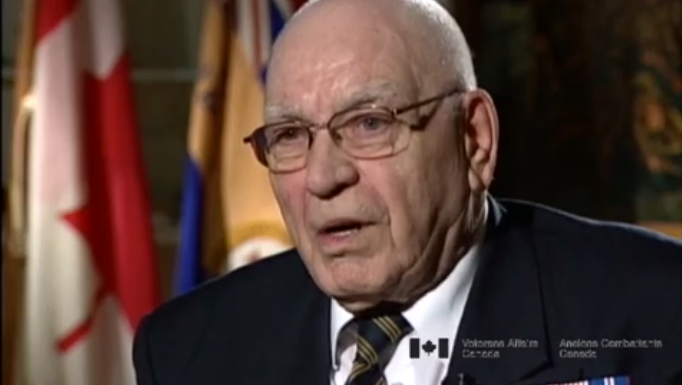
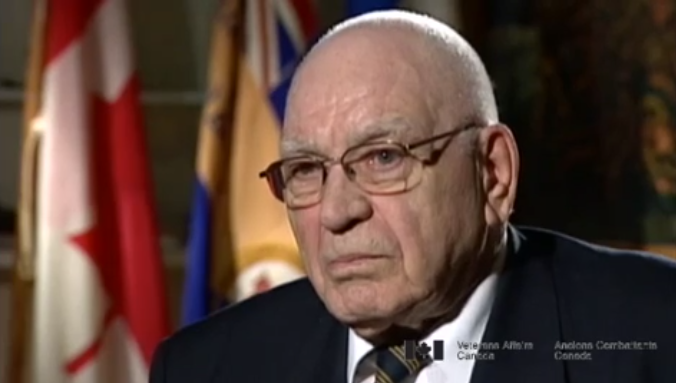
Mr. Welland discusses his deployment to Korea as captain of HMCS Athabascan, and describes doing primarily humanitarian intervention. He relates one incident wherein HMCS Athabascan provided naval bombardment to aid an American retreat.
Transcription
Then the Korean War started and I was made the captain of the Athabascan, which is another, a new destroyer. The Korean War was very dangerous if you happened to be a soldier, because all the fighting took place ashore. And the role of the navy there was to stop the North Koreans using the sea to supply themselves, because they started the war by capturing all of South Korea. Our job was to drive them back. But the navy could really do nothing about it. It was really a soldier’s war and we were never in any ... it was quite different. The weather was perfect, the wind didn’t blow and the sea didn’t freeze and so on. And there was no Korean, no naval opposition to us. It was possible but it never happened. And the same with the air force. The air force’s role in Korea was minimal. They flew a lot of planes but there was no opposition to them. We used to bombard the shore in Korea but nobody ever fired back at us or rarely. So it was ... we were ‘do-gooders.’ We rescued people and we picked up derelict boats at sea, full of survivors who were trying to escape their captors. There was not much danger of being killed. We did one operation which got ourselves into the newspapers. This was when the North Koreans drove our forces - the Canadians were there too, but mainly Americans - south and 25,000 US soldiers were killed. So this was a major operation, but it was entirely the army that had the losses. Well, we ... there were six destroyers went up a river in North Korea and we crept up this river in the dark. And we shelled the Chinese army that were chasing the Americans south and held them off for a while with destroyer gun fire. But we were in no particular danger ourselves. We stayed there too long, in my opinion. My ship was there ten and half months. It’s just too long. In peacetime, I wouldn’t mind that. In fact, in World War Two, I was away much longer than that. I didn’t mind because we were actually, you know, in action doing things. But the Korean War, it was a, for me, it was a boring thing.
Catégories
There Was No Naval Opposition To Us.
Médium
Video
Propriétaire
Veterans Affairs Canada
Guerre ou mission
Guerre de Corée
Personne interviewée
Robert Welland
Branche
Marine
Unité ou navire
HMCS <em>Athabascan</em>
Military Rank
Sous-lieutenant
Occupation
Anti-submarine officer
Durée
3:23