Attention!
Cette vidéo est disponible en anglais seulement.
Description
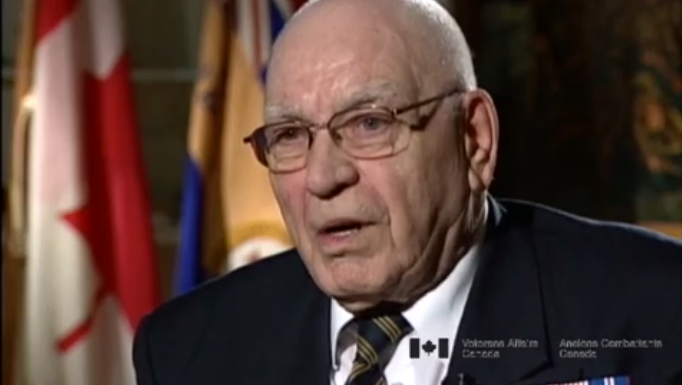
Mr. Clark describes being in Halifax when the war ended, and gives some details of and insight into the subsequent Halifax riot.
Transcription
VE Day? I remember very well. Our ship was on dry dock, and I was just coming … we had to go on, I don’t know why. Some of us had to go on night duty, just in case somebody took something. I don’t know what they thought they were going to do, but we had to be on duty. We were staying uptown. We couldn’t stay on the ship because she was on dry dock at the time. And I was just coming off the, coming up off the shipyards. If you’ve ever been around the Halifax shipyards, coming up …I don’t know, it may be changed now. But coming up, just right from the dry dock, up right from the shipyards and the dry dock, up there, up the gangplank. Just got out onto the street and they started blowing the whistles and horns and everything. They said the war was over. The next day is when they started the looting. But they blamed the servicemen for it. It wasn’t the servicemen, it was the civilians done the looting. I mean, where was I going to take something to the ship? Couldn’t take something back. The boys might have broke out ... I mean, the first place they broke into Halifax, was the navy guys. Not blaming the navy, they done the breaking in, most of it. Because they were living around Halifax, and they headed out for, I just forget the name of the store now, but there was one store where they had navy outfitting and so on. And they said, if you wanted a new tiddly or anything, something special, you could get it there. But they charge awful prices. And that’s the first place they broke into. They smashed the windows out, but I don’t know if they took any of it, hardly. Civilians done the looting. I remember a woman I knew, worked in a canteen. She that … she lived over in Dartmouth and she said that after they ... Then they started going around raiding houses, like, looking for the loot and so on. She said it was laughable over on their street. She said, “There wasn’t a service person living on their street. But,” she said, “… people were coming out of the house with loot of some kind or other, taking it out and putting … go down, putting it in front of the neighbour’s house. And the neighbour come out, come up and put it in front of their house,” or something like that. She was telling me there was no navy people there, but there’s lots of, lots of loot there. I will admit that, like the liquor stores, yes, the servicemen probably broke them in. And some of them, they might have broken in the odd store. But most of the stores, the windows were just smashed out and people helped themselves. But the idea was to blame it on the servicemen, because they could get the government to pay for their loot. It’s like one woman I knew, that worked in a ladies wear. Now, I’m sure none of the boys was in the ladies wear, taking too much. I don’t think there’s much they wanted, no, but I mean ... And … but she said they got a whole new store front, and practically a new store. A better store than they ever had, because the government paid for it. But I mean ... and they looted that. Well, now I can’t see too many of the boys going to a ladies store, looting too much stuff. No, it was the civilians that was taking the stuff out of it.
Catégories
There wasn’t a service person living on their street
Médium
Video
Propriétaire
Veterans Affairs Canada
Guerre ou mission
Seconde Guerre mondiale
Emplacement géographique
Canada
Personne interviewée
Charles Howard Clark
Branche
Armée
Unité ou navire
Royal Canadian Army Service Corps
Military Rank
Corporal
Occupation
Nurse-Orderly
Durée
2:44