Attention!
Cette vidéo est disponible en anglais seulement.
Description
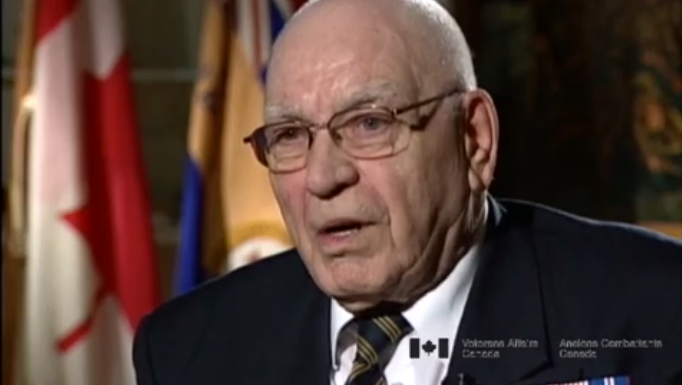
Mr. Campbell describes his responsibilities as a radar mechanic with the Bomber Command and the equipment used during his service.
Transcription
I started my training in September of ’41. By June, I was on my way overseas by boat with about four or five hundred other radar mechanics. We went to Hastings to begin with, at a reception depot, and after two weeks we were quickly moved from there one day, and down to Bournemouth. The next day, the Dieppe raid went out of Hastings. We were in Bournemouth by that time, so we were out of the way of the army. I was one of those fortunate enough to be shipped to a Canadian squadron. Started out with a 420 Squadron in, near Lincoln, in Lincolnshire. And then we moved north into Yorkshire, where we were converted to heavier aircraft and the radar being installed. So we had, as you go through Bomber Command, we started out … the first equipment we had was identification of our aircraft for our own defences, an automatic transceiver. Then we got into equipment that would … so we could help with navigation. Then, equipment for defence of the aircraft. And finally, target finding equipment, which was the last equipment the Bomber Command used. We could, as an American recently said, “They were more accurate at night than we were in the daytime.” So we had the old boy equipment, which was fairly highly refined. The thing that gave the big break to us in the development of radar was the discovery of the magnetron, which, if you have a microwave oven at home, it contains one. This permitted us to go to very high frequencies and short wave lengths. It increased our accuracy and gave us a big advantage.
Catégories
Discovery Of Magnetron
Médium
Video
Propriétaire
Veterans Affairs Canada
Guerre ou mission
Seconde Guerre mondiale
Emplacement géographique
Angleterre
Personne interviewée
Phil Campbell
Branche
Aviation
Unité ou navire
Escadron 420
Military Rank
Corporal
Occupation
Méchanicien de radar
Durée
2:32