Attention!
Cette vidéo est disponible en anglais seulement.
Description
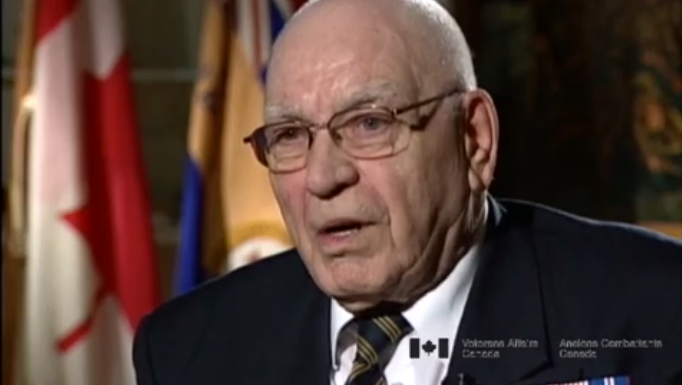
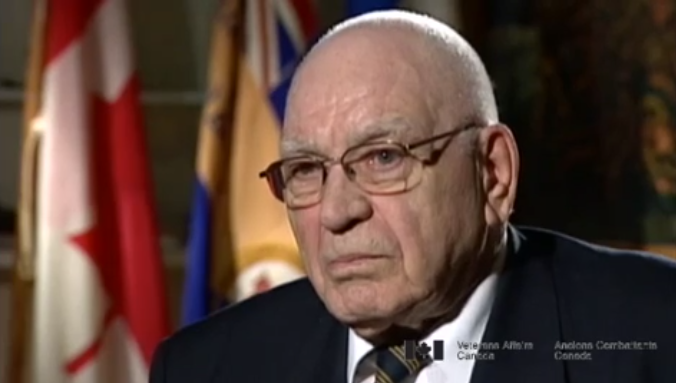
Mr. Gray discusses his eventual enlistment in the Royal Canadian Navy and the Navy’s impact in wartime Halifax.
Transcription
I was 17 and the trend that day, the trend at that time, was to join up and serve your country in time of war. Seventeen, I go down and I join the army. I went to Quebec for basic training. We had 90 days basic training up there. There was a draft that was going to go overseas, and my brother said, “You’re not going.” He said. So, he went and he told them, “This guy is only 17 years old. He is not going overseas.” So, when I had proof of my birth certificate and showed them, they found that I was 17, and then that was the end of my career in the army. I served about six months in 1941. Interviewer: How old were you supposed to be? Eighteen, eighteen, and then, like I say, they, they give you a pretty full day, a pretty . . . boot camp and basic training. It was tough, it was rough, but it was good. It was great. You were in great shape. I was in great shape. I was always a big man and always big boned and afraid of nothing that crept, crawled or walked at that time. This time, we were now eligible. Five or six boys that were in the gang that used to hang around the block all joined in the navy and I tagged along with them. I joined here in Sydney, and I went to Halifax. And in 1941, going on in September . . . and we went to Halifax, and we done basic training in Halifax. Well, I was sort of used to the basic training because I had that during my little stint in the army. Well, the basic training I took with the navy was great. Like I said, I was a big man and I was pretty able, and they used to get us up at 5:30 in the morning and we’d run the streets of Halifax, all them cobblestones. We’d run for about six or seven . . . we’d run until about six or seven o’clock in the morning and then we’d go back into the barracks and we’d, they made breakfast there for you. There’d be lots to eat. It was great. Halifax was a navy town, navy town, the military, all soldiers and very few civilians. And, and if you see three or four civilians in a, in a crowd, you know, the, the militia, the military really took over. They’d walk on the . . . the, the civilians would probably see three or four guys coming down and say, “Oh, we don’t want to get into trouble with them fellas. We’ll walk on the road.” You know. And the guys who was in the military figured, “Oh, we’re heroes, you know. We can do this, like.” We were sort of young fellas. We were wild, and we had no fear, and it didn’t, it didn’t matter to us. We were in the navy. So what, you know, what do you want us to do? You know, we thought we were pretty big shots, pretty hefty guys. We learned our lesson.
Catégories
Early Enlistment
Médium
Video
Propriétaire
Veterans Affairs Canada
Guerre ou mission
Seconde Guerre mondiale
Emplacement géographique
Canada
Personne interviewée
Earl Gray
Branche
Marine
Unité ou navire
NCSM <em>St. Croix</em>
Military Rank
Matelot de classes
Occupation
Deck Crew
Durée
3:14