Attention!
Cette vidéo est disponible en anglais seulement.
Description
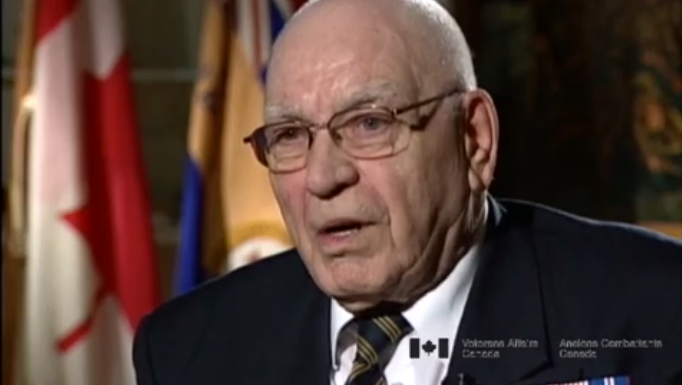
Mr Ewing explains how he contracted tuberculosis while being held in a Japanese prisoner of war camp and survived thanks to a comrade’s homemade contraption.
Transcription
Surviving Tuberculosis as a POW
I noticed that I was losing strength and losing weight and, and, and then I also noticed that flecks of blood in sputum. So self-diagnosis, I decided it was, was tuberculosis but I also thought to myself, "Well, everybody must have it because with these conditions, how can anybody escape it." But it turned out that not everybody did have it. Anyway, I, one day I came back from, from work and, and I had a real haemorrhage and I didn't know whether it was going to stop or not, but it did. And I reported to the, Captain Reid, who was our, the medical officer in, in 3-D at that time. So he put me in, they had a little sick bay at the end of the, at the end of one of the huts, I don't know what it could hold maybe, six or seven people maybe. Anyway I was put in there with a chap by, a Sergeant Russell, who was one of our people also, and then the decision was made to send both of us up to, up to Shinegawa. Sergeant Russell died but I managed to survive. Actually, I was extremely fortunate in that shortly after we arrived in Shinegawa, a number of doctors came in, were sent in from, some of them from the Philippines, some of them from Hong Kong, and among the doctors was a chest specialist, Dawson Grove, he was a Lieutenant Commander in the British Navy, and he examined me and he designed, or, or, or sketched out a machine that, to, to administer pneumothorax, and it was made by a Norwegian, a fella by the name of Pedersen, who was in the Merchant Navy and captured by the Japanese. He made this apparatus and it was tried out on me and it, it was successful in, in collapsing a lung which was, gave the lung a rest and, and stopped the progress of the disease. Otherwise, again, I wouldn't have been here. The, it was quite an ingenious contraption, it even measured the volume of air that was put into, injected into the pleural cavity.
Interviewer: Do you, can you describe how it worked?
There was two, two glass bottles, I guess originally they had held probably sterile water, and, and graded in, in millimetres up to a thousand, I think, it was, there was, these two bottles were about a litre each, held about a litre each, and the, it was, the markings were on the outside of the bottle as many pharmaceuticals are. And you fill one bottle with water and, and as it, and tip the, tip the apparatus so that the water goes into the other, the other jar and it forces the air up a, up a pipe and into the chest cavity. So you can tell how much, because there is a gradation on the, on the bottles, you can tell how much air has been administered. So that, it worked very well and as I say it was a life saver to me.
I noticed that I was losing strength and losing weight and, and, and then I also noticed that flecks of blood in sputum. So self-diagnosis, I decided it was, was tuberculosis but I also thought to myself, "Well, everybody must have it because with these conditions, how can anybody escape it." But it turned out that not everybody did have it. Anyway, I, one day I came back from, from work and, and I had a real haemorrhage and I didn't know whether it was going to stop or not, but it did. And I reported to the, Captain Reid, who was our, the medical officer in, in 3-D at that time. So he put me in, they had a little sick bay at the end of the, at the end of one of the huts, I don't know what it could hold maybe, six or seven people maybe. Anyway I was put in there with a chap by, a Sergeant Russell, who was one of our people also, and then the decision was made to send both of us up to, up to Shinegawa. Sergeant Russell died but I managed to survive. Actually, I was extremely fortunate in that shortly after we arrived in Shinegawa, a number of doctors came in, were sent in from, some of them from the Philippines, some of them from Hong Kong, and among the doctors was a chest specialist, Dawson Grove, he was a Lieutenant Commander in the British Navy, and he examined me and he designed, or, or, or sketched out a machine that, to, to administer pneumothorax, and it was made by a Norwegian, a fella by the name of Pedersen, who was in the Merchant Navy and captured by the Japanese. He made this apparatus and it was tried out on me and it, it was successful in, in collapsing a lung which was, gave the lung a rest and, and stopped the progress of the disease. Otherwise, again, I wouldn't have been here. The, it was quite an ingenious contraption, it even measured the volume of air that was put into, injected into the pleural cavity.
Interviewer: Do you, can you describe how it worked?
There was two, two glass bottles, I guess originally they had held probably sterile water, and, and graded in, in millimetres up to a thousand, I think, it was, there was, these two bottles were about a litre each, held about a litre each, and the, it was, the markings were on the outside of the bottle as many pharmaceuticals are. And you fill one bottle with water and, and as it, and tip the, tip the apparatus so that the water goes into the other, the other jar and it forces the air up a, up a pipe and into the chest cavity. So you can tell how much, because there is a gradation on the, on the bottles, you can tell how much air has been administered. So that, it worked very well and as I say it was a life saver to me.
Catégories
Surviving Tuberculosis as a POW
Médium
Video
Propriétaire
Veterans Affairs Canada
Guerre ou mission
Seconde Guerre mondiale
Emplacement géographique
Japon
Campagne
Hong Kong
Personne interviewée
Kenneth Alexander Ewing
Branche
Armée
Unité ou navire
<em>Royal Rifles of Canada</em>
Military Rank
Private
Occupation
Carabinier
Durée
04:35