Attention!
Cette vidéo est disponible en anglais seulement.
Description
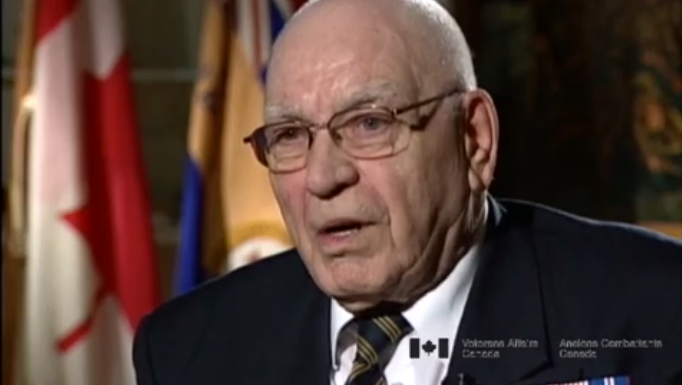
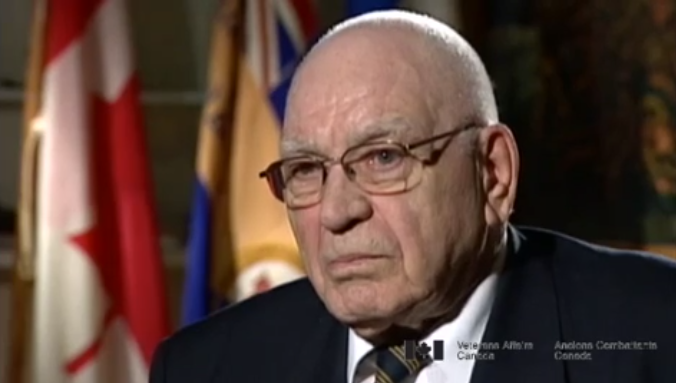
War camps and illness weakened Mr Ewing physically but they did not affect his mind and his return to normal life.
Transcription
Return to Civilian Life
I was in hospital until, in the army hospital in Fredericton. They transferred me up from Lancaster to Fredericton, and I was there, I tried again, I tried and this time I was successful in convincing the military doctors that my health was better than they thought. I told, I got the doctor to listen, I collared him one day and I said, "How long do you keep people that have had pneumothorax? " He said, "Well about six months." I said, "Well, what am I doing here? " I said. "I've had it for two years or more." And he looked, he looked very strange and, and he said, "Let me check." So he went back and that was the first time anybody had ever read my record, I guess. So, I got out the next day. But I was still, when I went home I tried to make up for all the, all the time that I had been away, playing hockey and probably partying a little too much, even though I wasn't very much of a party person. And anyway, I ended up back in hospital again. And I got out again after six months and I did the same thing, I ended up back in hospital. And that convinced me that, finally that I couldn't do this sort of thing. So I, when, the last time I was in hospital I, well I had, before I even went overseas, when I joined the army I had, I had, I had told my mother that I would go back to school when I, when my service was finished, and so I, when I got out of hospital the last time or, well not quite the last time, but the last time for tuberculosis, I went back to school and eventually to university, and so it was 1952 before I joined the workforce.
Interviewer: When you think back, Mr. Ewing, on your time in the Canadian Army, the chaotic battle of Hong Kong, the miserable conditions and squalor that you lived in for almost four years in Japanese captivity. When you think back on that experience, how would you say that it affected you in later life?
Well, I guess it made me appreciate life. I certainly appreciate what I was able to do, it gave me, I think, the ability to stick with something that I didn't necessarily like but had to be done. So, I guess, and I suppose also perhaps I'm more thoughtful of, of other people and certainly more knowledgeable about my own self.
Interviewer: Did you experience any psychological difficulties coming back to Canada?
I think, I don't think so. I recall having an assessment made in, when I was in the hospital in Saint John, New Brunswick, the Lancaster Military Hospital, and, and when the guy was all finished he said that you know, in his report, something about "level headed" and "apparently wants to get on with, wants to get on with his life and forget the past." But I didn't necessarily forget the past but I got on with life all right.
I was in hospital until, in the army hospital in Fredericton. They transferred me up from Lancaster to Fredericton, and I was there, I tried again, I tried and this time I was successful in convincing the military doctors that my health was better than they thought. I told, I got the doctor to listen, I collared him one day and I said, "How long do you keep people that have had pneumothorax? " He said, "Well about six months." I said, "Well, what am I doing here? " I said. "I've had it for two years or more." And he looked, he looked very strange and, and he said, "Let me check." So he went back and that was the first time anybody had ever read my record, I guess. So, I got out the next day. But I was still, when I went home I tried to make up for all the, all the time that I had been away, playing hockey and probably partying a little too much, even though I wasn't very much of a party person. And anyway, I ended up back in hospital again. And I got out again after six months and I did the same thing, I ended up back in hospital. And that convinced me that, finally that I couldn't do this sort of thing. So I, when, the last time I was in hospital I, well I had, before I even went overseas, when I joined the army I had, I had, I had told my mother that I would go back to school when I, when my service was finished, and so I, when I got out of hospital the last time or, well not quite the last time, but the last time for tuberculosis, I went back to school and eventually to university, and so it was 1952 before I joined the workforce.
Interviewer: When you think back, Mr. Ewing, on your time in the Canadian Army, the chaotic battle of Hong Kong, the miserable conditions and squalor that you lived in for almost four years in Japanese captivity. When you think back on that experience, how would you say that it affected you in later life?
Well, I guess it made me appreciate life. I certainly appreciate what I was able to do, it gave me, I think, the ability to stick with something that I didn't necessarily like but had to be done. So, I guess, and I suppose also perhaps I'm more thoughtful of, of other people and certainly more knowledgeable about my own self.
Interviewer: Did you experience any psychological difficulties coming back to Canada?
I think, I don't think so. I recall having an assessment made in, when I was in the hospital in Saint John, New Brunswick, the Lancaster Military Hospital, and, and when the guy was all finished he said that you know, in his report, something about "level headed" and "apparently wants to get on with, wants to get on with his life and forget the past." But I didn't necessarily forget the past but I got on with life all right.
Catégories
Return to Civilian Life
Médium
Video
Propriétaire
Veterans Affairs Canada
Guerre ou mission
Seconde Guerre mondiale
Emplacement géographique
Canada
Campagne
Hong Kong
Personne interviewée
Kenneth Alexander Ewing
Branche
Armée
Unité ou navire
<em>Royal Rifles of Canada</em>
Military Rank
Private
Occupation
Carabinier
Durée
04:25