Attention!
Cette vidéo est disponible en anglais seulement.
Attention!
Cette vidéo contient des scènes au contenu graphique qui pourraient choquer, et est réservée à un auditoire averti.
Description
The Italian Campaign is over and the Loyal Edmonton Regiment has moved into the French City of Marseilles.
Transcription
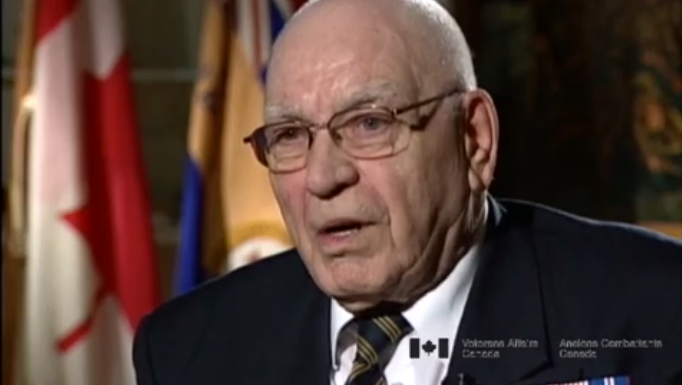
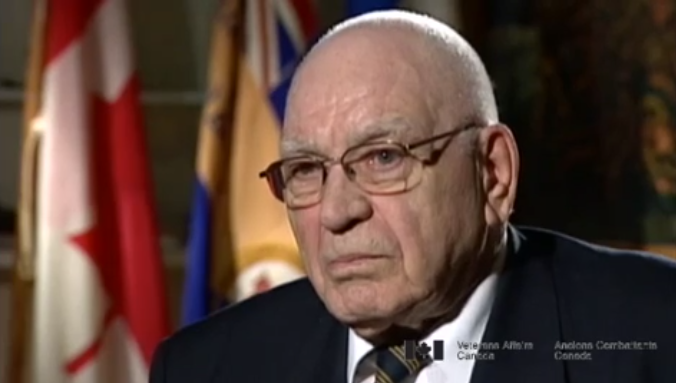
We went through from Marseille down the Rouen Valley, through France. And as we were going along there, all this German equipment that was blown up. I guess they couldn't escape ‘cause the river is on one side, the mountain was on the other. So they bottled them up I understand, the air force did, and they done a hell of an executioner's job on that group. We come through and into Belgium and that was really nice, getting into where it was civilized.
Interviewer: Tell me, Mr. Lenko, what was your reaction on leaving Italy? Were you happy to have it behind you?
Well, yeah, we were kind of glad we were having a change. We were glad. ‘Cause we spent about 22 months there.
Interviewer: And the fact that you were to join the rest of the Canadian Army in northwest Europe, what did that mean?
Well, it meant we were together again. We were a group, we were back together. Yeah, into Belgium. Finally, we had to go into Holland and then there was some fighting there. We, I think we only lost about 16 men there. But it was odd. I was mostly around Barneveld, Apeldoorn, Amersfoort, and we got by the IJssel River. And that was about the last go, was across the IJssel, IJssel River.
Interviewer: Were there any engagements with the enemy in Holland that were memorable to you?
Oh yeah. Well, just that they were on one side of a canal and we'd be on the other. And mostly, Holland was in real sad shape, everything was stripped and people were starving, really, really starving. I was with the group that had to go to where the planes were landing to bring in food and I'd be by a German, the German was here, I'd be by him, I had my rifle, he had theirs. It was actually before the war was really over. And the Dutch people were with us to pick up the supplies. They had orange bands on them, we called them ‘orangees'. But they were the ones that were grabbing the food then. But it was finally, we got word that war was over.
Interviewer: What was your reaction?
We were pretty happy. Really happy. And then we had to move in land to, I forget the name of the towns, Harlingen, and areas like that because we had to start taking their weapons away and gathering them up and get them home.
Interviewer: Tell me, Mr. Lenko, what was your reaction on leaving Italy? Were you happy to have it behind you?
Well, yeah, we were kind of glad we were having a change. We were glad. ‘Cause we spent about 22 months there.
Interviewer: And the fact that you were to join the rest of the Canadian Army in northwest Europe, what did that mean?
Well, it meant we were together again. We were a group, we were back together. Yeah, into Belgium. Finally, we had to go into Holland and then there was some fighting there. We, I think we only lost about 16 men there. But it was odd. I was mostly around Barneveld, Apeldoorn, Amersfoort, and we got by the IJssel River. And that was about the last go, was across the IJssel, IJssel River.
Interviewer: Were there any engagements with the enemy in Holland that were memorable to you?
Oh yeah. Well, just that they were on one side of a canal and we'd be on the other. And mostly, Holland was in real sad shape, everything was stripped and people were starving, really, really starving. I was with the group that had to go to where the planes were landing to bring in food and I'd be by a German, the German was here, I'd be by him, I had my rifle, he had theirs. It was actually before the war was really over. And the Dutch people were with us to pick up the supplies. They had orange bands on them, we called them ‘orangees'. But they were the ones that were grabbing the food then. But it was finally, we got word that war was over.
Interviewer: What was your reaction?
We were pretty happy. Really happy. And then we had to move in land to, I forget the name of the towns, Harlingen, and areas like that because we had to start taking their weapons away and gathering them up and get them home.
Catégories
On To France-And Eventually The War's End
Médium
Video
Propriétaire
Veterans Affairs Canada
Guerre ou mission
Seconde Guerre mondiale
Emplacement géographique
Europe
Campagne
Belgique
Personne interviewée
Sam Lenko
Branche
Armée
Unité ou navire
<em>Loyal Edmonton Regiment</em> / Companie D / 17<sup>e</sup> Platon
Occupation
Brigade Headquarters
Durée
03:24