Attention!
Cette vidéo est disponible en anglais seulement.
Description
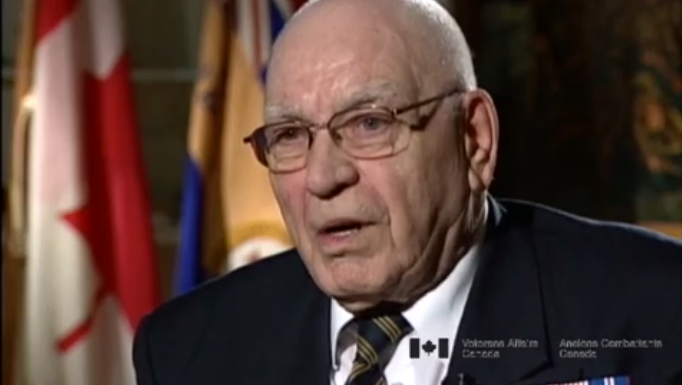
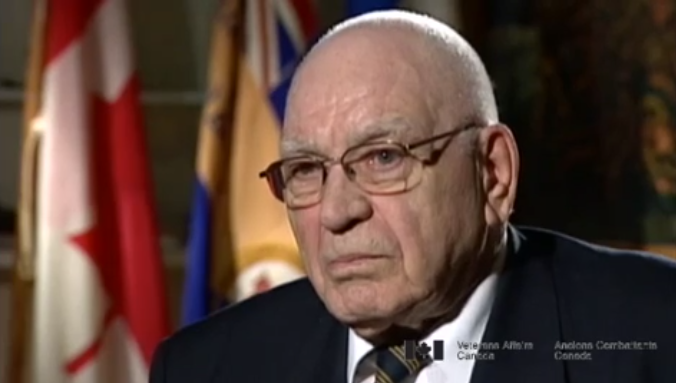
Mr. Spear recalls his flight training in Windsor Mills, Quebec, (near Sherbrooke) and Dunnville, Ontario, (near Lake Erie) ending with him earning his wings.
Transcription
This was the elementary school at Windsor Mills, they called it in those days. It's Windsor now. It's near, oh, Sherbrooke, Quebec. So that's where we met our instructors who were all civilians. There were no air force on the station, except the CO. And the meals were provided by a catering outfit from Montreal. And we took dual instruction. We were flying, not Tiger Moths, we were flying de Havilland Fleet, no, Fleet Finch II rather, on skis because it was still winter time. So we took instruction up until the time we went solo and then we went and did some solo flying and some further instruction. And then I remember the weather turned mild and the snow started to disappear so we were sent home on leave for a week or two. Then we came back, the planes had been re-equipped with wheels. So then we flew on, off the ground with wheels.
Interviewer: How long, Mr. Spear, would it be normal or how long would it be normal to solo?
I think the average is somewhere around 8-10 hours. I believe, I think if you went over 12, that probably you were washed out and they figured if you couldn't make it by then, you weren't going to. I think I was around 9 hours or something myself and I was just, I guess, probably an average pilot.
Interviewer: But during this period of time, they were assessing, the instructors were assessing each of the students?
As far as I know. Yeah, well, I don't know assessing as to what their future would be but certainly... I guess they were, you were being assessed, yes, because at the end of all your flying, they had a pretty good idea of what you were capable of and what, what you were best at. Anyways, and then along with that and while we were doing all the flying, a half a day we'd be flying and the other half, we'd be at ground school. So they divided the crowd up in two classes or flights. So we studied navigation and theory of flight and two or three other subjects. And then we had to write exams at the end. And one of our, my close friends, a friend I had made in Manning Pool, he was washed out because he didn't pass those ground exams and he was just out of high school. I never could figure out why he couldn't pass them because the rest of us all did. So then anyway, we eventually left there and we were sent to what they call a Service Flying School at Dunnville down on Lake Erie, I guess it is, yeah. And that was a complete change because that was all air force. The meals, the catering, the cooking was done by air force and the instruction, the instructors were all air force officers. And we started flying a single wing monoplane, The Harvard. So I thought, "Well, that's a good sign." because some...We could have been sent to a twin engine school, which would indicate you were going to be a bomber pilot. So, we just did more advanced flying there. We learned to fly at night and made landings and fly instruments and do a few aerobatics. Then, I had probably done 50 hours of at elementary and maybe another 100 at service school at Dunnville so by the time we finished, I had about 150 hours and I got my wings and got my sergeant stripes. Now, a certain number of our class, I don't know, maybe 20% or 30%, got commissioned right away. They were a higher standard or they had made the best marks or impressed the instructors the most, anyway. So, we always felt that was a bit unfair because we were all going to do the same thing. I got my commission eventually, but in the mean time, I lived sort of a second class life. So then, we were told what we were going to do. Some were going to be instructors in Canada, others were going to be going overseas, and I guess that about covers it. We didn't know exactly what we were going to do overseas, but we were sent home on leave and told to report to Halifax in two weeks time or something like that.
Interviewer: How long, Mr. Spear, would it be normal or how long would it be normal to solo?
I think the average is somewhere around 8-10 hours. I believe, I think if you went over 12, that probably you were washed out and they figured if you couldn't make it by then, you weren't going to. I think I was around 9 hours or something myself and I was just, I guess, probably an average pilot.
Interviewer: But during this period of time, they were assessing, the instructors were assessing each of the students?
As far as I know. Yeah, well, I don't know assessing as to what their future would be but certainly... I guess they were, you were being assessed, yes, because at the end of all your flying, they had a pretty good idea of what you were capable of and what, what you were best at. Anyways, and then along with that and while we were doing all the flying, a half a day we'd be flying and the other half, we'd be at ground school. So they divided the crowd up in two classes or flights. So we studied navigation and theory of flight and two or three other subjects. And then we had to write exams at the end. And one of our, my close friends, a friend I had made in Manning Pool, he was washed out because he didn't pass those ground exams and he was just out of high school. I never could figure out why he couldn't pass them because the rest of us all did. So then anyway, we eventually left there and we were sent to what they call a Service Flying School at Dunnville down on Lake Erie, I guess it is, yeah. And that was a complete change because that was all air force. The meals, the catering, the cooking was done by air force and the instruction, the instructors were all air force officers. And we started flying a single wing monoplane, The Harvard. So I thought, "Well, that's a good sign." because some...We could have been sent to a twin engine school, which would indicate you were going to be a bomber pilot. So, we just did more advanced flying there. We learned to fly at night and made landings and fly instruments and do a few aerobatics. Then, I had probably done 50 hours of at elementary and maybe another 100 at service school at Dunnville so by the time we finished, I had about 150 hours and I got my wings and got my sergeant stripes. Now, a certain number of our class, I don't know, maybe 20% or 30%, got commissioned right away. They were a higher standard or they had made the best marks or impressed the instructors the most, anyway. So, we always felt that was a bit unfair because we were all going to do the same thing. I got my commission eventually, but in the mean time, I lived sort of a second class life. So then, we were told what we were going to do. Some were going to be instructors in Canada, others were going to be going overseas, and I guess that about covers it. We didn't know exactly what we were going to do overseas, but we were sent home on leave and told to report to Halifax in two weeks time or something like that.
Catégories
Flight Training
Médium
Video
Propriétaire
Veterans Affairs Canada
Guerre ou mission
Seconde Guerre mondiale
Emplacement géographique
Canada
Personne interviewée
Allen Maxwell Spear
Branche
Aviation
Military Rank
Sergent
Occupation
Pilote
Durée
05:12