Attention!
Cette vidéo est disponible en anglais seulement.
Description
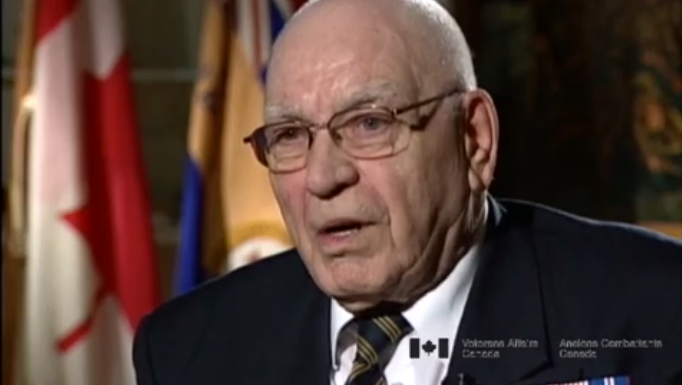
Mr. Moore describes how low he would fly on a surface attack on a submarine and how depth charges and acoustic and magnetic homing torpedos were used.
Transcription
Uh maybe twenty feet, at night. Well they briefed us to go on attack at 300 feet we started losing crews and so that told me very quickly that the enemy knows we are going to attack at 300 feet. So these even a u-boat if he sticks his stern to you he had some weapons mounted on deck and set up a box you had to fly over or through it and if you have to fly through it the odds of you getting through it with something the size of a Lib is not very good. So what I tried to do, particularly at night, when we had the tracer, I tried to keep the tracer going over the coop top. Which meant I'm going lower and lower and lower to the point where you felt as if you pulled up a bit to get over when you were attacking.
We used our turrets to clear their decks if they were on the surface. And one of them in particular on D-day was on the surface and the nose gunner did a great job in, in clearing the way as we were approaching the, the target as we called it.
Interviewer: And what do you use to hit the, to attack the target?
Uh depth charges. And we had acoustic and magnetic homing torpedos. I didn't know that. See our, when we went out to the Black Hole, going back aways, the weapons that we carried were six depth chargers, which isn't a lot of weapon. When we got in, say to the channel on D-day we carried magnetic homing torpedo and we carried 12 depth chargers. So we decided, the crew decided, to use six of six eh. So on one attack we got a three, three straddle with our depth charges and on the other we got a four, two. And we got confirmation, immediate confirmation on the sinkings.
We used our turrets to clear their decks if they were on the surface. And one of them in particular on D-day was on the surface and the nose gunner did a great job in, in clearing the way as we were approaching the, the target as we called it.
Interviewer: And what do you use to hit the, to attack the target?
Uh depth charges. And we had acoustic and magnetic homing torpedos. I didn't know that. See our, when we went out to the Black Hole, going back aways, the weapons that we carried were six depth chargers, which isn't a lot of weapon. When we got in, say to the channel on D-day we carried magnetic homing torpedo and we carried 12 depth chargers. So we decided, the crew decided, to use six of six eh. So on one attack we got a three, three straddle with our depth charges and on the other we got a four, two. And we got confirmation, immediate confirmation on the sinkings.
Catégories
Attacking submarines
Médium
Video
Propriétaire
Veterans Affairs Canada
Guerre ou mission
Seconde Guerre mondiale
Emplacement géographique
Europe
Personne interviewée
Ken Moore
Branche
Aviation
Unité ou navire
224<sup>e</sup> Escadron
Occupation
Pilote
Durée
02:14