Attention!
Cette vidéo est disponible en anglais seulement.
Description
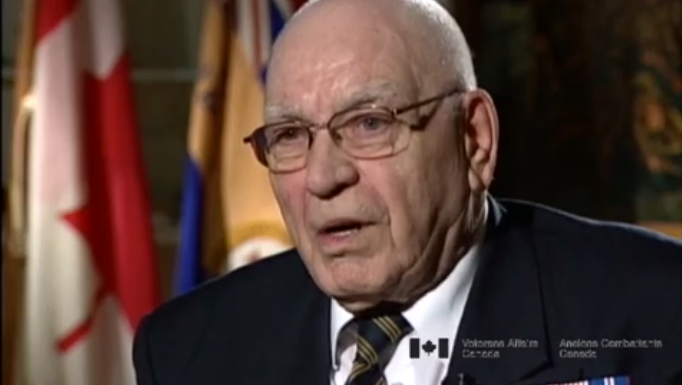
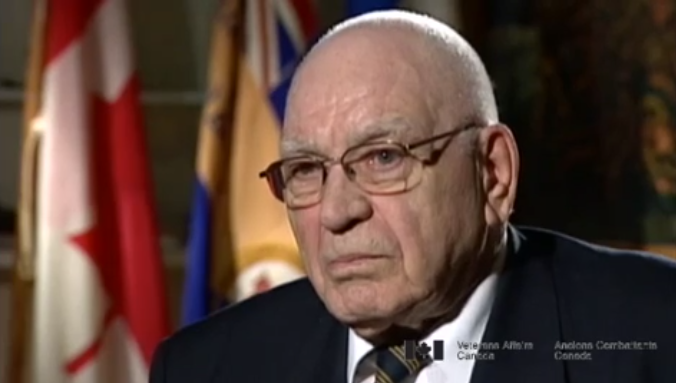
Mr McCrindle describes the loss of a young 16 year old man where Mr. McCrindle's troops were being billeted. This broke his heart and he disobeyed orders by helping the family get a coffin for the boy.
David McCrindle
Le père de M. McCrindle a immigré au Canada en 1911 et a servi durant la Première Guerre mondiale au sein du Black Watch de Montréal. Après la guerre, il est resté en Écosse et est retourné au Canada lorsque David était âgé de deux ans. M. David McCrindle a quitté l'école durant la Crise car sa famille n'avait pas les moyens de payer des études. Il a travaillé pour un bijoutier pour 6,50 $ par semaine et, en juin 1940, il s'est joint à la MANP, le soir et la fin de semaine. Le 9 janvier 1941, le jour de son 19e anniversaire, il s'est joint à l'équipe de Woodstock et a reçu son instruction à Woodstock, Ontario. M. McCrindle s'est rendu en Angleterre où il a reçu son instruction de signaleur. Il a participé à la campagne d'Italie et est revenu au Canada après la guerre.
Transcription
Well while we were up in this little town called Savio, we were, I was going to say we were billeted, but we had taken over a little, sort of a small not quite farming town. There were no big industries. And we took over this home, not all of it, part of it, and we lived in it and we ate in it and I had my signal set in it and so on. We got to know these people quite well because this was at a time when we were bogged down and we couldn't move. Everything was at a total stand still. And I remember this young fellow, he was maybe sixteen years of age, and strangely enough he was blond, pure blond. And he got a job working for the allies, clearing mines. And if he didn't get blown up...that broke my heart. And that family were so upset that I disobeyed orders and I took my signal wagon, and they wanted to get a coffin for the boy. And I took them and we went to, oh I don't know where, across all through muddy fields and everything, and got a coffin and brought it back for to bury the kid in. Young people should never be exposed to things like this. That really upset me when that young boy got killed. And he was such a nice young fellow.
Interviewer: How old were you at that time?
At that time, I'd be, let me see, it would be in December 45 I guess, just around Christmas time. I'd be 23, yeah. No pardon me, I'd be 22 going on, I'd be 23 in January.
Interviewer: So you weren't much older than him.
No. But I'd had all the experience of being in the Army for about four years so. And I'd certainly had better advantages than him.