Attention!
Cette vidéo est disponible en anglais seulement.
Description
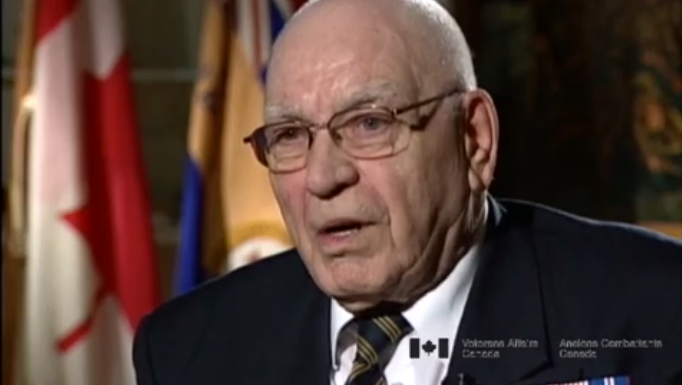
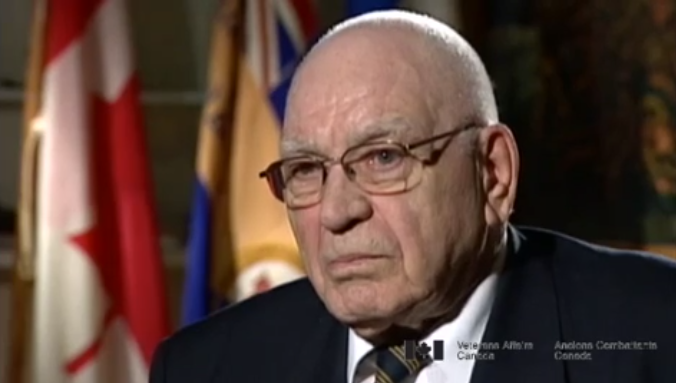
Mr. Castonguay describes his impressions of Hong Kong. He was happy to finally see the land he had learned about in school and was impressed by the atmosphere which was so different from his home.
Bernard Castonguay
Bernard Castonguay est né à Montréal, au Québec, le 9 février 1921. Il était le quatrième d'une famille de 11 enfants. Son père était monteur de tuyaux à vapeur pour la Canadian Pacific Railway. M. Castonguay a quitté la maison à l'âge de 16 ans, à la recherche d'aventure. Il a travaillé comme bûcheron et à la construction des chemins de fer. En 1940, incapable de trouver du travail, M. Castonguay s'est rendu à Québec pour s'enrôler dans le Royal Rifles of Canada. Il fut envoyé à Gander, à Terre-Neuve, où il fut signaleur et sentinelle. On l'envoya ensuite à Saint John, au Nouveau-Brunswick. À Hong Kong, M. Castonguay fut fait prisonnier par les Japonais et envoyé au camp de prisonniers de guerre (Omeni) de Nagasaki, au Japon, pour travailler dans une mine de charbon. Après son service, M. Castonguay a travaillé pour l'Institut national canadien pour les aveugles (INCA). Il devint par la suite directeur régional de l'INCA. Il fut également bénévole pour le Conseil canadien des aveugles.

Transcription
Interviewer: When you first saw the colony of Hong Kong, what was your impression?
When I was on the ship and I saw the yellow mountain. It was yellow. And that was really what I saw in my geography books at school. And I was happy. I was really happy to see that my dream was realized, I was in China.
Interviewer: After the ship docked and you men were marched through the city of Victoria.
Right, the city of Kowloon.
Interviewer: Oh Kowloon, sorry. What was your impression of the city?
Well we saw a lot of Chinese of course, we're not used to. And the city impressed me because they had big blocks of houses, 4, 6, how do you say?
Interviewer: Stories?
Stories. And there was a lot of Chinese around just to see us pass you see. And the atmosphere, the smell was quite something different than what we used to smell. It was hot, warm climate and humid. And it had a different smell.
Interviewer: It's my understanding you marched up Nathan Road and can you recall the attitude of the people that were watching you men march up Nathan Road?
They seemed to be very sympathetic, very much. We didn't see anyone do anything that was disagreeable.