Attention!
Cette vidéo est disponible en anglais seulement.
Description
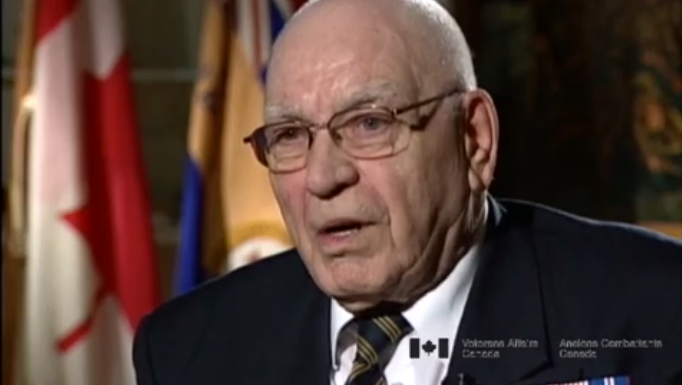
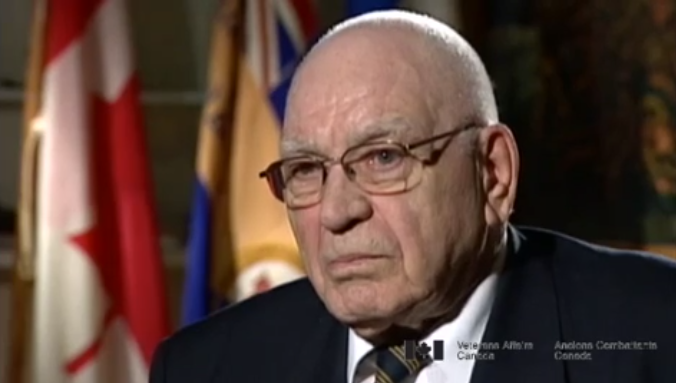
Mr. Castonguay recalls how the prisoners were sent to Japan by boat or train to a coal mine where they worked in dangerous conditions.
Bernard Castonguay
Bernard Castonguay est né à Montréal, au Québec, le 9 février 1921. Il était le quatrième d'une famille de 11 enfants. Son père était monteur de tuyaux à vapeur pour la Canadian Pacific Railway. M. Castonguay a quitté la maison à l'âge de 16 ans, à la recherche d'aventure. Il a travaillé comme bûcheron et à la construction des chemins de fer. En 1940, incapable de trouver du travail, M. Castonguay s'est rendu à Québec pour s'enrôler dans le Royal Rifles of Canada. Il fut envoyé à Gander, à Terre-Neuve, où il fut signaleur et sentinelle. On l'envoya ensuite à Saint John, au Nouveau-Brunswick. À Hong Kong, M. Castonguay fut fait prisonnier par les Japonais et envoyé au camp de prisonniers de guerre (Omeni) de Nagasaki, au Japon, pour travailler dans une mine de charbon. Après son service, M. Castonguay a travaillé pour l'Institut national canadien pour les aveugles (INCA). Il devint par la suite directeur régional de l'INCA. Il fut également bénévole pour le Conseil canadien des aveugles.

Transcription
In January 1943, the camp commandant got a bunch of us lined up on one side and as he walked, we had to walk across the field. And if we walked well enough, we didn't know why, but we were sent to a ship and embark for Japan. And when we got aboard the ship we went down in the hull and we were placed so close to one another, one standing up against another, just like sardines. I said how are we going to sleep here you know. But anyway we, that was done that way. We were three days aboard that ship. We stopped in Formosa to refuel and we went on to Nagasaki. Many of us were all sick of course but we were able to work you know. Well we had to walk through the city until, to a train station. And then they gave us some buns, white buns to eat, at night. And we travel. And we change train a few times, I don't know why. And finally we got to Fukuoka. Homani(sp) was the name of the camp. A coal mine, we work in a coal mine. At the beginning, we had to work on the hard rock to enlarge the tunnel going down towards the coal. We were drilling, using dynamite and loading cars to get the rock out. And then mixing cement to make a partly cement wall. The whole thing was reinforced with iron coming from Canada. Rails you know in the U shape. So we work for a good year like this you know. Very dangerous, some died. Especially after the dynamite had explode, it was a ceiling that may fell down on you while you are loading rocks on the train you know.