Description
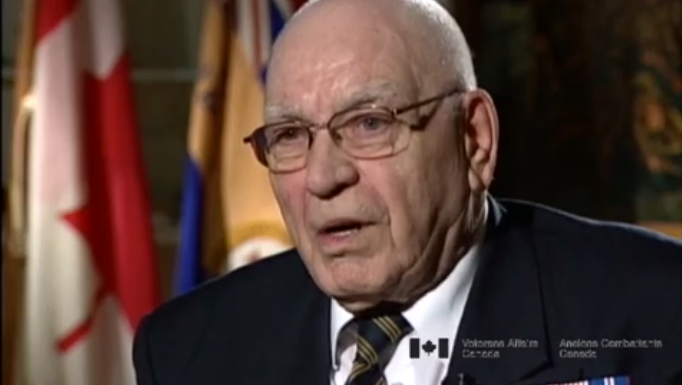
Mr. Castonguay remembers eating again after the Americans dropped food for them. He then describes going on a quest for beer for himself and the other POWs in the camp after the war had ended.
Bernard Castonguay
Bernard Castonguay est né à Montréal, au Québec, le 9 février 1921. Il était le quatrième d'une famille de 11 enfants. Son père était monteur de tuyaux à vapeur pour la Canadian Pacific Railway. M. Castonguay a quitté la maison à l'âge de 16 ans, à la recherche d'aventure. Il a travaillé comme bûcheron et à la construction des chemins de fer.
En 1940, incapable de trouver du travail, M. Castonguay s'est rendu à Québec pour s'enrôler dans le Royal Rifles of Canada. Il fut envoyé à Gander, à Terre-Neuve, où il fut signaleur et sentinelle. On l'envoya ensuite à Saint John, au Nouveau-Brunswick.
À Hong Kong, M. Castonguay fut fait prisonnier par les Japonais et envoyé au camp de prisonniers de guerre (Omeni) de Nagasaki, au Japon, pour travailler dans une mine de charbon.
Après son service, M. Castonguay a travaillé pour l'Institut national canadien pour les aveugles (INCA). Il devint par la suite directeur régional de l'INCA. Il fut également bénévole pour le Conseil canadien des aveugles.
Transcription
And it took some times before we got out of there though. So the planes, American planes came over, dropping food. And we start eating biscuits and jam and chocolate and all kinds of things. Especially chewing gum, the first load was only chewing gum. And the fellas would want to drink you know, want something to drink but we couldn't get anything. So I said I'm going to try and get some beer. I start to collect all the money I could in the camp, I had a big pile of money in. I got the truck driver of our regiment and I said we are going to get a truck. So I walk through Fukuoka and I saw Fukuoka, there was nothing except one building built with brick and cement. The rest was all burnt out, flattened out. And that was a hotel, and inside there was a Red Cross. So I met the Red Cross man and I told him what I wanted to have. I said I want a truck. Well he said, number one, I think, camp, US Army camp was going to leave tomorrow. Going to leave tomorrow and that they have two trucks, you can have one. Alright, good. So I go to the camp, I sleep there and the next morning when they went out, I took the truck with this Sergeant Nicholson, who was my driver. And I explained to him what I wanted and he said, "You'll have to go and see the Gendarmerie". The Japanese they called you know like us it's the Mounted Police, over here it's the Gendarmerie in Japan to have permission to go to the brewery. I said, "Alright." So he told me where it was. I went there. I see the headquarters of the Gendarmerie. I told him what I wanted. He sent a guard with us in the truck and we went to the brewery. And with the money I had, I filled the whole truck with beer. Rice beer, the big bottles you know. So I came back to the camp with that all happy you know and proud to bring good beer. So what happened, a great disappointment. There were seven men layed out who died having drank bad liquor, bad homemade beer of some kind. They died. I arrived too late for them. After the funeral well I could distribute the beer all over. So I think that was welcome.