Attention!
Cette vidéo est disponible en anglais seulement.
Description
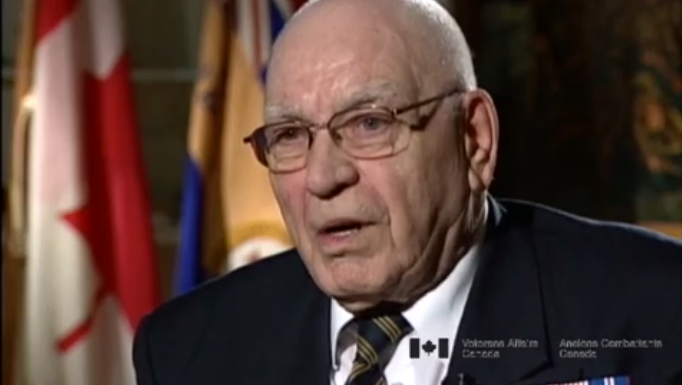
Tom Godden
M. Godden est né à Lynn, au Massachusetts, en mars 1921. Très jeune, il est déménagé à Terre-Neuve. Au moment où la guerre a éclaté, M. Godden travaillait pour le service des postes. Son employeur ayant refusé de le libérer pour qu'il puisse s'enrôler, il a remis sa démission. Il s'est enrôlé à St. John's en 1941 et est devenu membre du 166e Régiment d'artillerie de campagne (Terre-Neuve), un régiment d'artillerie légère. Il a servi comme estafette durant la majeure partie de la guerre, servant en Afrique et en Europe. M. Godden a été témoin du fameux bombardement allié sur Monte Cassino. Après la guerre, M. Godden est revenu à Terre-Neuve et a connu une carrière florissante à la Pan-American World Airways.
Transcription
It was a, I suppose, I don't know what you'd called it a second or third line of communication. Your first lines of communication naturally are your signaller, your wireless and your landline communications from command post to gun position and so on. But you carried dispatches, you carried fire orders and you had to communicate between Headquarters and before, before when you went into a new position, the guns were surveyed in or one thing or another in to the position and the command post officer, I was attached to the command post, I was the command post officer's dispatch rider. And they'd...we wouldn't have any lines of communication made yet to the Headquarters and that, so I'd have to carry dispatches back and forth. Stuff like that you know. Kind of a glorified messenger if you want to, but, you know. They... after a while, after some time, it was a bit rough, and they asked me if I'd like to come off of the bike and go back on the vehicles for awhile, and I said no. I didn't want to, I liked the riding, and I liked to be on my own, sort of thing, which was good. You know, I always enjoyed that. So, I stayed with it until the war ended.