Attention!
Cette vidéo est disponible en anglais seulement.
Description
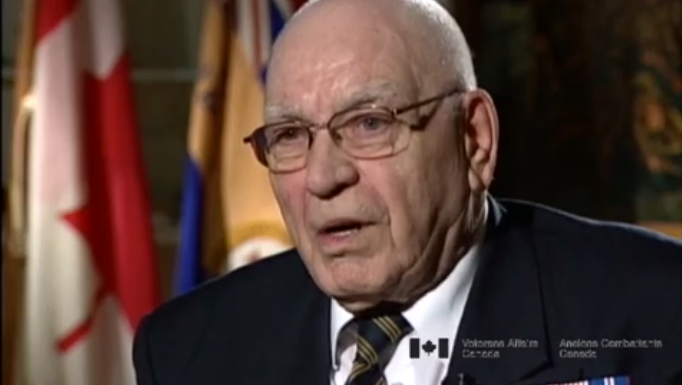
Harry Routhier
Troisième de cinq enfants, Harry Routhier est né le 6 décembre 1899 à Chelsea, Québec. Son père était mécanicien d'appareils à vapeur; son grand-père, qui fut député, est l'auteur de l'O Canada. Il a fréquenté les écoles de Phoenix et de Mission Junction, en Colombie-Britannique, et a travaillé sur une ferme dans les Prairies. Il n'a jamais terminé ses études et a menti au sujet de son âge pour s'enrôler à 16 ans. Après son instruction à Regina, il a joint les rangs du 217e Bataillon, avant d'être transféré au 46e Bataillon. Il a participé activement à la bataille d'Amiens, en France, en août 1918. Après la guerre, il a été bûcheron et a habité par la suite à Langley, en Colombie-Britannique.
Transcription
Interviewer: When the shellfire would come in, on you men, Whizz Bangs, there would be casualties?
Oh yes.
Interviewer: You saw them?
Yup, and if you were in the trench, the platoon ahead of you may be advancing and you'd see them and you had to get them in yourself to the what you call a post.
Interviewer: To an aid post?
Ya.
Interviewer: So you men would go out and bring back wounded?
Oh yes, yes.
Interviewer: You would be under fire yourself then?
Under fire, yes, we would even crawl, but the bullets (inaudible). If the Germans saw you they'd have you as long as they didn't turn the machine gun on you, but at night you'd plow all over No Man's Land and try and catch them in their post. Sneaking, sneaking at night you know, and it was pretty cagey, you know.
Interviewer: Dangerous?
Very dangerous, very dangerous, you never knew.
Interviewer: Did you go on many of those night raids?
Oh yes, quite a few.
Interviewer: Did you ever capture German prisoners?
No, no.
Interviewer: Were you involved in fire fights during those raids?
In what?
Interviewer: Were you involved in ambushes or?
Oh yes, oh yes we were.
Interview: You would come into contact with the enemy?
Yes, oh yes.