Attention!
Cette vidéo est disponible en anglais seulement.
Description
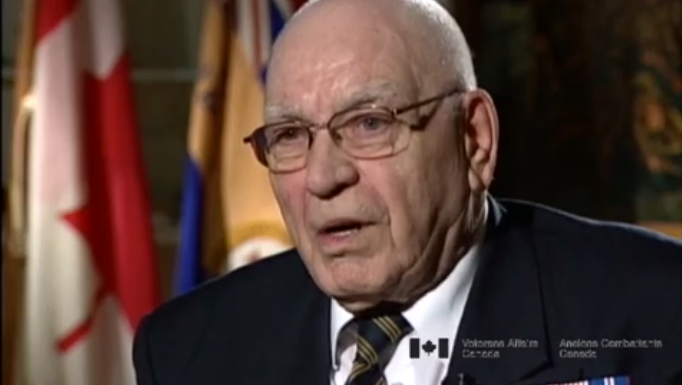
Harry Routhier
Troisième de cinq enfants, Harry Routhier est né le 6 décembre 1899 à Chelsea, Québec. Son père était mécanicien d'appareils à vapeur; son grand-père, qui fut député, est l'auteur de l'O Canada. Il a fréquenté les écoles de Phoenix et de Mission Junction, en Colombie-Britannique, et a travaillé sur une ferme dans les Prairies. Il n'a jamais terminé ses études et a menti au sujet de son âge pour s'enrôler à 16 ans. Après son instruction à Regina, il a joint les rangs du 217e Bataillon, avant d'être transféré au 46e Bataillon. Il a participé activement à la bataille d'Amiens, en France, en août 1918. Après la guerre, il a été bûcheron et a habité par la suite à Langley, en Colombie-Britannique.
Transcription
No I didn't, no I didn't, I was surprised, I was surprised. But I think there were so many in my, there were slight wounds. I called it slight, you know, just grazed the bone, that was about it. But the places were all full, so they said get him over the Blighty.
Interviewer: So when you got back to England, and you were convalescing, they awarded you a wound stripe, did they not?
That's right, ya. I often wonder why they don't have them today on your, just one, two, three on your sleeve.
Interviewer: What was the significance of that wound stripe on your sleeve while you were in England?
Oh well, the girls all looked for that stripe, you were a hero.