Attention!
Cette vidéo est disponible en anglais seulement.
Description
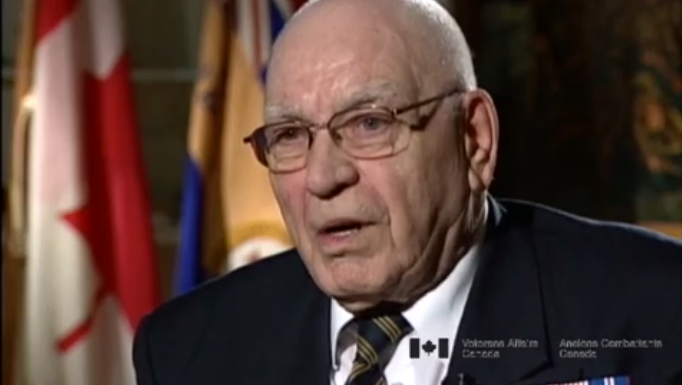
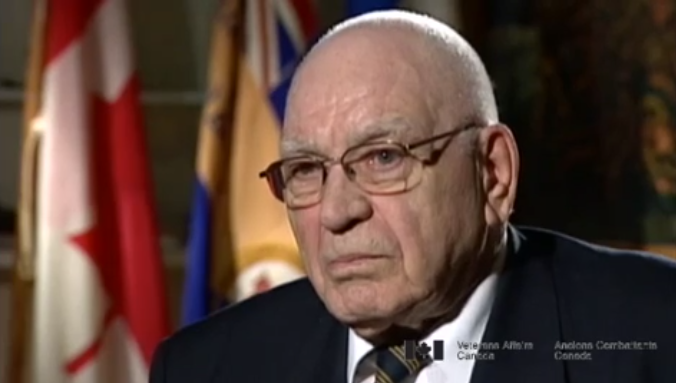
Harry Routhier
Troisième de cinq enfants, Harry Routhier est né le 6 décembre 1899 à Chelsea, Québec. Son père était mécanicien d'appareils à vapeur; son grand-père, qui fut député, est l'auteur de l'O Canada. Il a fréquenté les écoles de Phoenix et de Mission Junction, en Colombie-Britannique, et a travaillé sur une ferme dans les Prairies. Il n'a jamais terminé ses études et a menti au sujet de son âge pour s'enrôler à 16 ans. Après son instruction à Regina, il a joint les rangs du 217e Bataillon, avant d'être transféré au 46e Bataillon. Il a participé activement à la bataille d'Amiens, en France, en août 1918. Après la guerre, il a été bûcheron et a habité par la suite à Langley, en Colombie-Britannique.
Transcription
Well I remember we were ready to go over the top and this gas, that was the first attack of gas and they told us to wet our handkerchiefs and hold it over our mouths. We didn't have no masks or anything then see, so that's what we did and that's what saved some of us, and a lot of them died through it.
Interviewer: So during that gas attack, there were men that died from the effect of the gas?
Yes after, shortly after, short of breath, there was no cure that they had, you know.
Interviewer: You were gassed as well.
Yes, I had a touch of gas, a touch of gas, but you had to get your handkerchief, the word went through to wet your handkerchief, you understand what I mean? And hold it over your mouth and nose.
Interviewer: Was the handkerchief, did you make it wet with urine?
Yes.
Interviewer: And the idea was that it would go over your mouth and that would neutralized the chlorine in the gas?
Yes
Interviewer: What affect did that gas attack have on you in later life?
Well I never got rid of it, I never got rid of it. Many died over it you know, and somehow or another I was too tough, too tough to die, you know.
Interviewer: But this is the reason why you went into the woods?
Drove me into the woods; I had more relief in the woods than any other job; railroad and steamboat, and anything.
Interviewer: Eighty years have passed since the war ended, Mr. Routhier. Are you still affected by the gas that you took that day?
Yes, I take treatments.
Interviewer: And your wound that you took in your shoulder, did that affect you in later life as well? No, I wouldn't say, I wouldn't say that.