Description
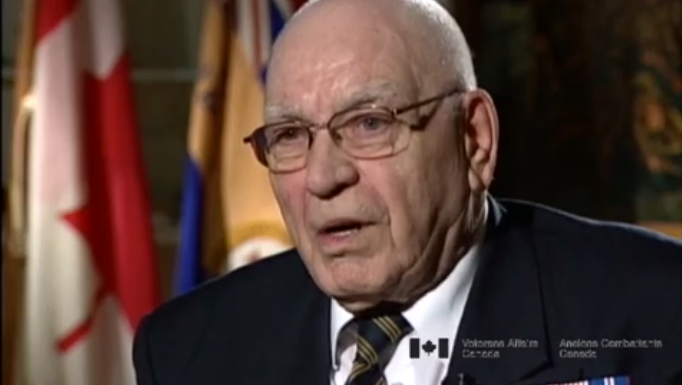
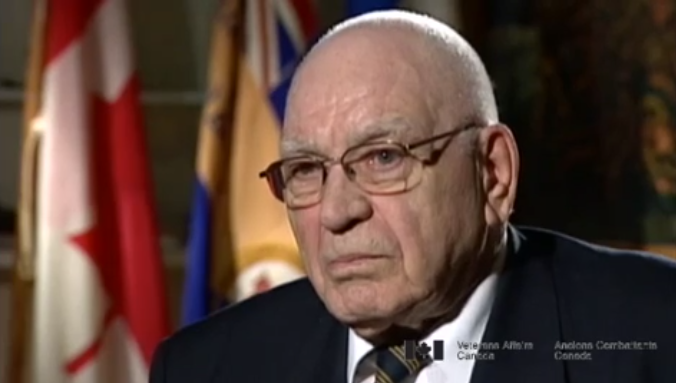
Mr. Danson describes his participation in forming an honour-guard for the visit of the King and Queen of England in 1939.
Barnet J (Barney) Danson
M. Danson est né en Ontario, en 1921. Avant la guerre, il travaillait pour Columbia Pictures. En tant que Juif, M. Danson était bien conscient du climat politique en Europe. Quelque chose lui disait que la guerre était imminente, et l'envie d'aller se battre l'a pris. Il s'est donc enrôlé, en temps de paix, dans l'espoir de suivre un entraînement et d'être fin prêt advenant le déclenchement de la guerre. M. Danson était officier d'infanterie dans le Queen's Own Rifles of Canada. À l'automne 1944, il fut blessé et dut mettre fin à sa participation à la guerre. Il devint par la suite un homme d'affaires prospère. Plus tard, il fit son entrée sur la scène politique et servit à titre de ministre de la Défense au sein du gouvernement Trudeau.
Transcription
One of the interesting things at that time however was, the King and Queen came in June of ‘39, I guess it was. And the Queens Own were to mount a guard of honour for the King and Queen, and we had full-dress uniforms that had been put away in storage, they hadn't been used since 1911 I think it was, when Sir Henry Pellet took the regiment over at his own expense to England for some jubilee. So we thought we'd put the full dress uniforms on and look pretty smart. And we got them out of the storage and they had turned from a rifle green, which is darker than a hunter's green, to something bluey grey, almost like the German uniforms, and full of moth holes, just terrible. But we had an officer, Roger Clarkson in the regiment whose family owned Parkers Dye Works, and they went to work on it, and they sewed up the holes, and they re-died the uniforms and then, they went around to try and find soldiers who would fit the uniforms and I fitted one of them. So I became a member of the guard. And it was rather interesting, we were down at the Union Station in Toronto when they arrived, and smartly came to attention, presented arms, and did all the things that good soldiers did. We thought we were very, very good, but the King and Queen didn't say anything. They had probably seen better in their day. And as soon as they moved off, I think they were going to the racetrack for the Queen's Plate, they rushed us back to the Union Station, put us into our khaki uniforms, where we had putties, it was just the old fashioned uniforms. And whipped us up to University Avenue, and when the King and Queen drove by we presented Arms again. They didn't know that it was the same troops that had just presented arms. And they went to, I think they were going to give each one of the Scottish, the Queen was, their honours at the back campus at the University. And then they were going into the legislature at Queen's Park. So they moved us over to the legislature, and we were all spic and span, ready for them to come in. And the Governor General's Horse Guards and the Royal Canadian goons came on their horses, and stood in front of us. So that not only could we not be seen, but the horses did some awful naughty stuff on us, and the mares made it particularly uncomfortable. Nevertheless, when the King and Queen came we presented arms once again, and, I guess they moved us back down University Avenue and they drove by, and we presented arms again. Then they moved us on to St. Catherines and we presented arms a few times there. And I remember Niagra Falls, I remember, I think it was St. George's Church, it was a Sunday and they went to church and we presented arms inside and outside and again on the bridge, I guess it was a rainbow bridge. The royal train had to cross into the States, they were going to Washington, and we presented arms there for the last time. I've always felt that the King was so impressed with this huge army he had in Canada, that he declared war 3 months later. So that was one of our first experiences.