Description
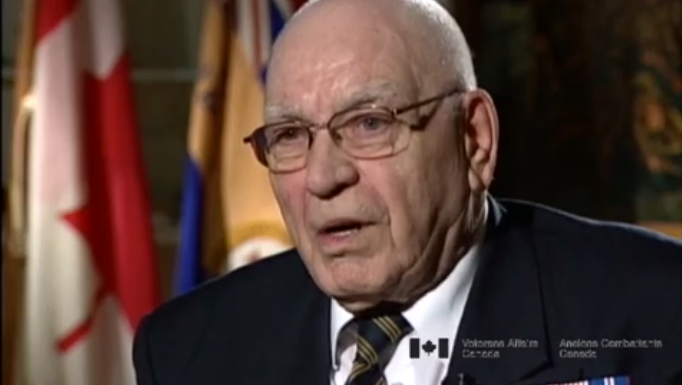
As a Prisoner of War in the Rouen hospital, Mr. Gorman continues the story of his treatment there and his subsequent move to a POW camp located in Eastern Germany.
Donald Gorman
M. Gorman est né le 23 juin 1921. Son père était mécanicien de machines fixes dans une école secondaire de Windsor et était un ancien combattant de la guerre des Boers et de la Première Guerre mondiale. M. Gorman a quitté l'école après avoir obtenu son immatriculation junior et a travaillé dans une boulangerie, une poissonnerie et comme apprenti mécanicien à l'usine de machines à écrire Remington-Rand, à Windsor. Après s'être enrôlé le 16 septembre 1939, il a reçu son instruction élémentaire à Windsor, avant d'être envoyé en juin 1940 à Borden afin de recevoir son instruction avancée. M. Gorman s'est rendu outre-mer avec le Royal Hamilton Light Infantry Regiment et a participé au raid sur Dieppe.
Transcription
We were there for about a good week, close to a week and Ted was helping as much as he could and whatnot. And then one day they came in and they wanted all the officers and I’m pretty, about 100% sure of this, but anyway there was this man across from me and he went and he got his tunic out, it was underneath his pillow and he put it on, and he was a colonel and it was Merritt. Cec Merritt and he had been helping guys with bed pans and everything else in there and what not, but anyway, he, off he went. They got all the officers and they took them off to an Offlag, what they called an Offlag and then they started looking for those that weren’t wounded and my friend Ted got scooped up. In the mean time, all the rest of the men, that were taken prisoner, they were just outside of Dieppe and anyway they, I don’t know what they were, if they were in a barn or what, but anyway, they had them all together and Ted went with them, he ended up back there with them, and he went off into Eastern Germany. On the train trip through, this is what my friends told me anyway, they mentioned to Broadbent that he smelled a bit and finally he got a bit feverish and whatnot, and he had been wounded in the shoulder and he never said anything to anybody. And of course the thing was festering and he ended up in a hospital in Eastern Germany in what they call Stalag 8B Lamsdorf it was known then. Then in the mean time they come along and they loaded us all on the hospital train and it was a great propaganda move. They had chalked on the side, Dieppe POW’s and we went, it took three days to get into Germany anyway. We ended up at a surgical hospital at a place called (inaudible) and it was in the, out in the country and anyway, it was manned by all British medical staff, who had been taken prisoner in 1940 at Dunkirk.