Attention!
Cette vidéo est disponible en anglais seulement.
Description
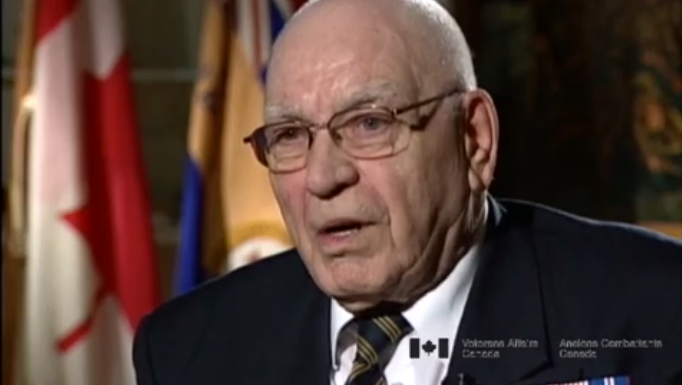
Mr. Stanger talks about the advantages of a corvette, the disadvantages of sleeping in berths, the components of a “happy ship”, and shipping routes in the North Atlantic.
Transcription
Difficult to say. The, the corvette was an extremely good sea boat. She was designed partly after northern island trawlers, therefore she could handle very bad weather. You had a sense of security even though they were very small. I think we only carried something like ninety people, ninety men. Life was a bit tough, but we used to look forward to the kai (sp) on the bridge at night, that’s the chocolate, hot chocolate. Food was hard to, to manage because you were never sitting still, even though you know you’re chair was chained to the deck and the fiddlies (sp) were on the table so your plate wouldn’t land in your lap. The plate and the table landed in my lap once on the deck, whole thing went over. But there, I mean, that was the way you lived. You’re wet half the time.
We were in berths and the officers were in berths. I sometimes think it would have been much better to be in a hammock. Trying to wedge your knees against one side of your berth and your back and your elbows against the other to stay in there, wasn’t easy.
Right down through, I think, I think it’s the captain, and what he imparts, the first lieutenant and, and so on down through and how the guys all get together. If they, if they’re happy with the captain, you get a happy ship, basically.
First of all it was Western Local, what was known as Western Local, that was St. John’s, Halifax, New York.
Interview: So the triangle run, was that it?
Yeah the triangle run. And then North Atlantic, or Deep Sea, you went St. John’s, Londonderry. So, I didn’t get into that til I joined the Magog. Well actually, didn’t get on with Magog either because we got torpedoed before we took a convoy.
We were in berths and the officers were in berths. I sometimes think it would have been much better to be in a hammock. Trying to wedge your knees against one side of your berth and your back and your elbows against the other to stay in there, wasn’t easy.
Right down through, I think, I think it’s the captain, and what he imparts, the first lieutenant and, and so on down through and how the guys all get together. If they, if they’re happy with the captain, you get a happy ship, basically.
First of all it was Western Local, what was known as Western Local, that was St. John’s, Halifax, New York.
Interview: So the triangle run, was that it?
Yeah the triangle run. And then North Atlantic, or Deep Sea, you went St. John’s, Londonderry. So, I didn’t get into that til I joined the Magog. Well actually, didn’t get on with Magog either because we got torpedoed before we took a convoy.
Catégories
What Makes a ‘Happy Ship’
Médium
Video
Propriétaire
Veterans Affairs Canada
Guerre ou mission
Seconde Guerre mondiale
Emplacement géographique
Océan Atlantique Nord
Personne interviewée
Edgar Thorne (Peter) Stanger
Branche
Marine
Occupation
Officier marinier
Durée
02:08