Description
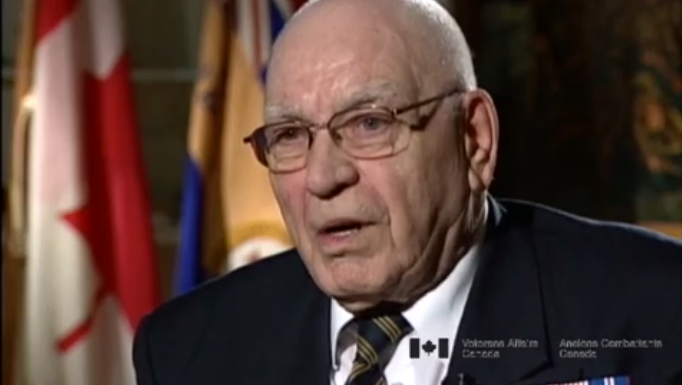
Many merchandise exchanges took place between allied soldiers and members of the surrendered German army. Mr. Grand describes how he was interested in taking home one of the excellent German cameras and how he arranged a deal.
John Grand
M. Grand est né en 1909, comme il le décrit, dans « un petit village perdu dans la nature du Sud du Manitoba ». Son père a exploité une terre au Manitoba, puis en Saskatchewan. John Grand a décrit sa jeunesse pendant la grande dépression comme étant pauvre et dure.
<br><br>
À l’adolescence, M. Grand était très intéressé par l’électronique et il possédait un certificat de radioamateur. Il a essayé de s’enrôler dans le Signal Corps dans les années 1930, mais il a été rejeté parce qu’il n’était pas assez musclé. Il se souvient d’avoir été si pauvre qu’il a souvent pris la file pour obtenir de la nourriture à une soupe populaire. Son premier emploi consistait à travailler dans une chaîne de montage chez Canadian Marconi au salaire de 11 cents de l’heure.
<br><br>
Il s’est enrôlé dans le Corps royal canadien des transmissions quand la guerre a été déclarée en 1939. On lui a d’abord attribué la fonction d’opérateur de radio, mais lorsque ses superviseurs se sont rendu compte de ses compétences mécaniques, il a rapidement été fait radiotechnicien. Son service outre-mer comprend le débarquement à Dieppe, la participation à la campagne de Normandie et la libération de la Hollande.
Transcription
I knew that they had some pretty good cameras, Leica cameras, and they’re the very best. So I says to them, I don’t want to go home without having a Leica camera. And of course I didn’t smoke but I had about four five thousand cigarettes in the kitbags and I didn’t want to take them back to Canada. So I went back to the camp, and, with a jeep, and I asked a guy “Anybody sprechen Franco? ” And so on about French, and no, nobody could speak French. But then they said they knew a guy that could speak English. So I says “Ok.” Alright he came down, so I said “I’m looking for a camera and I don’t want to steal it,” I says, “I want to make a deal with one of your officers for this camera. But I don’t want to steal it,” I says “I just want to buy it.” “Oh,” he says, “Ok here’s a guy I know that has a camera and he’s got it hidden in a hill down there and you wouldn’t find it anyway even if you wanted to.” I says “I’m not trying to.” So that’s it. So he brought, brought me this guy and so the guy says “You got cigarettes? ” “Yes.” I says “I got cigarettes, five thousand cigarettes.” So they opened up the bags and made sure that it was not full of straw or hay or something...no. They counted the bags, they counted the boxes and everything was there. Five thousand. I says “Ok” “Yes,” he says, “He’s willing to trade Leica camera.” I says “It’s in good shape? ” “Oh yes,” he says “In very good shape.” He says “I got it in a plastic bag and, but it’s buried in the ground and you wouldn’t find it.” I says “Ok, so how do we get it? ” “Well,” he says “I’ll go around the hill” he says “On this side, and you go around on the other side. I don’t want to walk with you because that would stir up some trouble.” So he says “Let’s go separate. You go one side and I’ll go the other side.” So went behind the hill and he kicked around in the dirt and he pulled out this bag, plastic bag and that was a cigarette....uh - my Leica. I looked at the lens, made sure there was no scratches on it. Oh yes in very good shape, it looked good. So I put out my hand, he put out his, we had a handshake. He went his way, I went my way. I had the camera, he had the cigarettes. And that’s the way it went. Now there was a lot of bargains that were made like that.