Description
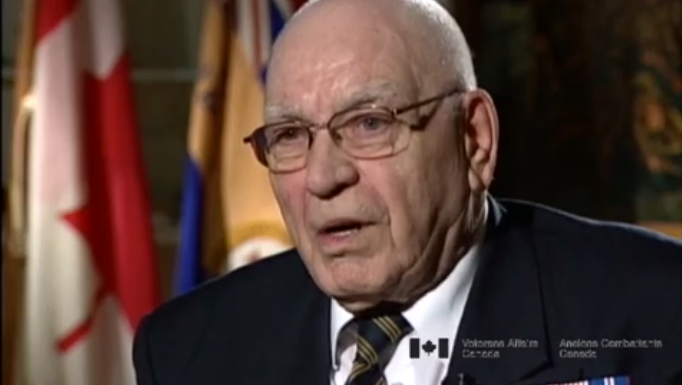
Mr. Yarnell describes some characteristics of the Spitfire. He explains how to bail out and how to do a ‘belly’ land in case of trouble.
Cyrill St. Clair (Cy) Yarnell
M. Yarnell est né le 9 août 1920 à Carlow, en Irlande. Il a déménagé au Canada à l'âge de 8 ans. Il s'est enrôlé dans l'Aviation royale du Canada (ARC) en 1940 à l'âge de 20 ans. Il a suivi la formation initiale de pilote à Victoriaville (Québec), où il a appris à piloter le Fleet Finch pour enfin maîtriser le Harvard. Il a suivi la formation d'instructeur de vol à Trenton et formé des pilotes d'un grand nombre de pays. Après avoir été instructeur pendant un an, M. Yarnell a été envoyé outre-mer. Il a effectué des missions aériennes au-dessus de l'Afrique du Nord, de l'Italie et de l'Allemagne et participé aux batailles de la vallée du Liri et de Monte Cassino. Après la guerre, il est demeuré dans l'Aviation royale du Canada (ARC). Lorsqu'il a pris sa retraite de l'ARC en 1975, M. Yarnell avait le grade de colonel. Il est membre de l'Association des Forces aériennes du Canada et participe activement aux activités du musée de l'Aviation de Trenton. M. Yarnell et son épouse, Phyllis, ont trois enfants, sept petits-enfants et un arrière-petit-enfant.
Transcription
The peculiar thing about our aircraft was that you sat in a bucket seat, you sat on your parachute, it was under your bum, and strapped in. But, and if you had to bail out, we did not have ejection seats like the lads have today which are marvellous. We would have to wheel back the canopy, drop the Spitfire door, which you could drop down, stand up, turn around and put your right leg on the wing and then jump. And that was not a particularly enticing thought, so I decided if I'd had had a problem I'd have probably tried to ride it down and belly land it somewhere. But that's the only instruction we had.If the ground was level and you left the under cart up and you just flew it and actually held it at about two or three feet above the ground, four feet, until it literally stalled, it could in fact mush in. I can't comment more than that cause I've never did it but I've seen lots of indications where guys have done that and walked away from the bird without the slightest problem. On one occasion, landing in Italy, I used to prefer to fly my aircraft onto the ground. As you know the Spit was a very long snout with a tail wheel so when you landed and pulled that snout up so that you would land on the under cart and the tail wheel, your view would be obliterated so I used to bring it in and actually try to fly it onto the ground and once I was on the ground then gently drop the tail. On one occasion I did this and I noticed the engine was very, very rough, very rough and when I parked the aircraft I saw that when landing like that I had the tail too high and I had taken about four inches off each one of the propeller blades. Oh, yeah, and that's a four bladed prop. Yeah.